
Chef Juliette
Various Almond Preparations
Five almond preparations, one discipline: remove the skins cleanly, dry every kernel through, then cut, toast, or cloak it in pale caramel without letting its fragrant oils escape.
A cooking platform built around craft, culture, and the stories behind what we eat.
Created by Chef Juliette
Based on No. 2572, Orange or Tangerine Soufflé Righi, from Le Guide Culinaire (1907) by Auguste Escoffier
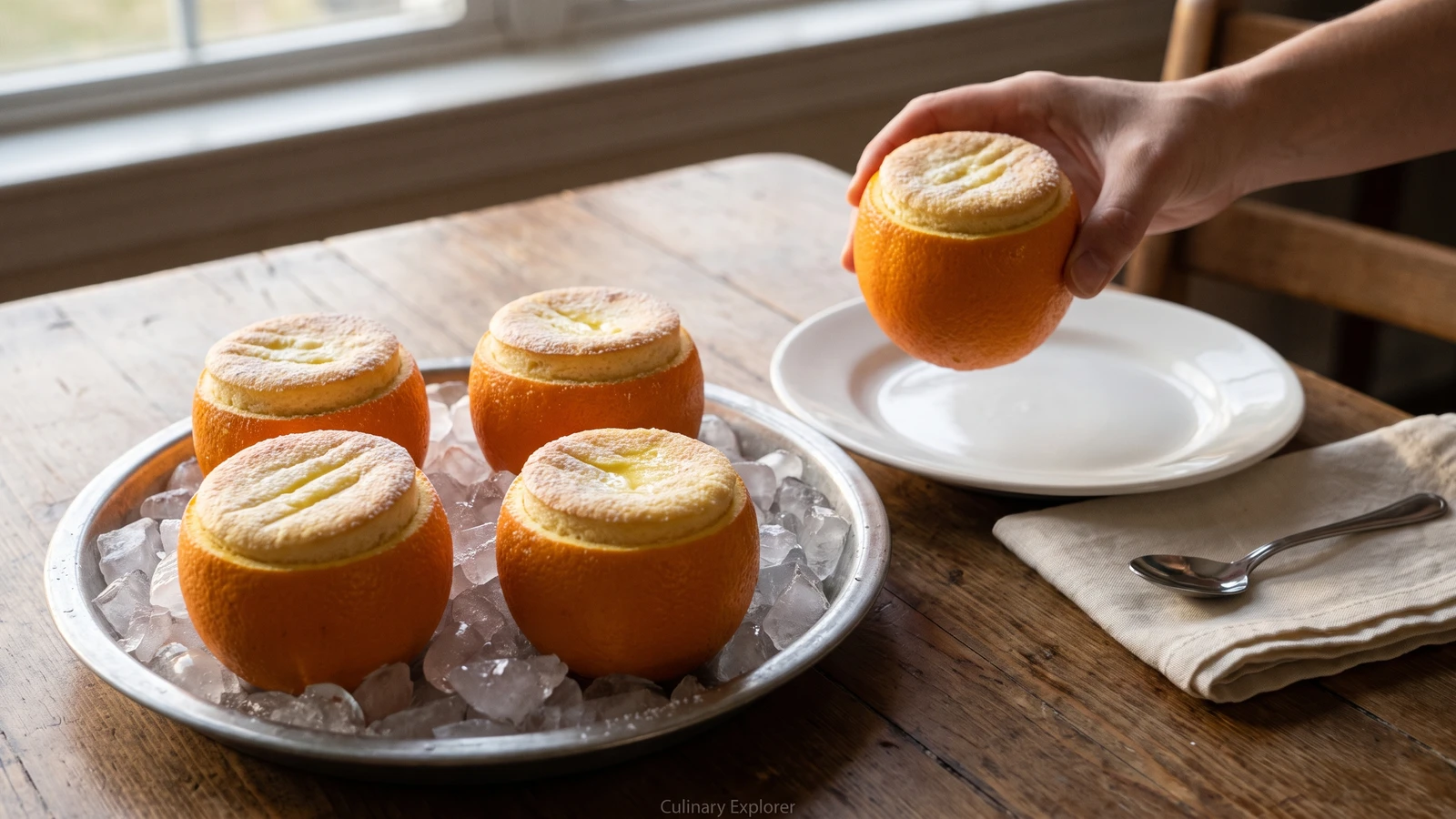
Frozen citrus below, feather-light soufflé above: Soufflé Righi turns one intact peel into a small feat of timing, baked on crushed ice for two minutes or four.
Soufflé Righi à l’orange ou à la mandarine (orange or tangerine soufflé baked over matching citrus ice) teaches control of opposing temperatures. The one true thing to know is this: the lower half must remain frozen while the cap rises and sets, so speed is not a flourish. Speed is the dish.
The original recipe assumed a pâtisserie brigade with fruit ices ready, several hands to hollow the peels, and a fierce oven waiting for service. At home, good matching sorbet replaces the brigade’s separate ice production, and a fully heated broiler provides the swift top heat. That production schedule was scaffolding and can go. The unbroken peel, the half-filling of ice, the fresh appareil à soufflé (soufflé mixture), the bed of broken ice, and the exact cooking times must stay. One cook, one stove, one evening.
The finished Righi arrives with a pale-gold crown above a shell still cold enough to bead with condensation. Set the whole operation before whipping the whites: frozen shells, crushed ice, serving plates, and fierce heat ready and waiting. Once the appareil is folded, the clock owns the dessert.
Soufflé Righi belongs to the cosmopolitan Parisian grand-hotel repertory of French classical pastry, not to a single regional household larder. Righi is a French menu spelling used for Switzerland’s Mount Rigi, and the snowy name suits a dessert that places a warm, cloudlike crown over fruit ice. Its practical marvel is the intact citrus peel and broken-ice bed, which allow two temperatures to reach the table in one vessel.
Quantity
4 oranges (about 1.2 kg total), or 8 tangerines (about 1 kg total)
scrubbed and dried
Quantity
2 cups (475 ml / about 400 g)
softened just until spoonable
Quantity
1/2 cup (120 ml / 125 g)
reserved from the hollowed fruit
Quantity
6 tablespoons (90 ml / 75 g), divided
Quantity
1 tablespoon (15 ml / 8 g)
Quantity
2 (about 36 g)
Quantity
1 tablespoon (15 ml / 14 g)
Quantity
3 (about 90 g)
at room temperature
Quantity
1/2 teaspoon (2.5 ml / 2.5 g)
Quantity
1/8 teaspoon (0.6 ml / 0.8 g)
Quantity
6 cups (1.4 liters / about 900 g), divided
| Ingredient | Quantity |
|---|---|
| thick-skinned navel oranges or large tangerinesscrubbed and dried | 4 oranges (about 1.2 kg total), or 8 tangerines (about 1 kg total) |
| orange or tangerine sorbet matching the chosen fruitsoftened just until spoonable | 2 cups (475 ml / about 400 g) |
| strained orange or tangerine juicereserved from the hollowed fruit | 1/2 cup (120 ml / 125 g) |
| caster or superfine sugar | 6 tablespoons (90 ml / 75 g), divided |
| cornstarch | 1 tablespoon (15 ml / 8 g) |
| large egg yolks | 2 (about 36 g) |
| unsalted butter | 1 tablespoon (15 ml / 14 g) |
| large egg whitesat room temperature | 3 (about 90 g) |
| fresh lemon juice | 1/2 teaspoon (2.5 ml / 2.5 g) |
| fine sea salt | 1/8 teaspoon (0.6 ml / 0.8 g) |
| crushed ice | 6 cups (1.4 liters / about 900 g), divided |
Cut a neat circular opening around the stem of each fruit, about 1 1/4 inches (3 cm) wide for oranges or 3/4 inch (2 cm) for tangerines. Angle the knife toward the center and lift out a conical plug rather than slicing the fruit across. Working over a bowl, loosen and remove the flesh through that opening with a grapefruit spoon, keeping every peel whole. Press the extracted flesh and strain the juice. If you make a pinhole in a peel, keep it and mark the damaged side so it can be buried deeply in the ice; a long tear requires another fruit because the shell must support the frozen filling.
Spoon the matching citrus sorbet into each shell until the cavity is exactly half full, pressing it against the sides so no air pockets remain. Keep the upper half empty for the appareil. Stand the shells upright in a small tray and freeze for at least 1 1/2 hours, until the sorbet and peels are thoroughly firm. The half-fill is part of the structure, not decoration: too much sorbet leaves no room for the crown, while too little loses the hot-cold balance.
Reserve 1 tablespoon of the citrus juice. Simmer the remaining juice in a small saucepan until reduced to about 5 tablespoons (75 ml), concentrating the fruit without adding another flavor. Whisk 3 tablespoons of the sugar with the cornstarch and yolks until smooth, then temper with the hot reduction. Return everything to the saucepan and whisk over medium-low heat until the base thickens and gives two or three slow bubbles. Cook for 30 seconds more, remove from the heat, and whisk in the butter. If it catches into small lumps, immediately whisk in the reserved cold juice and pass it through a fine sieve. Ça se rattrape. Cover the surface directly and chill until cold but still pliable.
Set an oven rack about 4 inches (10 cm) below the upper element. Heat the oven to its maximum setting, ideally 500°F (260°C), for 30 minutes, then turn the broiler to high for another 5 minutes. Spread 4 cups of the crushed ice in a cold rimmed metal baking sheet, making a bed deep enough to hold the shells upright. Keep the remaining ice frozen for serving. The heat must be fully ready before the whites are whipped; a slow oven melts the ice before the appareil can rise.
Beat the egg whites with the lemon juice and salt until foamy. Add the remaining 3 tablespoons of sugar gradually, beating until the whites are glossy and hold medium-firm peaks whose tips bend slightly. Stir one-third of the whites into the cold citrus base to loosen it, then fold in the rest in two additions with broad strokes. Stop as soon as no white streaks remain. If the chilled base has become rigid, soften it with a spatula before adding any whites; forcing delicate whites through a solid base knocks out the air the Righi needs.
Move the frozen shells directly from the freezer to the crushed-ice tray, burying their lower halves so they stand perfectly upright. Spoon the appareil over the frozen sorbet, filling each opening and building a rounded crown about 1 inch (2.5 cm) above the peel. Smooth the surface upward with the back of the spoon. Work briskly and load the oven within 90 seconds of folding.
Slide the tray beneath the fully heated broiler and close the door. Bake tangerines for exactly 2 minutes and oranges for exactly 4 minutes. Do not open the door, rotate the tray, or wait for a darker crust. The crowns should rise, set around the surface, and color pale gold at their highest ridges, while the lower peels remain cold. Pale is correct. Another minute trades the frozen heart for unnecessary browning.
Divide the reserved crushed ice among chilled shallow dessert plates. Lift each Righi from the hot tray with a small spatula, settle it upright in the fresh ice, and carry it straight to the table. The spoon should pass through the tender soufflé crown into firm citrus ice beneath. There is no holding time and no second reheating. À table!
1 serving (about 180g)
Culinary guides, cultural storytelling, and the editorial depth that makes cooking meaningful.
Discover Culinary ExplorerChef Juliette
Five almond preparations, one discipline: remove the skins cleanly, dry every kernel through, then cut, toast, or cloak it in pale caramel without letting its fragrant oils escape.

Chef Juliette
A pastry pantry lesson in one tray: filberts warmed only until their red skins release, rubbed clean, cooled, and chopped into a fragrant mise-en-place for cakes, creams, pralines, and petits fours.

Chef Juliette
The smallest pâtisserie discipline decides whether a cake leaves its mould intact: clarified butter in every corner, followed by the lightest veil of dry flour or fécule.

Chef Juliette
Four whites, one spotless bowl, and a patient change of speed: whisk gently until loosened, then briskly to glossy stiffness, with powdered sugar waiting if the foam begins to granulate.