
Chef Juliette
Various Almond Preparations
Five almond preparations, one discipline: remove the skins cleanly, dry every kernel through, then cut, toast, or cloak it in pale caramel without letting its fragrant oils escape.
A cooking platform built around craft, culture, and the stories behind what we eat.
Created by Chef Juliette
Based on No. 2563, Bananas Meringuées, from Le Guide Culinaire (1907) by Auguste Escoffier
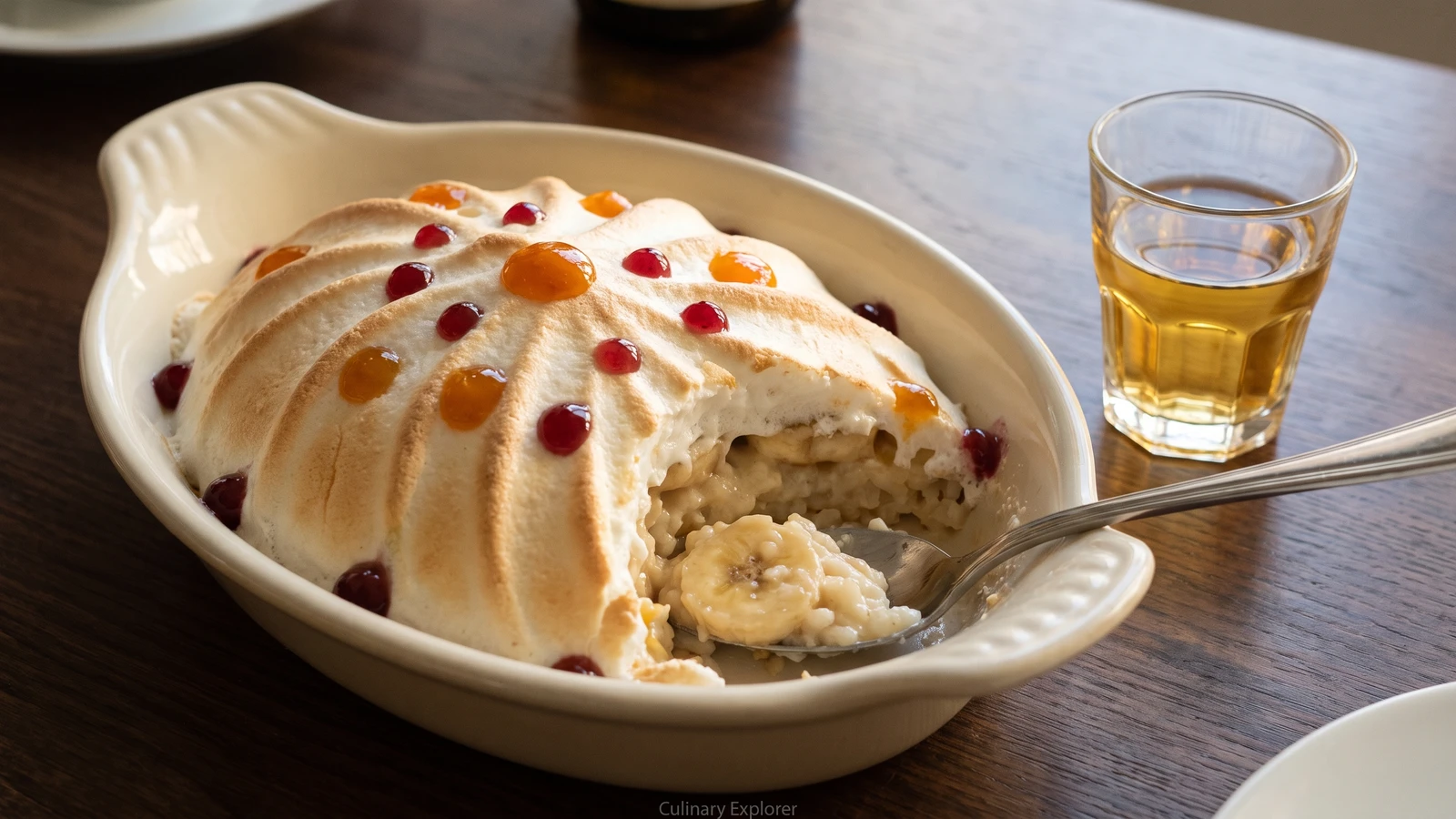
Whole-poached bananas, cut only once tender, rest on creamy vanilla rice beneath a domed meringue, lightly baked and jeweled with apricot and red-currant jam: an old entremets made for tonight's table.
Bananes meringuées (vanilla-poached bananas beneath meringue) teach the difference between tenderness and collapse. Poach the bananas whole, always. A raw roundel has exposed flesh on every side and will loosen into rags in the syrup; once the whole fruit is tender and cool enough to handle, it cuts cleanly and keeps its place above the vanilla rice.
The professional pastry kitchen assumed vanilla syrup, sweet rice, and ordinary meringue waiting at separate stations, plus a practiced hand to pipe a grand dome. Here, one saucepan, one mixer, and a 1½-quart gratin dish make four generous servings. Abricots Meringués (No. 2555) supplies the direct sweet-rice assembly, while Abricots Meringués (another method) (No. 2556) supplies the smoothed and piped finish. The flawn crust from the alternate method stays an alternative, because this treatment is the source's direct dish of fruit over sweet rice. Elaborate piping is brigade scaffolding. The whole poach, vanilla rice, meringue cover, light bake, and alternating jams are the dish.
A moderate home oven sets the meringue gently; it needs a pale biscuit tint, not a scorched broiler crust. One cook, one stove, one evening. The step that matters most comes first: don't put a knife through the bananas until they have left the syrup.
Bananes meringuées belong to the metropolitan French repertoire of entremets, particularly the Parisian dining room and grand-hotel pastry kitchen, rather than to a banana-growing region of France. Classical cooks absorbed the imported fruit into the grammar already used for apricots: vanilla poaching, sweet rice or a flawn crust, ordinary meringue, and bright jam decoration. The dish is French through its treatment rather than its geography, and its close kinship with the apricot formulas shows how readily the canon made room for a different fruit.
Quantity
4 medium (about 480 g peeled)
peeled and kept whole for poaching
Quantity
2 cups (480 ml / 480 g)
Quantity
¾ cup (180 ml / 150 g)
Quantity
1
split lengthwise and scraped, seeds and pod reserved separately
Quantity
2¼ cups (540 ml / 555 g)
divided
Quantity
½ cup (120 ml / 100 g)
Quantity
¼ cup (60 ml / 50 g)
Quantity
1½ tablespoons (22 ml / 21 g)
divided
Quantity
⅛ teaspoon (0.6 ml / 0.75 g)
Quantity
3 (about 90 g)
at room temperature
Quantity
¾ cup plus 2 tablespoons (210 ml / 180 g)
Quantity
1 tablespoon (15 ml / 8 g)
Quantity
2 tablespoons (30 ml / 40 g)
Quantity
2 tablespoons (30 ml / 40 g)
Quantity
1 cited preparation, Abricots Meringués (No. 2555)
used for the sweet-rice assembly
Quantity
1 cited preparation, Abricots Meringués (another method) (No. 2556)
used for the smoothed and piped finish
| Ingredient | Quantity |
|---|---|
| firm-ripe bananaspeeled and kept whole for poaching | 4 medium (about 480 g peeled) |
| water | 2 cups (480 ml / 480 g) |
| granulated sugar for the vanilla syrup | ¾ cup (180 ml / 150 g) |
| vanilla beansplit lengthwise and scraped, seeds and pod reserved separately | 1 |
| whole milkdivided | 2¼ cups (540 ml / 555 g) |
| short-grain white rice | ½ cup (120 ml / 100 g) |
| granulated sugar for the sweet rice | ¼ cup (60 ml / 50 g) |
| unsalted butterdivided | 1½ tablespoons (22 ml / 21 g) |
| fine sea salt | ⅛ teaspoon (0.6 ml / 0.75 g) |
| large egg whitesat room temperature | 3 (about 90 g) |
| superfine sugar | ¾ cup plus 2 tablespoons (210 ml / 180 g) |
| icing sugar | 1 tablespoon (15 ml / 8 g) |
| smooth apricot jam | 2 tablespoons (30 ml / 40 g) |
| smooth red-currant jam | 2 tablespoons (30 ml / 40 g) |
| direct source preparationused for the sweet-rice assembly | 1 cited preparation, Abricots Meringués (No. 2555) |
| alternate source preparationused for the smoothed and piped finish | 1 cited preparation, Abricots Meringués (another method) (No. 2556) |
Combine the water, ¾ cup granulated sugar, and scraped vanilla pod in a wide saucepan. Boil for 2 minutes, just until the syrup is clear and fragrant, then lower the heat until its surface barely trembles. Peel the bananas and slide them into the syrup whole. Poach for 5 to 7 minutes, turning once with two spoons, until they bend slightly but remain intact. Never cut them before poaching: raw roundels break apart in syrup. Lift the bananas onto a flat plate with a slotted spoon and cool for 10 minutes. If one splits, don't discard it. Lay the pieces together, cool them without handling, and place the fracture downward beneath the meringue. Ça se rattrape.
Reserve ¼ cup of the milk, then combine the remaining milk with the rice, ¼ cup granulated sugar, vanilla seeds, and salt in a heavy saucepan. Bring it slowly to a bare simmer and cook for 25 to 30 minutes, stirring often at first and almost constantly near the end, until the grains are completely tender and suspended in a thick ivory cream. Stir in 1 tablespoon of the butter. If the rice tightens before the grains are tender, add the reserved milk a spoonful at a time; if it remains loose, simmer it for another minute or two. It should fall reluctantly from the spoon, since it firms as it rests.
Heat the oven to 325°F (160°C). Butter a shallow 1½-quart (1.4 L) gratin dish with the remaining butter, spread in the vanilla sweet rice, and leave it until barely warm. Cut the poached bananas crosswise into ½-inch (1.25 cm) roundels and overlap them across the rice. For a whole-fruit presentation, arrange the bananas without cutting them. Either way, they meet the knife only after poaching.
Put the egg whites in a perfectly clean glass or metal bowl and whisk until they hold soft peaks. Add the superfine sugar gradually, one spoonful at a time, beating well after each addition. Continue until the ordinary meringue is dense, glossy, and stiff enough to hold a point. Rub a little between two fingers; if it feels gritty, keep whisking until the sugar dissolves. A greasy bowl leaves the whites slack, so wipe the bowl and beaters with a little vinegar before beginning if there is any doubt.
Cover the bananas with three-quarters of the meringue, carrying it to the rim so the fruit is completely enclosed, then smooth it into the dome directed by Abricots Meringués (No. 2555). Spoon the remaining meringue into a piping bag fitted with a small plain tip and pipe simple ribs, buttons, or a border, following the decorative treatment of Abricots Meringués (another method) (No. 2556). Fine ornament is pastry-station scaffolding; a clean border is enough at home. Sift the icing sugar lightly over the dome.
Bake for 12 to 16 minutes, until the meringue is lightly set and its raised edges have taken a pale biscuit-gold color. The source calls for slight cooking, so don't chase a dark crust. If the top colors too quickly, move the dish to a lower rack and reduce the oven to 300°F (150°C). Warm the apricot and red-currant jams separately until just spoonable, then dot them alternately over the piped decoration while the meringue is still warm. Rest for 10 minutes and carry the gratin dish directly to the table. À table!
1 serving (about 360g)
Culinary guides, cultural storytelling, and the editorial depth that makes cooking meaningful.
Discover Culinary ExplorerChef Juliette
Five almond preparations, one discipline: remove the skins cleanly, dry every kernel through, then cut, toast, or cloak it in pale caramel without letting its fragrant oils escape.

Chef Juliette
A pastry pantry lesson in one tray: filberts warmed only until their red skins release, rubbed clean, cooled, and chopped into a fragrant mise-en-place for cakes, creams, pralines, and petits fours.

Chef Juliette
The smallest pâtisserie discipline decides whether a cake leaves its mould intact: clarified butter in every corner, followed by the lightest veil of dry flour or fécule.

Chef Juliette
Four whites, one spotless bowl, and a patient change of speed: whisk gently until loosened, then briskly to glossy stiffness, with powdered sugar waiting if the foam begins to granulate.