
Chef Juliette
Various Almond Preparations
Five almond preparations, one discipline: remove the skins cleanly, dry every kernel through, then cut, toast, or cloak it in pale caramel without letting its fragrant oils escape.
A cooking platform built around craft, culture, and the stories behind what we eat.
Created by Chef Juliette
Based on No. 2560, Pine-apple à la Créole, from Le Guide Culinaire (1907) by Auguste Escoffier
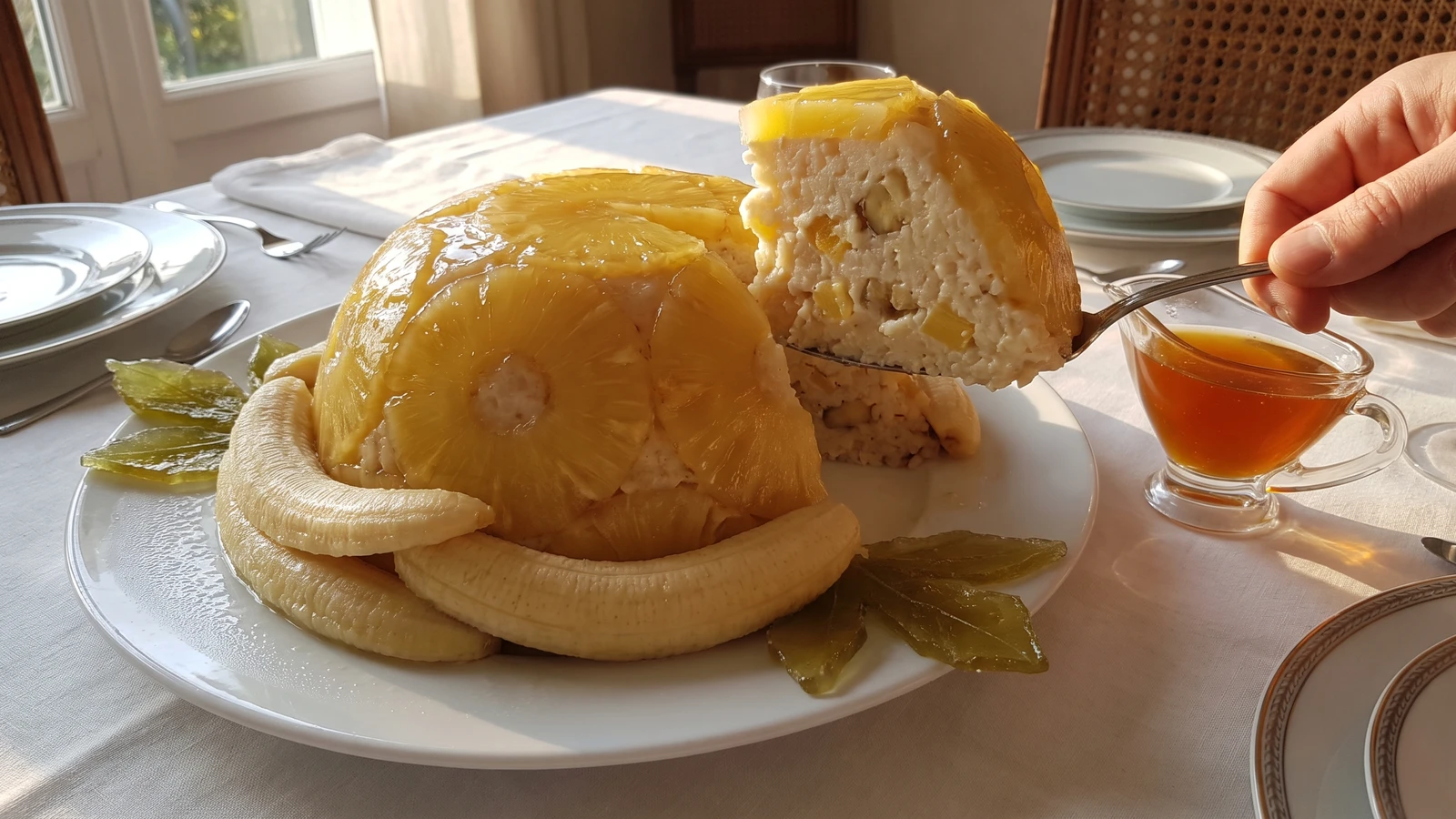
Pineapple slices, kirsch-bright and translucent, form a flawless dome around vanilla rice and a hidden centre of tropical fruit, with poached bananas and glossy apricot syrup waiting at the base.
Pine-apple à la Créole (a kirsch-poached pineapple and vanilla-rice dome) teaches architecture. Before you touch a pan, know the one true thing: its pineapple lining must be continuous, every thin slice overlapping the next, because one gap becomes the crack when the dome is turned out. The rice is not loose pudding here. It is the wall, tender and fragrant but thick enough to hold a hidden centre of diced fruit.
The source speaks as though a pastry brigade already had sweet rice and syrup in readiness, and it gives no household quantities. This dish did not call on a saucier, a perpetual stockpot, or a salamander; its hidden scaffolding was a proper dome mould, several hands, and a display-sized batch. Here a smooth 1.5-liter stainless bowl replaces the mould, the formula comes down to one pineapple and eight servings, and modern candied angelica stalk is cut into the broad leaves the garnish requires. Those are scaffolding changes. The kirsch-poached pineapple, vanilla rice, diced-fruit centre, poached bananas, and apricot-kirsch syrup all stay.
Drain the fruit until it no longer drips, then pack the rice while it remains pliable. The refrigerator does the patient work afterward. One cook, one stove, one evening, and the result turns out glossy and gold, with green angelica at the crown and apricot syrup waiting beside it. The unbroken pineapple lining is the step that decides everything.
Pine-apple à la Créole belongs to the Parisian classical entremets repertoire, where à la Créole often signalled rice joined with pineapple, banana, or other tropical fruit. The name is metropolitan French kitchen vocabulary rather than evidence of one specific Creole community's household dessert, and the moulded sweet travelled from grand dining rooms to bourgeois celebration tables. Candied angelica and kirsch supply the French finish, while the rice provides the architecture that presents the tropical fruit as a formal centrepiece.
Quantity
1 medium (about 3 lb / 1.4 kg whole)
peeled with the eyes removed and kept whole
Quantity
4 cups (960 ml / 960 g)
Quantity
2 cups (480 ml / 400 g)
Quantity
1/2 cup (120 ml / 113 g)
divided
Quantity
1 cup (240 ml / 200 g)
Quantity
3 cups (720 ml / 742 g)
Quantity
1/2 cup (120 ml / 100 g)
Quantity
1
split lengthwise
Quantity
1/4 teaspoon (1.25 ml / 1.5 g)
Quantity
3 tablespoons (45 ml / 42 g)
Quantity
1 fruit, about 3/4 cup (180 ml / 160 g prepared)
peeled, seeded, and diced
Quantity
4 medium, about 3 cups (720 ml / 470 g peeled)
1 diced for the centre; 3 split lengthwise for the border
Quantity
3/4 cup (180 ml / 240 g)
Quantity
2 broad strips (about 1 oz / 28 g)
cut lengthwise into large leaf shapes
| Ingredient | Quantity |
|---|---|
| ripe pineapplepeeled with the eyes removed and kept whole | 1 medium (about 3 lb / 1.4 kg whole) |
| cold water | 4 cups (960 ml / 960 g) |
| granulated sugar for the poaching syrup | 2 cups (480 ml / 400 g) |
| kirschdivided | 1/2 cup (120 ml / 113 g) |
| riz rond or other short-grain white rice | 1 cup (240 ml / 200 g) |
| whole milk | 3 cups (720 ml / 742 g) |
| granulated sugar for the rice | 1/2 cup (120 ml / 100 g) |
| vanilla beansplit lengthwise | 1 |
| fine sea salt | 1/4 teaspoon (1.25 ml / 1.5 g) |
| unsalted butter | 3 tablespoons (45 ml / 42 g) |
| firm-ripe custard apple, sugar apple, or cherimoyapeeled, seeded, and diced | 1 fruit, about 3/4 cup (180 ml / 160 g prepared) |
| firm-ripe bananas1 diced for the centre; 3 split lengthwise for the border | 4 medium, about 3 cups (720 ml / 470 g peeled) |
| smooth apricot preserves | 3/4 cup (180 ml / 240 g) |
| candied angelicacut lengthwise into large leaf shapes | 2 broad strips (about 1 oz / 28 g) |
Combine the water and poaching sugar in a deep, narrow nonreactive pot. Bring to a simmer, stirring only until the sugar dissolves, then add 2 tablespoons (30 ml) of the kirsch. Lower in the whole peeled pineapple and cover the surface with a cartouche, a round of parchment resting directly on the syrup. Simmer very gently for 25 to 30 minutes, turning the fruit every 5 minutes, until a skewer enters the thickest flesh with slight resistance. Remove the pot from the heat, stir in 1/4 cup (60 ml) more kirsch, and leave the pineapple in its syrup for 30 minutes. Reserve the remaining 2 tablespoons (30 ml) kirsch for the apricot syrup.
While the pineapple cools, scrape the vanilla seeds into the milk and add the pod and salt. Bring the milk to a bare simmer in a heavy saucepan, stir in the rice, and lower the heat. Cook for 30 to 35 minutes, stirring frequently across the pot floor, until the grains are completely tender and the milk has nearly disappeared. Stir in the rice sugar and butter, then cook for another 5 to 8 minutes. The rice must mound on the spoon and leave a furrow when stirred; if it flows back like loose pudding, cook it a few minutes longer. Ça se rattrape. If the milk catches, do not scrape the scorched floor. Transfer the clean upper rice to another pan and continue over gentler heat. Remove the vanilla pod, cover the surface, and cool until barely warm and pliable.
Lift the pineapple from its syrup and drain it for 10 minutes, reserving every drop of syrup. Cut the fruit vertically in half, then cut each half vertically into thin, regular slices about 1/8 inch (3 mm) thick, exactly as the dish requires. Trim away the tough pieces of core and any ragged edges, reserving those sound trimmings for the centre. Pat the slices until they no longer drip. Line a chilled 1.5-liter smooth metal bowl, beginning at its deepest point and radiating the slices toward the rim with their best sides against the metal. Overlap every slice by about 1/2 inch (1 cm). There must not be a single gap; if a slice tears, cover the tear with a smaller piece before proceeding.
Dice the reserved pineapple trimmings into pieces about 1/2 inch (1 cm) across. Bring 1 1/2 cups (360 ml) of the reserved pineapple syrup to a bare simmer. Add the pineapple dice and cook for 2 minutes, then add the prepared custard apple and one diced banana. Poach for only 45 seconds, just long enough to glaze the fruit without dissolving it. Lift everything into a fine-mesh sieve and spread it on a plate to cool and drain. Keep the syrup. If the fruit has softened more than intended, do not stir it further; chill it flat and spoon it gently into the centre. It will still serve perfectly.
Spoon the barely warm vanilla rice into the pineapple-lined bowl and press it gently against the slices with the dampened back of a spoon, building an even layer about 3/4 inch (2 cm) thick. Leave a deep hollow in the middle. Fill that hollow with the thoroughly drained diced fruit, stopping 3/4 inch (2 cm) below the rim, then cover it completely with the remaining rice. Press firmly enough to remove air pockets but not so hard that the pineapple lining slides. If a slice creeps out of place, lift back the rice, reset the slice, and patch the seam before continuing. Smooth the rice level with the rim.
Cover the rice directly with parchment or reusable wrap and set the bowl level in the refrigerator for at least 4 hours; 6 hours or overnight gives the cleanest turn. The cold firms the rice starch and marries it to the pineapple lining. Do not freeze the mould, because frozen fruit releases water as it thaws and weakens the very seams you worked to build.
About 30 minutes before serving, return 2 cups (480 ml) of the reserved syrup to a bare simmer. Split the remaining three bananas lengthwise and lower them into the syrup in batches. Poach for about 45 seconds on each side, handling them with a wide spatula so they retain their curves. Drain on a rack or plate and cool. If one splits, arrange its pieces as shorter arcs at the back of the dome; the border will still look generous.
Whisk the apricot preserves with 1/2 cup (120 ml) of the pineapple syrup and simmer for 3 to 5 minutes. Pass it through a fine-mesh sieve, pressing firmly, then cool it to room temperature and stir in the reserved 2 tablespoons (30 ml) kirsch. The finished syrup should be nappant, lightly coating a spoon while still pouring freely. If it is too thick, loosen it with reserved syrup one spoonful at a time; if thin, reduce it before adding the kirsch.
Chill a round serving platter, then uncover the mould and loosen only the rice at the rim with the tip of a thin knife. Invert the platter over the bowl and turn them together. Wrap the outside of the bowl with a warm, damp towel for 10 seconds and wait for the dome to release. If it holds, keep it inverted and repeat with the towel; do not shake it. Ça se rattrape. Arrange the poached banana halves in overlapping curves around the base, place the broad candied angelica leaves on top, and serve the apricot-kirsch syrup separately. À table!
1 serving (about 340g)
Culinary guides, cultural storytelling, and the editorial depth that makes cooking meaningful.
Discover Culinary ExplorerChef Juliette
Five almond preparations, one discipline: remove the skins cleanly, dry every kernel through, then cut, toast, or cloak it in pale caramel without letting its fragrant oils escape.

Chef Juliette
A pastry pantry lesson in one tray: filberts warmed only until their red skins release, rubbed clean, cooled, and chopped into a fragrant mise-en-place for cakes, creams, pralines, and petits fours.

Chef Juliette
The smallest pâtisserie discipline decides whether a cake leaves its mould intact: clarified butter in every corner, followed by the lightest veil of dry flour or fécule.

Chef Juliette
Four whites, one spotless bowl, and a patient change of speed: whisk gently until loosened, then briskly to glossy stiffness, with powdered sugar waiting if the foam begins to granulate.