
Chef Juliette
Various Almond Preparations
Five almond preparations, one discipline: remove the skins cleanly, dry every kernel through, then cut, toast, or cloak it in pale caramel without letting its fragrant oils escape.
A cooking platform built around craft, culture, and the stories behind what we eat.
Created by Chef Juliette
Based on No. 2441, Village Custard, from Le Guide Culinaire (1907) by Auguste Escoffier
Crème Villageoise turns dry biscuits and orchard fruit into a tender, spirit-scented pudding. Master its gently trembling bain-marie, and every baked custard becomes calmer work.
Crème Villageoise (Village Custard) teaches the rule beneath every baked custard: the bain-marie (hot-water bath) may tremble, but it must never boil. Gentle heat binds milk and eggs into silk. Hard heat separates them into curds, and no amount of ceremony can persuade them back.
The source assumed a large deep dish, an evenly tempered professional oven, and a cook who judged its unspecified fruit and liqueurs by hand. This version halves every stated quantity exactly, taking eight eggs plus four yolks down to four eggs plus two yolks and nearly one litre of milk down to 500 millilitres. The fruit and spirits are quantified only so you know what saturation looks like, and a deep household baking dish nested inside a roasting tin replaces the broad kitchen bain-marie. There is no saucier, permanent stockpot, or salamander involved. One cook, one stove, one evening.
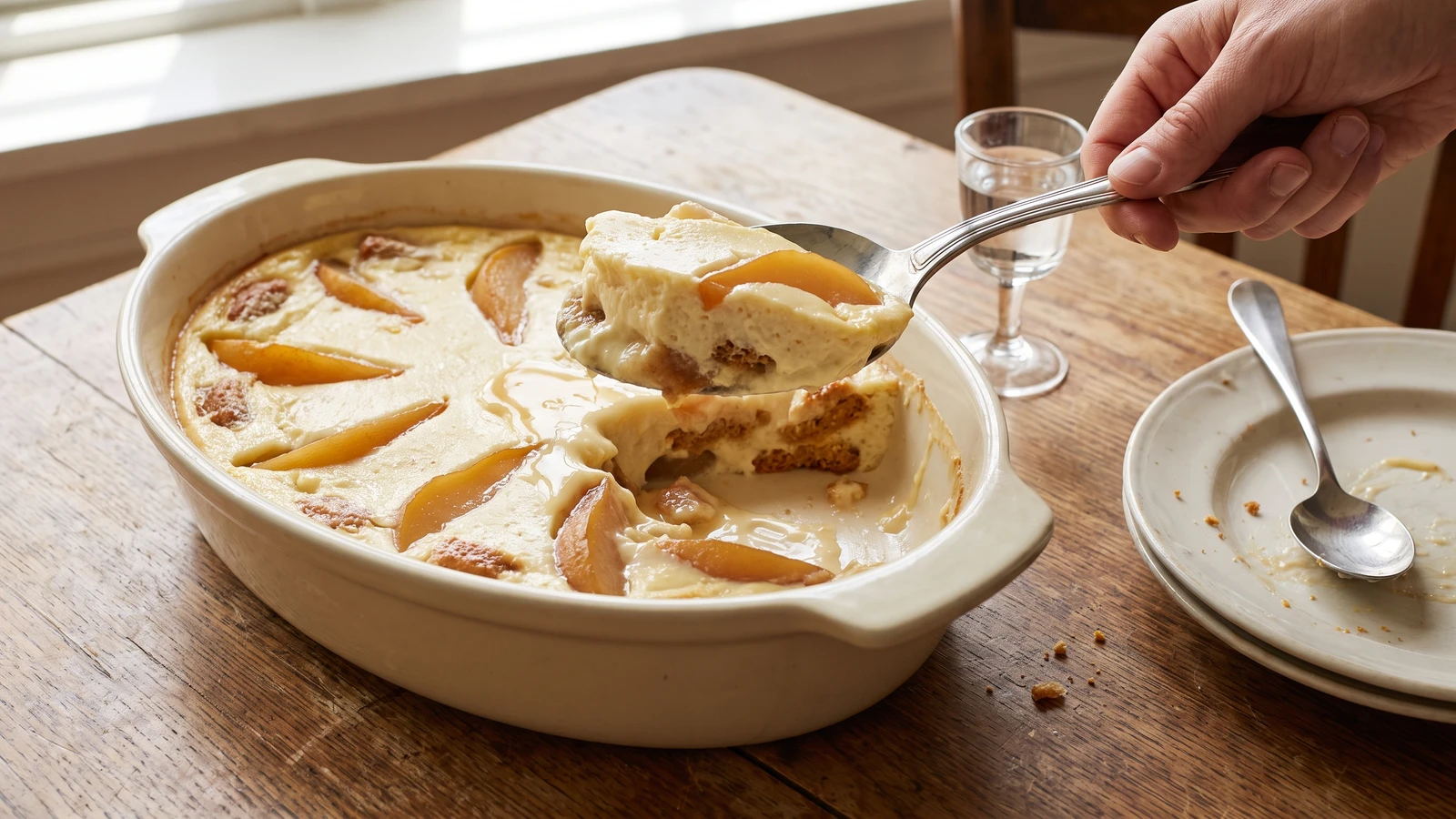
The finished Crème Villageoise should reveal soft layers when spooned: kirsch and anisette in the biscuits, tender pear or apple between them, then pale custard holding everything together. The layering is simple scaffolding; the gentle poach is the dish itself. Before the pan enters the oven, fix this in mind: watch the water more closely than the clock.
Crème villageoise belongs to the table of French cuisine bourgeoise rather than to one province, using dry biscuits, stewed orchard fruit, eggs, and milk to turn an economical pantry into a composed dessert. Classical kitchens retained that household structure, added kirsch and anisette from the liqueur cupboard, and codified its gentle bain-marie poach. Villageoise describes its plain domestic manner, not an origin in a particular named village or an invented blend of French regions.
Quantity
10 to 12 biscuits (2½ oz / 70 g)
Quantity
2 tablespoons (30 ml / 28 g)
Quantity
2 tablespoons (30 ml / 31 g)
Quantity
3 medium (1 lb / 450 g before trimming)
peeled, cored, and cut into ½-inch pieces
Quantity
3 tablespoons (45 ml / 45 g)
Quantity
½ cup plus 1 tablespoon (135 ml / 113 g)
Quantity
4
Quantity
2
Quantity
2⅛ cups (500 ml / 515 g)
| Ingredient | Quantity |
|---|---|
| plain dry biscuits | 10 to 12 biscuits (2½ oz / 70 g) |
| kirsch | 2 tablespoons (30 ml / 28 g) |
| anisette | 2 tablespoons (30 ml / 31 g) |
| firm-ripe pears or tart applespeeled, cored, and cut into ½-inch pieces | 3 medium (1 lb / 450 g before trimming) |
| water | 3 tablespoons (45 ml / 45 g) |
| powdered sugar, using starch-free superfine caster sugar as the modern equivalent | ½ cup plus 1 tablespoon (135 ml / 113 g) |
| large eggs | 4 |
| large egg yolks | 2 |
| whole milk | 2⅛ cups (500 ml / 515 g) |
Heat the oven to 300°F (150°C) with a rack in the lower middle. Choose a deep 1½-quart (1.5-litre) ovenproof dish that fits comfortably inside a roasting tin with room for water around it. Heat enough water to reach halfway up the dish until small bubbles cling to the vessel but none break the surface. The water should be very hot, not boiling.
Put the prepared pears or apples and the water in a covered saucepan. Cook over gentle heat for 8 to 12 minutes, stirring once or twice, until the fruit yields to a knife but still holds its shape. If the pan dries before the fruit softens, add another spoonful of water; if the fruit releases a puddle, uncover it and reduce the liquid until it merely coats the pieces. Leave the fruit to cool for 10 minutes.
Mix the kirsch and anisette in a shallow bowl. Dip or brush each dry biscuit until the liqueur reaches its centre but the biscuit can still be lifted whole. Arrange half the biscuits across the bottom of the deep dish, breaking pieces to close the gaps, and spread half the stewed fruit over them. Repeat with the remaining biscuits and fruit. If a soaked biscuit collapses, use it to patch a gap. This pudding is spooned, so tidy layers matter more than perfect shapes.
Whisk the sugar with the whole eggs and yolks just until the mixture is smooth and no longer gritty. Do not beat in a crown of bubbles, which would leave the surface coarse. Add the milk gradually, whisking gently after each addition, then skim away any foam with a spoon. Pour the custard slowly over the layered fruit and biscuits, pausing once so the first addition can soak through. Let the filled dish stand for 10 minutes.
Set the filled dish inside the roasting tin and pour the hot water around it until the water reaches halfway up its sides. Bake for 50 to 65 minutes. The water may quiver gently, but bubbles must never roll around the dish. If they appear, ça se rattrape: lower the oven to 275°F (135°C) and add a cup of cool water to the roasting tin. The Crème Villageoise is ready when the edges are set and the centre moves as one soft wobble; an instant-read thermometer at the centre should register about 175°F (79°C). If small curds appear at the rim, remove the dish immediately and chill it after cooling. The texture will be less silky, but the biscuit and fruit layers will still hold a generous pudding.
Lift the baking dish from the bain-marie at once and rest it for at least 30 minutes. Serve it softly warm, or cool it completely and chill for at least 4 hours. Use a deep serving spoon so every portion receives custard, stewed fruit, and spirit-soaked biscuit. À table!
1 serving (about 225g)
Culinary guides, cultural storytelling, and the editorial depth that makes cooking meaningful.
Discover Culinary ExplorerChef Juliette
Five almond preparations, one discipline: remove the skins cleanly, dry every kernel through, then cut, toast, or cloak it in pale caramel without letting its fragrant oils escape.

Chef Juliette
A pastry pantry lesson in one tray: filberts warmed only until their red skins release, rubbed clean, cooled, and chopped into a fragrant mise-en-place for cakes, creams, pralines, and petits fours.

Chef Juliette
The smallest pâtisserie discipline decides whether a cake leaves its mould intact: clarified butter in every corner, followed by the lightest veil of dry flour or fécule.

Chef Juliette
Four whites, one spotless bowl, and a patient change of speed: whisk gently until loosened, then briskly to glossy stiffness, with powdered sugar waiting if the foam begins to granulate.