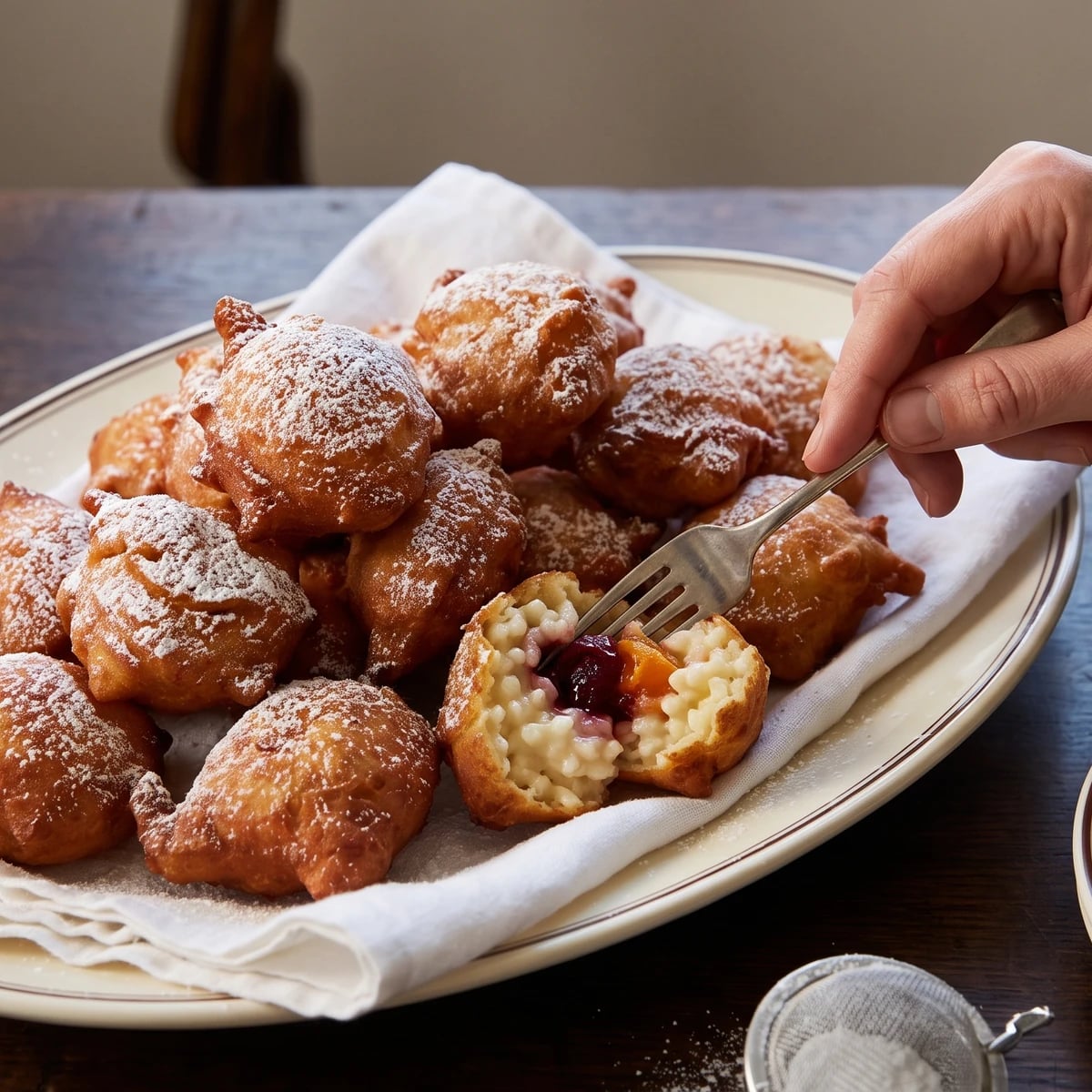
Sweet entremets rice encloses a jewel of stiff fruit salpicon, then wears a thin batter and fries to a crisp bronze. The seal is the dish, because hot fat finds every careless seam.
Pastries & Cookies
French
Comfort Food
Budget Friendly
Celebration
45 min
Active Time
50 min cook•3 hr 30 min total
Yield12 fritters (6 servings)
Beignets à la Suzon (rice fritters filled with fruit salpicon) teach enclosure. A salpicon is fruit cut into small, even dice and bound so it holds together. The one true thing to know is this: close the cold rice completely around that filling, because hot fat finds the smallest seam.
The source entry assumes rice for entremets and a stiff salpicon already waiting, plus a fry cook standing over plenty of hot fat. This dish never needed a saucier, a stockpot, or a salamander, but it did expect several prepared-component stations. For one cook, one stove, one evening, the honest equivalents are a heavy saucepan, a shallow tray, a thermometer, and twelve fritters instead of a service platter. The fruits aren't specified, so this version uses soft dried apricot and candied cherry bound with apricot preserves, a combination chosen for the stiffness the method demands.
Separate stations are brigade scaffolding and can go. Cooling the rice, reducing the salpicon until it holds a mound, using a thin batter, and sealing every ball are the dish and must stay. Before you touch the oil, inspect each Suzon carefully: no cracks, no exposed filling, no hopeful little gaps.
Beignets à la Suzon belong to the classical French entremets table, the sweet course where cooked rice was shaped, filled, battered, and fried for service. The preparation isn't tied to Lyon, Provence, or another regional larder: à la Suzon names a formula in the grand repertoire, while the surviving method leaves the fruits unspecified and insists instead on a stiff salpicon. Its journey to the home table changes the division of labor, not the idea, because preserved fruit and a saucepan of sweet rice perform the same work.
The technique, the tradition, and the story behind every dish.
Put the milk, vanilla seeds and pod, and salt in a heavy saucepan and bring them just to a simmer. Stir in the unrinsed rice, lower the heat, and cook uncovered for 30 to 35 minutes, stirring frequently and almost constantly near the end. Add the sugar during the final 5 minutes. The grains must be completely tender and the rice thick enough to fall from the spoon in heavy folds, with no loose milk around it. Remove the vanilla pod and stir in the butter. Beat the yolks with a spoonful of hot rice, stir them back into the pan, and cook gently for 1 to 2 minutes, until the mixture gives slow, heavy bubbles. If it remains loose, keep stirring over low heat rather than adding flour. Spread the rice about ⅓ inch (8 mm) thick on a parchment-lined tray, cool for 15 minutes, then refrigerate for 60 to 90 minutes, until cold and firm.
2
Stiffen the salpicon
Combine the diced apricots, candied cherries, and apricot preserves in a small saucepan. Cook over medium-low heat for 5 to 7 minutes, stirring, until the mixture is cohesive and a spoon drawn across the pan leaves a clear trail. A teaspoonful placed on a cold plate must hold its mound without a ring of syrup. Spread the salpicon on a plate and refrigerate until completely cold. If it loosens after chilling, return it to the pan and reduce it for another minute or two. The filling must be stiff before it meets the rice.
3
Enclose the filling
Divide the cold rice into 12 equal portions, keeping a tablespoonful aside for repairs. Between pieces of parchment, press each portion into a disc 3½ inches (9 cm) across, preserving the source preparation's size. Put 2 level teaspoons, about 14 g, of cold salpicon in the center. Draw the rice edges over the filling, pinch them firmly together, and roll the parcel into a smooth ball. Inspect every surface. If you find a crack, ça se rattrape: patch it with reserved cold rice, smooth it with lightly buttered fingertips, and chill the ball again. Arrange the sealed balls on a lined tray and refrigerate for at least 30 minutes.
Keep the salpicon away from the disc's edge. A smear caught in the seam prevents the rice from bonding, and the filling will escape when it reaches the fat.
4
Mix the thin batter
Reserve 2 tablespoons of the measured flour and 1 tablespoon of the measured water for adjustment. Whisk the remaining flour and the batter salt with the egg and most of the water until smooth, then add enough reserved water to make a thin batter that coats a spoon lightly and falls in a steady ribbon. If it runs off like plain water, whisk in some reserved flour; if it hangs in a heavy paste, loosen it with the reserved water. Let it stand for 10 minutes while the oil heats.
5
Batter and fry
Pour the oil into a deep, heavy pot, leaving the vessel no more than half full, and heat it to 350°F (175°C). Blot any surface moisture from the chilled balls. Dip one ball completely into the batter, lift it with a fork, and let the excess fall away before lowering it carefully into the oil. Fry three at a time for 3 to 4 minutes, turning them gently, until evenly crisp and deep golden. Keep the oil between 340°F and 350°F (170°C and 175°C). If the first fritter opens, lift it out immediately and stop: inspect the remaining unbattered balls, patch any weak seams with cold rice, and chill them for 10 minutes before continuing. Hot fat has found the flaw for you. Ça se rattrape.
The oil temperature will fall when each batch enters. Frying only three at once lets it recover quickly, so the coating crisps instead of drinking the fat.
6
Drain and sugar
Lift the Suzon onto a wire rack and let the excess oil drain for 1 minute. Arrange them loosely on an oval platter lined with a clean folded linen or unprinted absorbent paper, keeping the source preparation's napkin service without trapping oil beneath the crust. Dust generously with icing sugar and serve at once, while the coating is crisp and the sweet rice inside remains soft. À table!
Chef Tips
•Use short-grain rice and don't rinse it. Its surface starch is what lets the cold entremets rice hold together around the filling; parboiled or long-grain rice won't bind with the same confidence.
•The source leaves the salpicon fruits unspecified. You may replace the apricot and cherry with the same combined weight of finely diced preserved fruit, but cook it with the preserves until a cold spoonful holds its shape. Fresh berries are too wet for this enclosure.
•A thermometer earns its place here. Oil below 340°F (170°C) gives a greasy coating, while oil much above 350°F (175°C) browns the batter before the center is properly warmed.
•These need no sauce. Icing sugar is the finish named by the preparation, and anything poured over the crust would undo the frying. Serve with coffee or a small glass of demi-sec sparkling wine.
•Cool the frying oil completely, strain it through a fine sieve, and store it tightly covered if it remains clean. It can be used again for another sweet fry, which is how plenty of frying fat remains sensible rather than extravagant.
Advance Preparation
•The entremets rice and fruit salpicon can be prepared up to 24 hours ahead. Cool them promptly, cover them separately, and keep them refrigerated.
•The filled, carefully sealed balls can be shaped up to 6 hours before frying and held covered in the refrigerator. Mix the batter shortly before the oil heats.
•Fry the Suzon as close to serving as possible. Once fried, they soften during storage and never recover their first crispness completely.
Frequently Asked Questions
Nutrition Information
1 serving (about 195g)
Calories
560 calories
Total Fat
24 g
Saturated Fat
6 g
Trans Fat
0 g
Unsaturated Fat
17 g
Cholesterol
115 mg
Sodium
260 mg
Total Carbohydrates
77 g
Dietary Fiber
2 g
Sugars
38 g
Protein
10 g
Where cooking meets culture.
Culinary guides, cultural storytelling, and the editorial depth that makes cooking meaningful.