
Chef Juliette
Various Almond Preparations
Five almond preparations, one discipline: remove the skins cleanly, dry every kernel through, then cut, toast, or cloak it in pale caramel without letting its fragrant oils escape.
A cooking platform built around craft, culture, and the stories behind what we eat.
Created by Chef Juliette
Based on No. 2398, Dished English Custard (to Accompany Cold or Hot Stewed Fruit), from Le Guide Culinaire (1907) by Auguste Escoffier
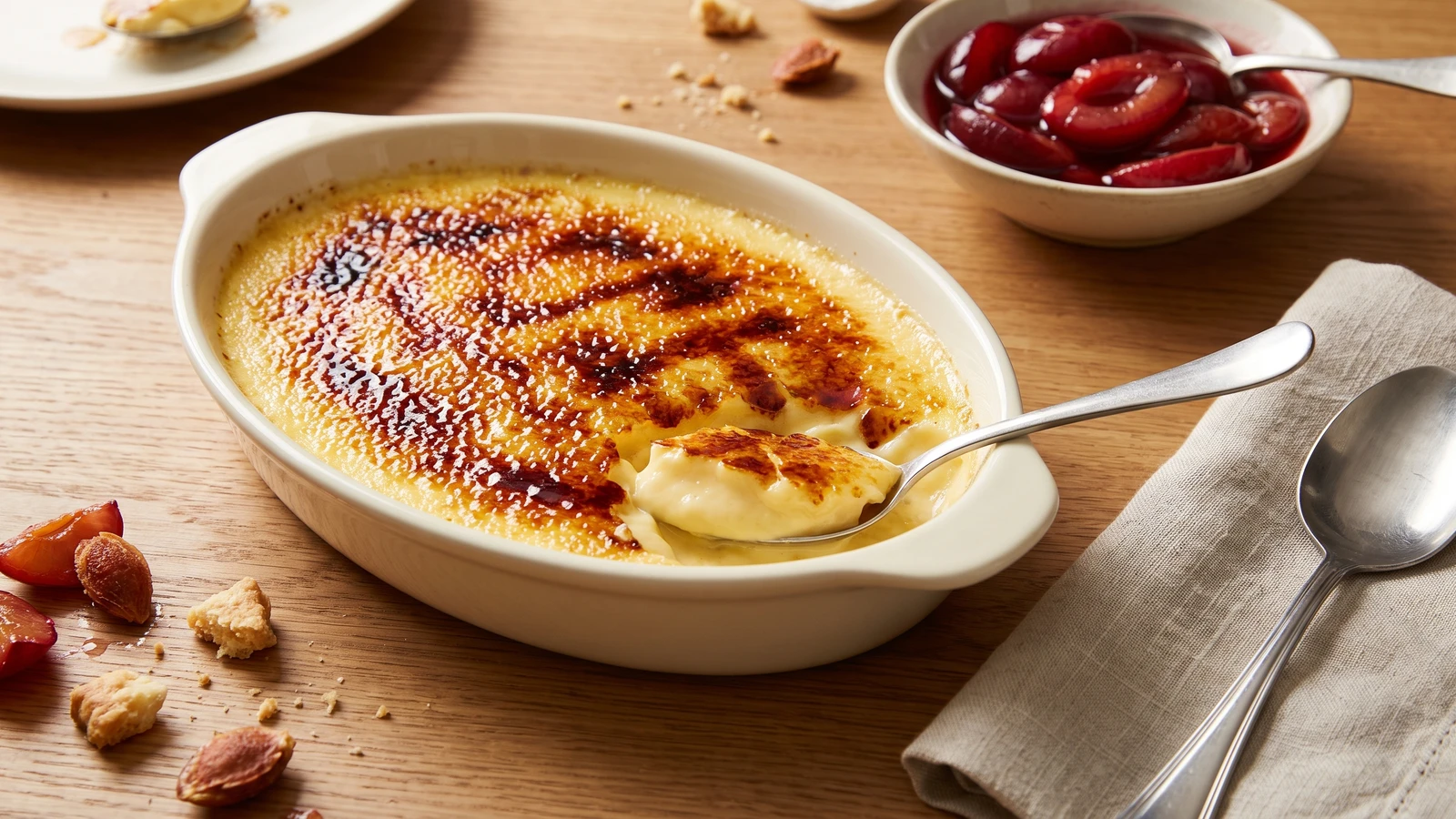
Crème Anglaise en Plat turns five yolks and milk into a tender, spoonable custard, then gives its sugared surface a caramel lattice under the broiler, ready for hot or cold stewed fruit.
Crème Anglaise en Plat (dished English custard) teaches the one true thing behind every tender custard: the heat must stop while the center still trembles. Five yolks can set half a quart of milk into something delicate enough to yield to a spoon, but only if the bain-marie, the hot-water bath, keeps the cooking gentle.
The original formula assumed a brigade-sized quart, a shallow silver or porcelain service dish, and a red-hot branding iron held ready at the range, the sort of finishing work handled beside a salamander. Here the quantity becomes 2 cups of milk and five yolks, preserving the book's ten-yolks-to-the-quart proportion exactly. A shallow broiler-safe porcelain dish receives the custard, and the broiler supplies the fierce top heat. The iron was service scaffolding; the generous icing sugar and caramelized criss-cross are the dish, so those stay. One cook, one stove, one evening.
The sugar darkens in seconds, but that isn't the difficult moment. The step that decides the Crème Anglaise en Plat comes earlier: pull the custard when its center still moves as one soft sheet.
In the Parisian classical repertoire, crème anglaise became the French name for an English-style egg custard, and this dished form carried it from the saucepan into a shallow service dish, where it was poached and served with fruit compotes. Its red-hot-iron lattice is not the solid glassy cap of crème brûlée: icing sugar is branded in crossings, giving bitter caramel against soft custard while leaving the dessert spoonable.
Quantity
2 cups (480 ml / 495 g)
Quantity
1/2 bean
split lengthwise and scraped
Quantity
1/2 cup plus 2 tablespoons (150 ml / 125 g)
Quantity
5 yolks (about 90 g)
Quantity
1/4 cup (60 ml / 30 g)
sifted
| Ingredient | Quantity |
|---|---|
| whole milk | 2 cups (480 ml / 495 g) |
| vanilla beansplit lengthwise and scraped | 1/2 bean |
| caster sugar | 1/2 cup plus 2 tablespoons (150 ml / 125 g) |
| large egg yolks | 5 yolks (about 90 g) |
| icing sugarsifted | 1/4 cup (60 ml / 30 g) |
Heat the oven to 300°F (150°C) and bring a kettle of water nearly to the boil. Set a shallow 1-quart (1-liter) broiler-safe porcelain dish inside a high-sided roasting pan. The shallow dish is not decoration: it lets the custard poach evenly and later carries it straight to the table.
Put the milk, vanilla seeds, and scraped pod in a small saucepan. Heat gently until the milk shivers at the edge and smells distinctly of vanilla, but don't let it boil. Cover, remove from the heat, and leave it for 10 minutes, then discard the pod.
Stir the yolks and caster sugar together until smooth and slightly lightened, without beating in a head of foam. Pour in the hot milk a little at a time while stirring constantly. If a few yellow flecks appear because the milk went in too quickly, stop and pass everything at once through a fine sieve. Ça se rattrape. Strain the finished mixture into the porcelain dish and skim away any bubbles, which would otherwise bake into a pocked surface.
Set the roasting pan on the oven rack, then pour the hot water around the porcelain dish until it reaches halfway up the sides. Bake in this bain-marie for 25 to 35 minutes. The outer inch should be set, while the center still quivers as one soft sheet when the pan is nudged; an instant-read thermometer will show about 170 to 175°F (77 to 79°C). If the edges begin to puff, lift the dish from the water immediately. Residual heat will finish the center, while another five minutes would turn the custard grainy.
Lift the porcelain dish carefully from the bain-marie. For a gently warm custard, rest it for 25 minutes. For cold service, cool it for 30 minutes, then refrigerate uncovered until cold, about 2 hours; cover only after it has chilled so condensation doesn't drip onto the surface. Before sugaring, blot away any beads of moisture with the corner of a clean towel.
Heat the broiler to high with a rack about 4 inches (10 cm) below the element. Set the custard dish on a dry sheet pan and sift the icing sugar copiously over the whole surface. Bridge the dish with folded strips of heavy foil about 3/4 inch (2 cm) wide, leaving narrow gaps between them, then broil for 20 to 45 seconds, just until the exposed sugar bubbles and turns amber. Lift off the hot strips with tongs, replace them at right angles, and broil again to complete the lattice. Don't look away. If one patch blackens, remove the dish, let the sugar harden briefly, scrape away only the bitter patch, then re-sugar and color it again. Ça se rattrape.
Let the caramelized lattice set for 2 minutes. Carry the Crème Anglaise en Plat to the table in its porcelain dish and spoon it beside hot or cold stewed fruit, rather than burying the sugar beneath the fruit juices. The custard should slump softly from the serving spoon while the caramel crossings give a faint crisp bite. À table!
1 serving (about 175g)
Culinary guides, cultural storytelling, and the editorial depth that makes cooking meaningful.
Discover Culinary ExplorerChef Juliette
Five almond preparations, one discipline: remove the skins cleanly, dry every kernel through, then cut, toast, or cloak it in pale caramel without letting its fragrant oils escape.

Chef Juliette
A pastry pantry lesson in one tray: filberts warmed only until their red skins release, rubbed clean, cooled, and chopped into a fragrant mise-en-place for cakes, creams, pralines, and petits fours.

Chef Juliette
The smallest pâtisserie discipline decides whether a cake leaves its mould intact: clarified butter in every corner, followed by the lightest veil of dry flour or fécule.

Chef Juliette
Four whites, one spotless bowl, and a patient change of speed: whisk gently until loosened, then briskly to glossy stiffness, with powdered sugar waiting if the foam begins to granulate.