
Chef Juliette
Various Almond Preparations
Five almond preparations, one discipline: remove the skins cleanly, dry every kernel through, then cut, toast, or cloak it in pale caramel without letting its fragrant oils escape.
A cooking platform built around craft, culture, and the stories behind what we eat.
Created by Chef Juliette
Based on No. 2385, Almond Paste, from Le Guide Culinaire (1907) by Auguste Escoffier
Pâte d’amandes is the quiet foundation of French confectionery: equal weights of almonds and sugar, bound just enough with egg white, worked cool and smooth for candies, cakes, and pastry fillings.
Pâte d’amandes teaches restraint in the processor: almonds and sugar must be ground very fine without becoming warm enough to surrender their oil. That is the one true thing to know before you press the button. Smoothness comes from short pulses and patience, not from running the machine until the mixture shines.
The source entry assumes a dedicated crushing machine handling pastry-room quantities, after already setting aside the laborious mortar. A home food processor with a sharp blade is its honest equivalent. Because the entry varies its proportions according to the paste’s eventual use, this home batch uses equal weights of almonds and sugar, a versatile middle ground for confectionery, cake work, and fillings. The mortar and large machine are production scaffolding and can go; the fine grinding and cautious binding are the preparation itself and must stay.
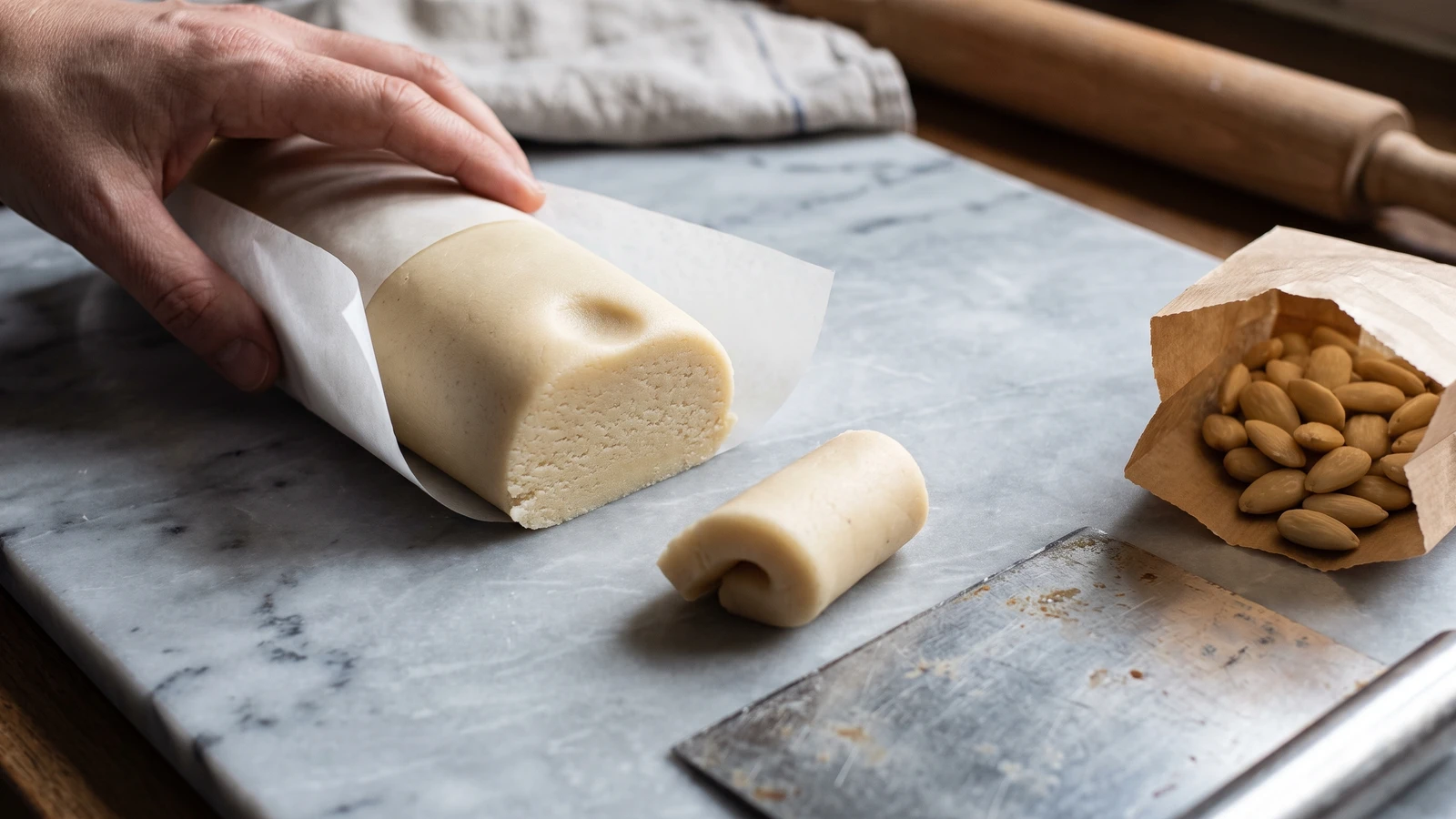
Finished pâte d’amandes should be pale ivory, close-grained, and supple enough to bend without cracking, with the clean taste of almonds rather than extract. Add the egg white by degrees. You can always add another drop, but taking one back requires rather more diplomacy.
Pâte d’amandes belongs to the confiseries and pâtisseries of France rather than to one province; its proportions change at the workbench according to whether it will be molded, filled, or baked. In Aix-en-Provence, the almond foundation joins candied melon in calissons, while Parisian pastry kitchens use firmer or softer grades for petits fours and cake work. The frequent equation with one fixed marzipan formula misses the French practice: pâte d’amandes is a family of working pastes, not a single sweetness.
Quantity
1½ cups (355 ml / 210 g)
completely dry and chilled
Quantity
1 cup plus 2 teaspoons (250 ml / 210 g)
Quantity
2 tablespoons (30 ml / 30 g)
added as needed
| Ingredient | Quantity |
|---|---|
| raw blanched almondscompletely dry and chilled | 1½ cups (355 ml / 210 g) |
| superfine white sugar | 1 cup plus 2 teaspoons (250 ml / 210 g) |
| pasteurized egg whiteadded as needed | 2 tablespoons (30 ml / 30 g) |
Chill the almonds for 15 minutes before grinding. They should be cool and completely dry, not frozen hard. Any water left from blanching turns the mixture gummy, so almonds blanched at home must dry uncovered before you begin.
Combine the chilled almonds and sugar in a food processor fitted with the metal blade. Pulse in one-second bursts, scraping the bowl frequently, until the mixture resembles very fine meal and feels only faintly sandy when rubbed between two fingers. If it begins smearing against the bowl or the bowl feels warm, stop immediately, spread the mixture on a plate, and chill it for 20 minutes before continuing two pulses at a time. Once fine and cool, remove 2 tablespoons of the dry mixture and reserve it.
Return the processor to short pulses and add 1 tablespoon of egg white. Add another teaspoon, pulse again, then continue a few drops at a time until the crumbs swell slightly and hold together when pressed. Return the reserved dry mixture and pulse just until incorporated, adding only enough remaining egg white to make the paste gather into soft clumps. Do not wait for a sticky ball to race around the blade. If you add too much and the paste clings wetly to your fingers, stop and chill it for 20 minutes before kneading. Ça se rattrape.
Turn the clumps onto a clean work surface and press them together. Knead with the heel of your hand for 30 to 60 seconds, only until the pâte d’amandes becomes uniform, smooth, and supple. If its edges crack, touch your fingertips to the remaining egg white and knead once or twice; pouring in even a teaspoon at this stage may make it sticky. Stop as soon as a bent piece curves without crumbling or leaving oil on your hand.
Shape the pâte d’amandes into a short, thick log and wrap it directly against the surface so no air reaches it. Chill for at least 1 hour, which allows the sugar and almonds to take up the moisture evenly. Let it soften for 10 minutes at room temperature before rolling or shaping. The rested paste should cut cleanly, bend without cracking, and carry no oily shine.
1 serving (about 28g)
Culinary guides, cultural storytelling, and the editorial depth that makes cooking meaningful.
Discover Culinary ExplorerChef Juliette
Five almond preparations, one discipline: remove the skins cleanly, dry every kernel through, then cut, toast, or cloak it in pale caramel without letting its fragrant oils escape.

Chef Juliette
A pastry pantry lesson in one tray: filberts warmed only until their red skins release, rubbed clean, cooled, and chopped into a fragrant mise-en-place for cakes, creams, pralines, and petits fours.

Chef Juliette
The smallest pâtisserie discipline decides whether a cake leaves its mould intact: clarified butter in every corner, followed by the lightest veil of dry flour or fécule.

Chef Juliette
Four whites, one spotless bowl, and a patient change of speed: whisk gently until loosened, then briskly to glossy stiffness, with powdered sugar waiting if the foam begins to granulate.