
Chef Juliette
Various Almond Preparations
Five almond preparations, one discipline: remove the skins cleanly, dry every kernel through, then cut, toast, or cloak it in pale caramel without letting its fragrant oils escape.
A cooking platform built around craft, culture, and the stories behind what we eat.
Created by Chef Juliette
Based on No. 2380, Pâte à Biscuit Manque, from Le Guide Culinaire (1907) by Auguste Escoffier
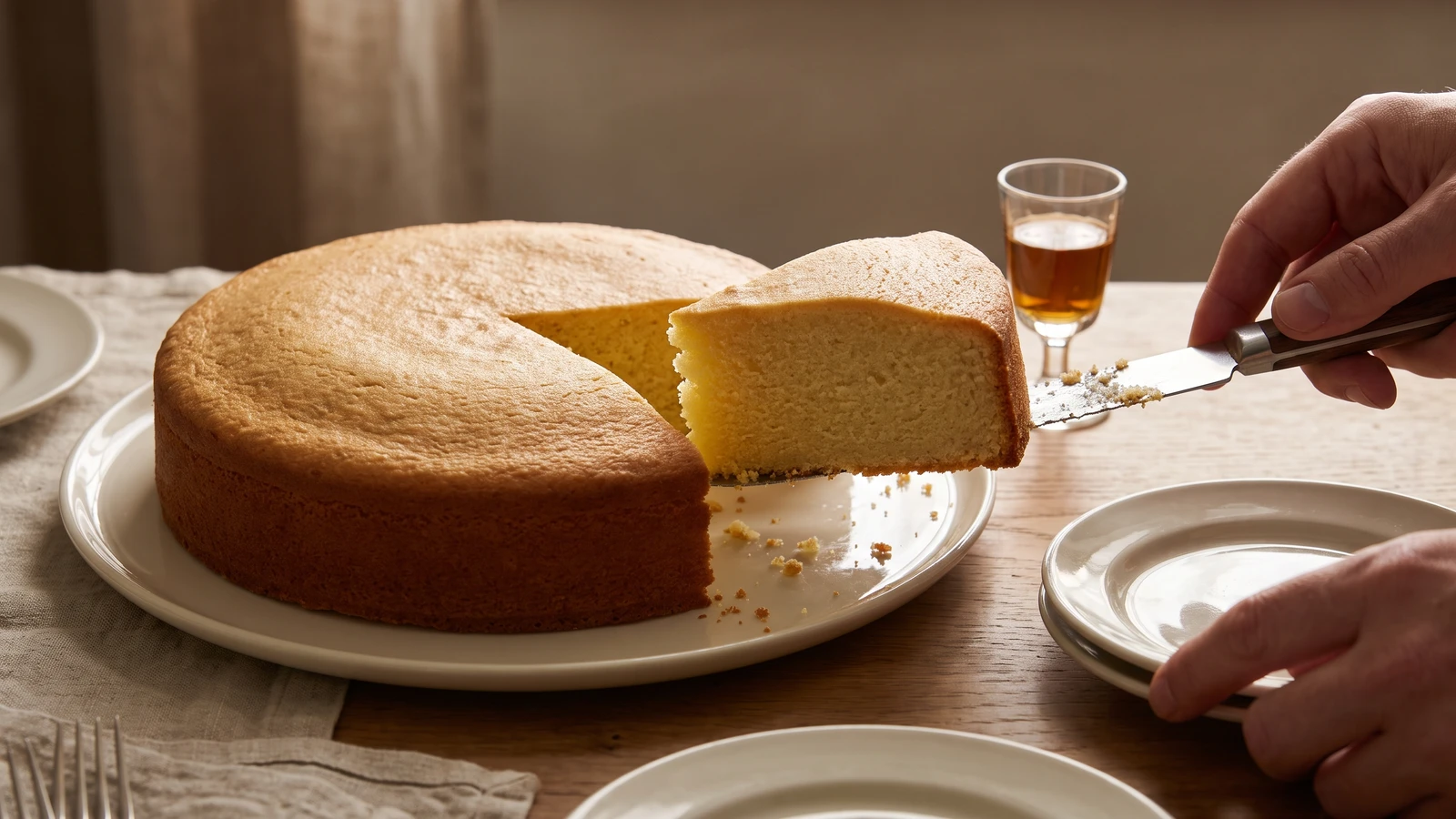
Six yolks, beaten to a thick ribbon, give this rum-scented biscuit manqué its entire rise and fine golden crumb, with no whisked whites and no leavening to lend a hand.
Pâte à biscuit manqué (batter for a yolk-raised butter cake) teaches the discipline of egg foam with nowhere to hide. There are no whisked whites and no leavener. The whole rise comes from blanchir, beating the yolks and sugar until pale and thick, so the one true thing to know before touching the pan is this: a loose yolk mixture makes a low, close cake.
The original formula began with eighteen yolks, a basin large enough to hold them, special molds, and a moderate oven whose heat a pastry cook judged by habit. This home version is exactly one-third of that brigade batch: six yolks, with the sugar, rum, flour, and butter kept in the same proportions. An electric mixer supplies the patient arm, an 8-inch round pan replaces the dedicated moule à manqué (round cake mold), and 340°F gives that moderate oven a number. The large batch and special molds were scaffolding. The full ribbon and careful lifting fold are the dish, and they stay. One cook, one stove, one evening.
Baked properly, the biscuit manqué is butter-gold outside with a fine yellow crumb, tender from yolks and melted butter, and quietly fragrant with rum. It needs no frosting to prove itself at a birthday table. Beat the yolks until the ribbon sits boldly on the surface before disappearing; that is the step that decides everything.
Biscuit manqué belongs to the French pâtisserie repertoire, and its best-known origin story places it in a Paris pastry kitchen where a sponge that had missed its intended form was enriched and baked anyway. The familiar round, slightly flared moule à manqué took its name from the cake, preserving that supposed failure as one of the standard pans of French baking. Accounts disagree on the precise mishap, but this formula is distinct from both génoise and white-lightened biscuit: beaten yolks alone must hold the air.
Quantity
6
at room temperature
Quantity
¾ cup (180 ml / 151 g)
Quantity
1 tablespoon (15 ml / 14 g)
Quantity
1 cup (240 ml / 123 g)
sifted
Quantity
6 tablespoons plus 2 teaspoons (100 ml / 95 g)
melted and cooled until barely warm
Quantity
1 teaspoon (5 ml / 5 g)
softened, for the pan
Quantity
1 tablespoon (15 ml / 8 g)
for dredging the pan
| Ingredient | Quantity |
|---|---|
| large egg yolksat room temperature | 6 |
| granulated sugar | ¾ cup (180 ml / 151 g) |
| rum | 1 tablespoon (15 ml / 14 g) |
| all-purpose floursifted | 1 cup (240 ml / 123 g) |
| unsalted buttermelted and cooled until barely warm | 6 tablespoons plus 2 teaspoons (100 ml / 95 g) |
| unsalted buttersoftened, for the pan | 1 teaspoon (5 ml / 5 g) |
| all-purpose flourfor dredging the pan | 1 tablespoon (15 ml / 8 g) |
Set a rack in the center of the oven and heat it to 340°F (170°C), or 325°F (165°C) with convection. Butter an 8-inch (20 cm) round cake pan with 2-inch (5 cm) sides, dust it thoroughly with the dredging flour, then turn and tap the pan until every greased surface is coated and the excess falls away. The old special mold contributed shape, not flavor; this ordinary round pan is its honest home equivalent.
Melt the butter gently, taking it off the heat while a few small pieces remain, then swirl until clear and fluid. Let it cool to roughly body temperature. Hot butter collapses the yolk foam, while cold butter sets into streaks, so keep it fluid and barely warm while you beat the eggs.
Put the yolks in a large bowl, add the sugar, and begin beating immediately. Blanchir means beating yolks and sugar until pale and thick, and here it supplies the cake's entire rise. Beat with an electric mixer on medium-high speed for 7 to 10 minutes, until the mixture is creamy ivory, has nearly tripled in volume, and falls from the whisk in a broad ribbon whose trace remains visible for several seconds. If it stays thin or feels gritty after eight minutes, set the bowl over barely warm water and whisk for 30 seconds, just until the sugar loosens, then remove it and continue beating until thick. Ça se rattrape. Keep the bowl no warmer than your hand, since overheated yolks begin to cook.
Pour the rum around the edge of the yolk foam and fold it through with two broad strokes. Sift one-third of the flour over the surface, cut the spatula down through the center, sweep across the bottom, and lift the batter over itself. Turn the bowl and repeat, adding the remaining flour in two portions. Drizzle the barely warm butter down the side of the bowl in a thin stream and continue lifting the batter until no flour or butter streaks remain. If butter pools at the bottom, bring it up with two or three deep, deliberate folds. Do not whisk after the flour enters; air knocked out now cannot be beaten back in.
Transfer the batter immediately to the prepared pan and level the top with one light sweep. It must sit no higher than two-thirds of the way up the pan; if your pan is shallower, put the excess into a separately buttered and floured ramekin. Bake for 30 to 35 minutes without opening the door during the first 25 minutes. The biscuit manqué is ready when the top is deep butter-gold, the center springs back under a gentle fingertip, and a skewer emerges clean or with a few tender crumbs. If the top colors before the center sets, lay a loose sheet of foil over it and finish baking.
Let the cake settle in its pan for 10 minutes, then loosen the edge with a thin knife and turn it onto a rack. Set it upright and cool for at least 20 minutes before cutting; sliced too soon, its still-delicate crumb compresses beneath the knife. Serve plain, while the rum and butter remain the whole argument. À table!
1 serving (about 55g)
Culinary guides, cultural storytelling, and the editorial depth that makes cooking meaningful.
Discover Culinary ExplorerChef Juliette
Five almond preparations, one discipline: remove the skins cleanly, dry every kernel through, then cut, toast, or cloak it in pale caramel without letting its fragrant oils escape.

Chef Juliette
A pastry pantry lesson in one tray: filberts warmed only until their red skins release, rubbed clean, cooled, and chopped into a fragrant mise-en-place for cakes, creams, pralines, and petits fours.

Chef Juliette
The smallest pâtisserie discipline decides whether a cake leaves its mould intact: clarified butter in every corner, followed by the lightest veil of dry flour or fécule.

Chef Juliette
Four whites, one spotless bowl, and a patient change of speed: whisk gently until loosened, then briskly to glossy stiffness, with powdered sugar waiting if the foam begins to granulate.