
Chef Juliette
Flan aux Carottes
A pale short-paste shell holds silken, lightly sweet carrot purée beneath neat glazed half-discs, their butter syrup catching the light: a classical tart poised between vegetable course and sweet.
A cooking platform built around craft, culture, and the stories behind what we eat.
Created by Chef Juliette
Based on No. 2366, Puff-paste, from Le Guide Culinaire (1907) by Auguste Escoffier
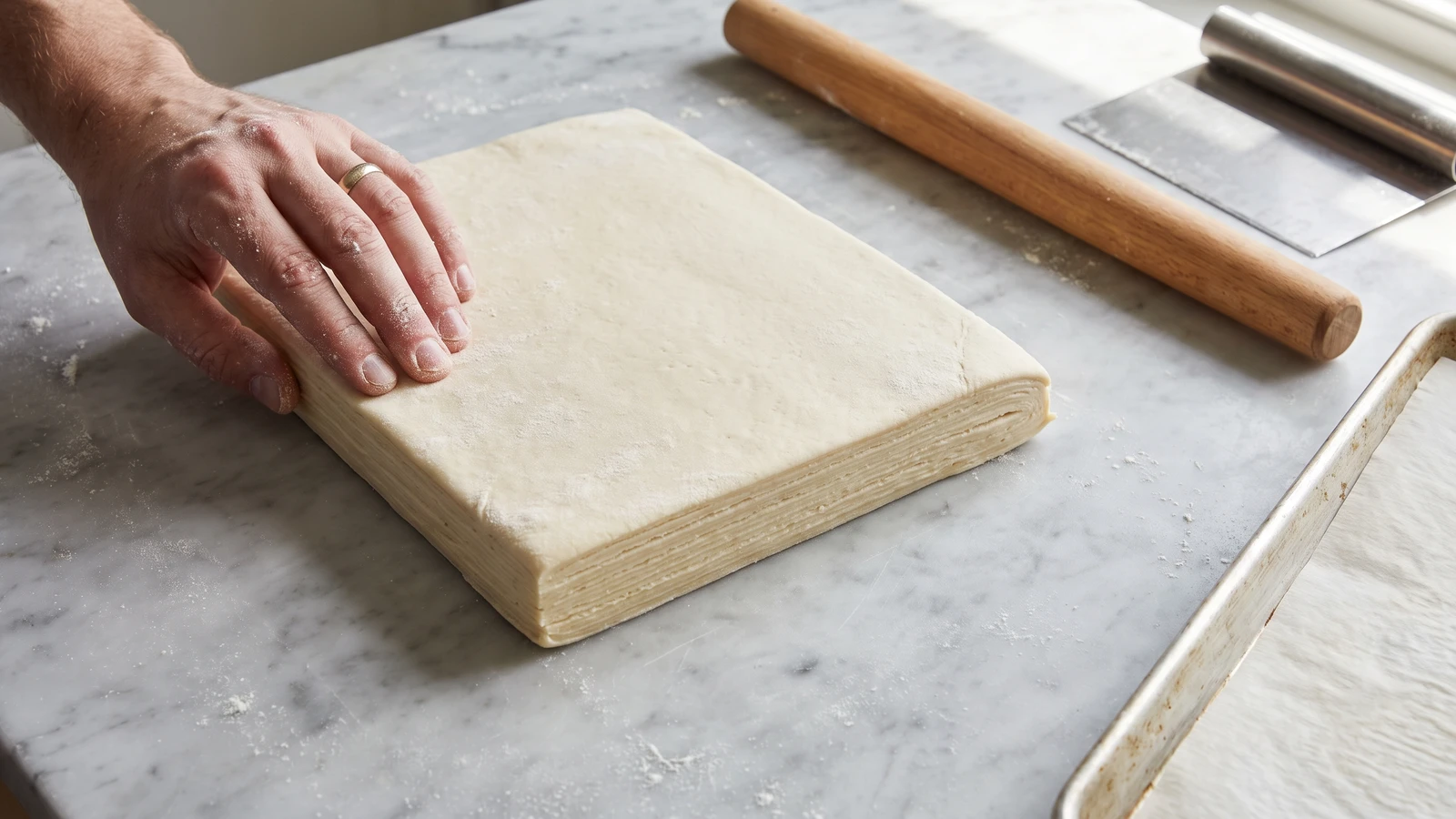
Feuilletage is the pastry lesson in matching textures: equal weights of flour and butter, six measured turns, and cool rests that keep hundreds of layers distinct enough to rise crisp and butter-gold.
Feuilletage (puff-paste) teaches one exact principle: butter and détrempe, the simple flour-and-water paste, must have the same softness before they are enclosed. If the butter is harder, it fractures into islands; if softer, it smears into the dough, and either way the layers lose their clean lift. Equal consistency, not icy ingredients, is the one true thing to know before touching the rolling pin.
The original formula assumed a cool pastry room, a broad mixing board, and enough hands to keep a one-pound flour batch moving. Here the quantity is halved, the eighteen-inch working length becomes a counter-friendly rectangle, and a refrigerator tray stands in for the cool room. The ratio remains untouched: equal weights of flour and butter, six single turns, with rests between pairs. The broad board and brigade pace are scaffolding; those six turns and rests are the dish. One cook, one stove, one evening.
Finished feuilletage is a pale, supple slab with its butter nowhere visible, ready to bake into crisp, separate leaves. Roll steadily, never hurriedly, and stop whenever the dough resists or the butter changes texture. The decisive step comes before the first turn: press the butter and détrempe with one finger and make certain they yield alike.
Feuilletage belongs to the pastry rooms of Paris and then to the French national canon, moving between pâtisserie sweets and savory tourtes, vol-au-vent, and pâtés en croûte. Its invention is often assigned to a single clever hand, but layered doughs traveled across kitchens for generations; the French contribution was to make turns, resting, and equal consistency into a disciplined, repeatable system. Its rise needs no yeast: heated water held in the dough and butter expands between sealed sheets, while the butter keeps those sheets distinct.
Quantity
1¾ cups plus 2 tablespoons (about 445 ml / 227 g)
Quantity
¾ teaspoon (3.75 ml / 4.7 g)
Quantity
Up to a scant ⅔ cup (about 140 ml / 140 g)
added as needed
Quantity
1 cup (240 ml / 227 g)
softened only until cool and pliable
Quantity
Up to 2 tablespoons (30 ml / 15 g)
for dusting
| Ingredient | Quantity |
|---|---|
| all-purpose flour | 1¾ cups plus 2 tablespoons (about 445 ml / 227 g) |
| fine table salt | ¾ teaspoon (3.75 ml / 4.7 g) |
| very cold wateradded as needed | Up to a scant ⅔ cup (about 140 ml / 140 g) |
| unsalted buttersoftened only until cool and pliable | 1 cup (240 ml / 227 g) |
| additional all-purpose flourfor dusting | Up to 2 tablespoons (30 ml / 15 g) |
Sift the 227 g flour onto a clean work surface or into a broad bowl. Make a well, add the salt and about ½ cup (120 ml / 120 g) of the cold water, then draw the flour inward with your fingertips or a bench scraper. Add only enough of the reserved water to gather the mixture into a rough, cohesive paste. Press it together without kneading, flatten it into a square, cover, and rest for 20 minutes. The détrempe should hold without becoming smooth or elastic. If dry crumbs remain, wet your fingertips with the reserved water and press again; if it feels sticky, give it the full rest before reaching for more flour. Ça se rattrape.
Work the butter between two sheets of parchment with the rolling pin, pressing and folding it until smooth, cool, and pliable. Press one finger into the butter and another into the rested détrempe: both marks should form with the same pressure. If the butter cracks, leave it at room temperature for a few minutes; if it shines or smears, chill it briefly. Flatten the détrempe into an even galette about 8 inches (20 cm) across. Spread or press the butter evenly over its center, leaving a broad uncovered border, then draw the four edges inward to enclose the butter completely and form a square packet. Pinch the seams closed and rest the covered packet in a cool place or refrigerator for 10 minutes.
Dust the surface and packet very lightly with the additional flour. Roll from the center outward in long, even passes, keeping the sides straight, until the packet forms a rectangle about three times as long as it is wide, roughly 15 by 5 inches (38 by 13 cm). Brush away loose flour. Fold the bottom third upward and the top third over it, like a letter, then press gently with the rolling pin to settle the layers. This is one turn. Rotate the packet one-quarter turn, roll and fold it the same way for the second turn, mark two shallow fingertip dents on top, cover, and refrigerate for 10 minutes. If butter breaks through, dust that spot sparingly, cover, and chill until the packet is pliable but no longer greasy; then continue with lighter pressure.
Set the rested packet with its folded spine turned one-quarter turn from its previous position. Roll it again to the same three-to-one rectangle, brush off excess flour, and fold in thirds. Rotate, repeat, and mark four fingertip dents to record the fourth turn. Cover and refrigerate for another 10 minutes. If the dough springs back or shortens as you roll, stop and rest it for 10 additional minutes; pressing harder only develops more elasticity. Patience, not force.
Repeat the rolling, brushing, folding, and quarter-turning twice more to complete the fifth and sixth turns. Keep your pace steady so the butter remains evenly pliable, and use only enough dusting flour to prevent sticking. Mark six dents, cover, and refrigerate for at least 10 minutes before cutting or rolling for another preparation. If the chilled butter has become rigid, let the packet stand for 2 to 3 minutes until it bends without cracking; the dough and butter must meet the rolling pin as equals.
Roll the rested feuilletage to the thickness required by the preparation that will use it, keeping the pressure even from center to ends. Cut with a very sharp knife or pastry wheel pressed cleanly through the dough; a dull blade drags and seals the exposed layers, preventing a full rise. If you have scraps, stack them flat and roll them together rather than kneading them into a ball. The six turns are complete, the butter remains enclosed, and the feuilletage is ready for its galette, tart, vol-au-vent, or savory case.
1 serving (about 600g)
Culinary guides, cultural storytelling, and the editorial depth that makes cooking meaningful.
Discover Culinary ExplorerChef Juliette
A pale short-paste shell holds silken, lightly sweet carrot purée beneath neat glazed half-discs, their butter syrup catching the light: a classical tart poised between vegetable course and sweet.
Chef Juliette
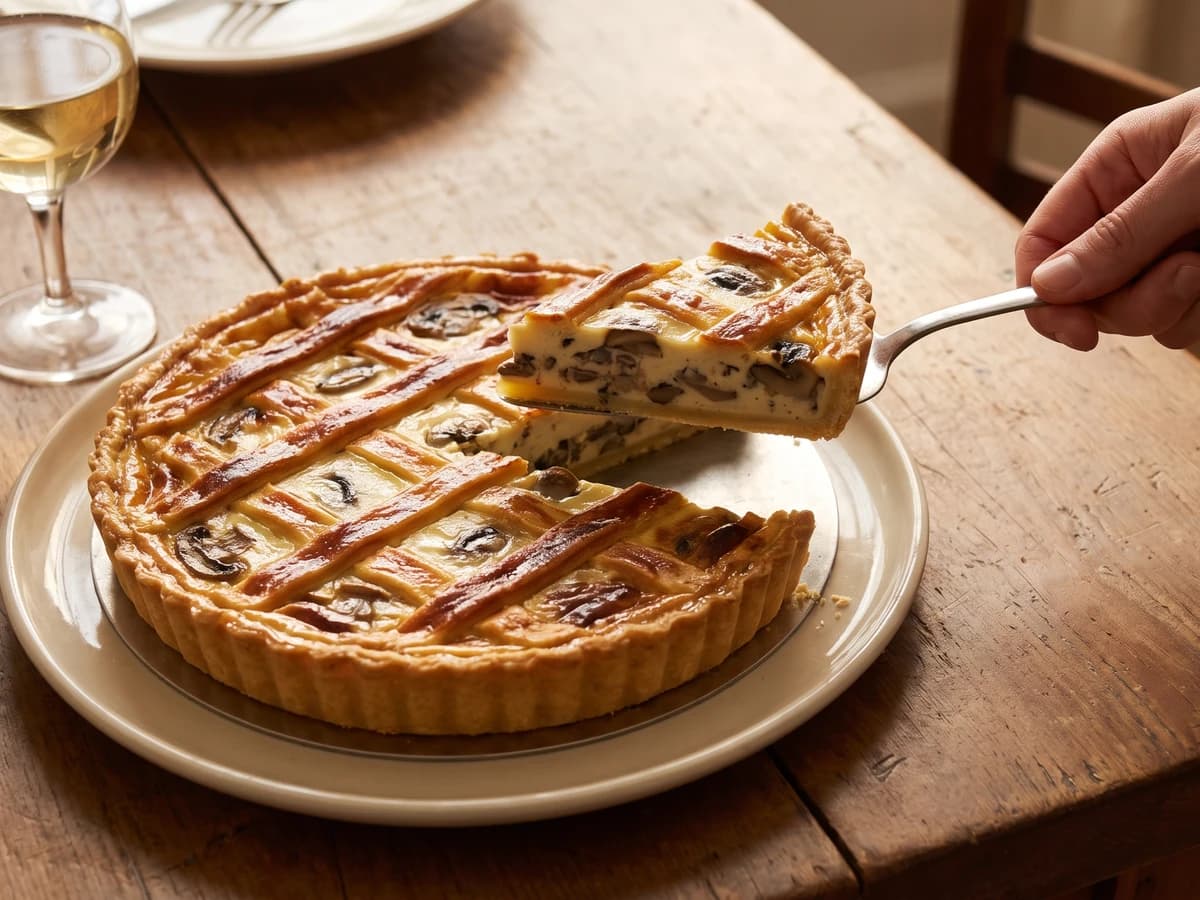
A hot mushroom flan under a butter-gold lattice, with cream reduced close around barely opened caps and a crisp short-paste base protected by one discipline: cool the filling completely.

Chef Juliette
Four little mushroom flans, latticed and gilded, baked hard and fast until butter-gold: a classical garnish scaled to the meat it accompanies and served before its crispness has time to fade.
Chef Juliette
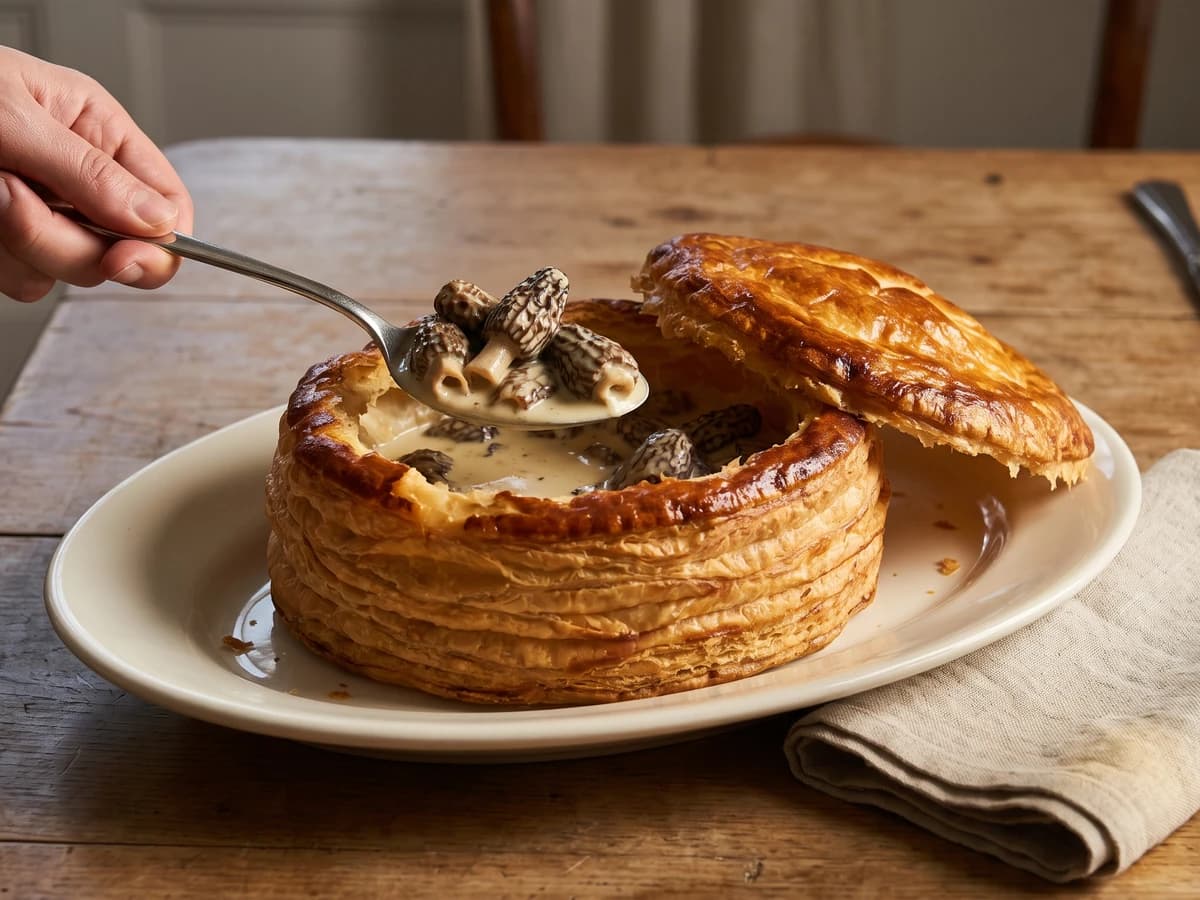
Morels surrender their liquor, then take it back as a glossy cream-and-butter sauce inside burnished puff pastry. The lesson is simple and absolute: reduce with patience, then heat gently and never boil.