
Chef Juliette
Various Almond Preparations
Five almond preparations, one discipline: remove the skins cleanly, dry every kernel through, then cut, toast, or cloak it in pale caramel without letting its fragrant oils escape.
A cooking platform built around craft, culture, and the stories behind what we eat.
Created by Chef Juliette
Based on No. 2350, Candied Fruit, from Le Guide Culinaire (1907) by Auguste Escoffier
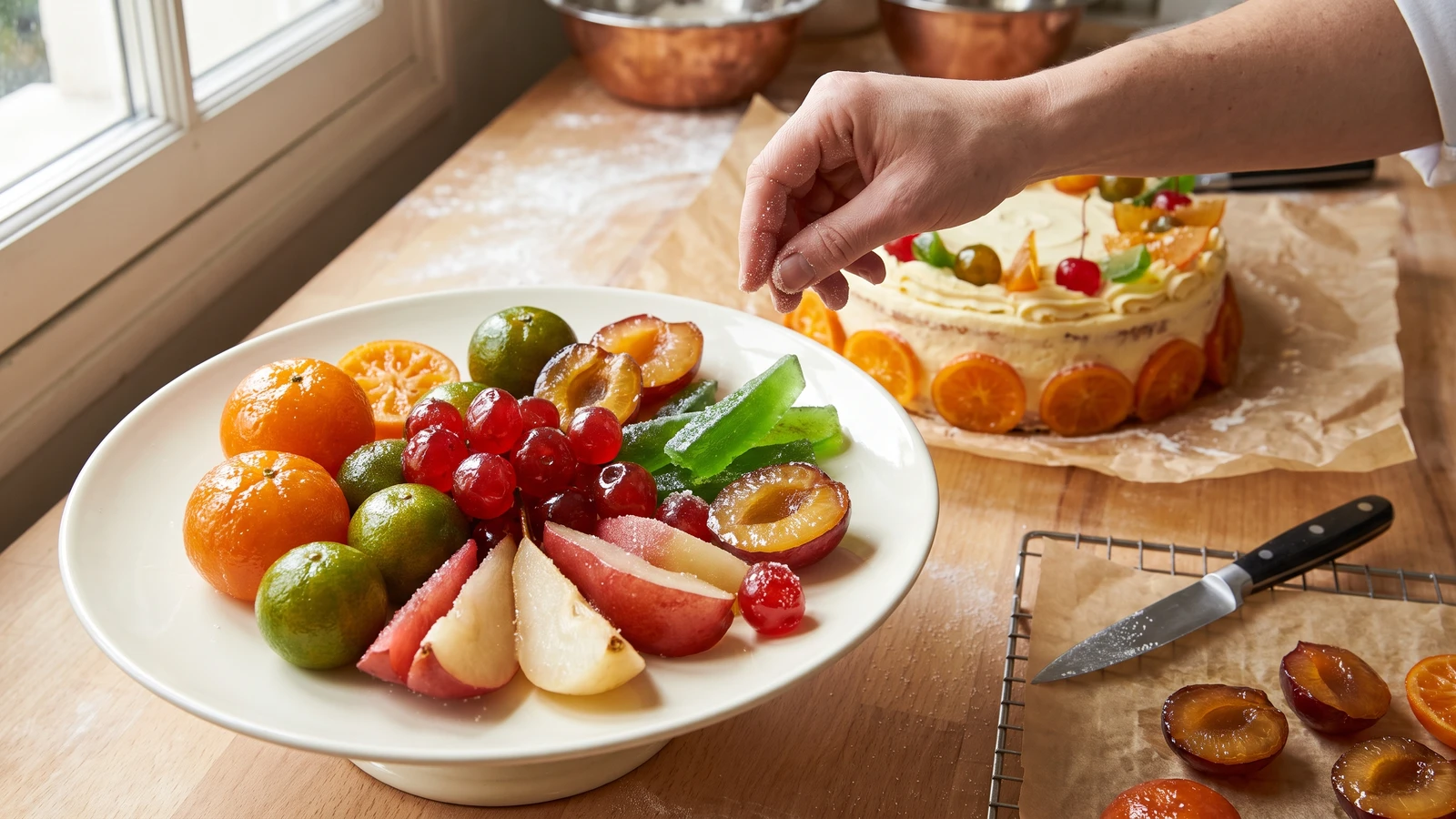
Fruits confits are the French pastry cupboard in jewel form: angelica, golden and green chinois, cherries, plums, and pears, bought ready-made, drained carefully, and cut with intent for cakes worth celebrating.
Fruits confits teach the discipline of knowing when craft means making and when it means choosing. The one true thing to know before touching a pan is that this entry asks for fruit already candied: angelica, golden and green chinois, cherries, plums, and red and white pears. Buy them ready-prepared without apology. The Guide does.
The original entry supplied no syrup formula or quantities because it assumed a pastry kitchen with a standing confectioner's assortment, ready to reach for whenever a cake required it. Repeated syrup baths, glazing, colour sorting, and bulk storage are the supplier's scaffolding, not the dish asked of you. The honest home equivalent is a balanced 340-gram assortment, enough for one celebration cake without leaving six jars open for months. One cook, one stove, one evening, and the stove stays cold.
What remains is real work: choose supple fruit, drain it thoroughly, and cut each variety according to its purpose. The surface must be dry before it meets icing or batter. That single step keeps the colours clear, the decoration steady, and every piece recognizably itself.
Fruits confits have a particular home in Apt, in Provence's Vaucluse, where confectioners preserve fruit through repeated baths of increasingly concentrated sugar syrup. From the confiseur's jars they entered the French pâtisserie cupboard as both ornament and structure for celebration cakes. In this vocabulary, a chinois is a very small candied orange, represented here in golden and green forms, not the conical kitchen strainer that bears the same name.
Quantity
⅓ cup (80 ml / 50 g)
in whole lengths or broad strips
Quantity
2 very small fruits (about 50 g)
Quantity
2 very small fruits (about 50 g)
Quantity
¼ cup (60 ml / 50 g)
Quantity
2 small fruits (about 50 g)
Quantity
½ cup (120 ml / 90 g)
half red and half white
| Ingredient | Quantity |
|---|---|
| ready-prepared candied angelicain whole lengths or broad strips | ⅓ cup (80 ml / 50 g) |
| ready-prepared golden chinois | 2 very small fruits (about 50 g) |
| ready-prepared green chinois | 2 very small fruits (about 50 g) |
| ready-prepared candied cherries | ¼ cup (60 ml / 50 g) |
| ready-prepared candied plums | 2 small fruits (about 50 g) |
| ready-prepared candied pear pieceshalf red and half white | ½ cup (120 ml / 90 g) |
Buy the fruits confits ready-prepared from a good confectioner or baking supplier. Look for plump fruit with distinct shapes, clear colour, and a glossy or lightly sugared surface according to the maker's finish. Avoid leaking packages, collapsed fruit, and pieces hidden beneath a thick, opaque crust of sugar. This selection is the first act of cooking here, even though no pan is involved.
If the fruits are packed in syrup, lift them out without crushing them and arrange each kind separately on a small wire rack set over a tray. Let them drain for 30 minutes, then blot the undersides gently with parchment or a lint-free cloth. Fruit sold with a dry glacé finish can go directly to the rack. Do not rinse it, because water dissolves the protective sugar surface and leaves the fruit wetter and stickier.
Work on parchment with a small, sharp knife, wiping and drying the blade between colours. Cut the angelica into narrow batons, diamonds, or long leaves; leave the chinois whole so their small orange shape remains visible; keep cherries whole or halve them; and slice plums and pears into neat wedges for decoration. If the fruit will become part of a cake rather than its ornament, dice the plums, pears, cherries, and angelica evenly so every slice receives the whole assortment.
Set the larger pear, plum, and chinois pieces first while the cake's icing, marzipan, or glaze is still tacky, then place the cherries and use angelica to make clean lines between them. Dryness is the principle that decides the result: syrupy fruit slides, stains pale icing, and refuses to stay where you put it. If a piece moves or leaves a bead of syrup, lift it away, blot both surfaces, wait until the finish is tackier, and set it again.
For fruit used inside a cake, fold the evenly diced assortment into the batter at the point directed by that cake's own formula. For decoration, stop once the shapes look generous and balanced; candied fruit wants confident placement, not fussy handling. Store unused pieces by kind between parchment in airtight containers, following the maker's storage directions, so red and green syrups do not migrate into the pale pear.
1 serving (about 340g)
Culinary guides, cultural storytelling, and the editorial depth that makes cooking meaningful.
Discover Culinary ExplorerChef Juliette
Five almond preparations, one discipline: remove the skins cleanly, dry every kernel through, then cut, toast, or cloak it in pale caramel without letting its fragrant oils escape.

Chef Juliette
A pastry pantry lesson in one tray: filberts warmed only until their red skins release, rubbed clean, cooled, and chopped into a fragrant mise-en-place for cakes, creams, pralines, and petits fours.

Chef Juliette
The smallest pâtisserie discipline decides whether a cake leaves its mould intact: clarified butter in every corner, followed by the lightest veil of dry flour or fécule.

Chef Juliette
Four whites, one spotless bowl, and a patient change of speed: whisk gently until loosened, then briskly to glossy stiffness, with powdered sugar waiting if the foam begins to granulate.