Culinary Explorer

A cooking platform built around craft, culture, and the stories behind what we eat.
Discover Culinary Explorer
Paillettes au Parmesan

Paillettes au Parmesan

Created by Chef Juliette

Based on No. 2322, Paillettes au Parmesan, from Le Guide Culinaire (1907) by Auguste Escoffier

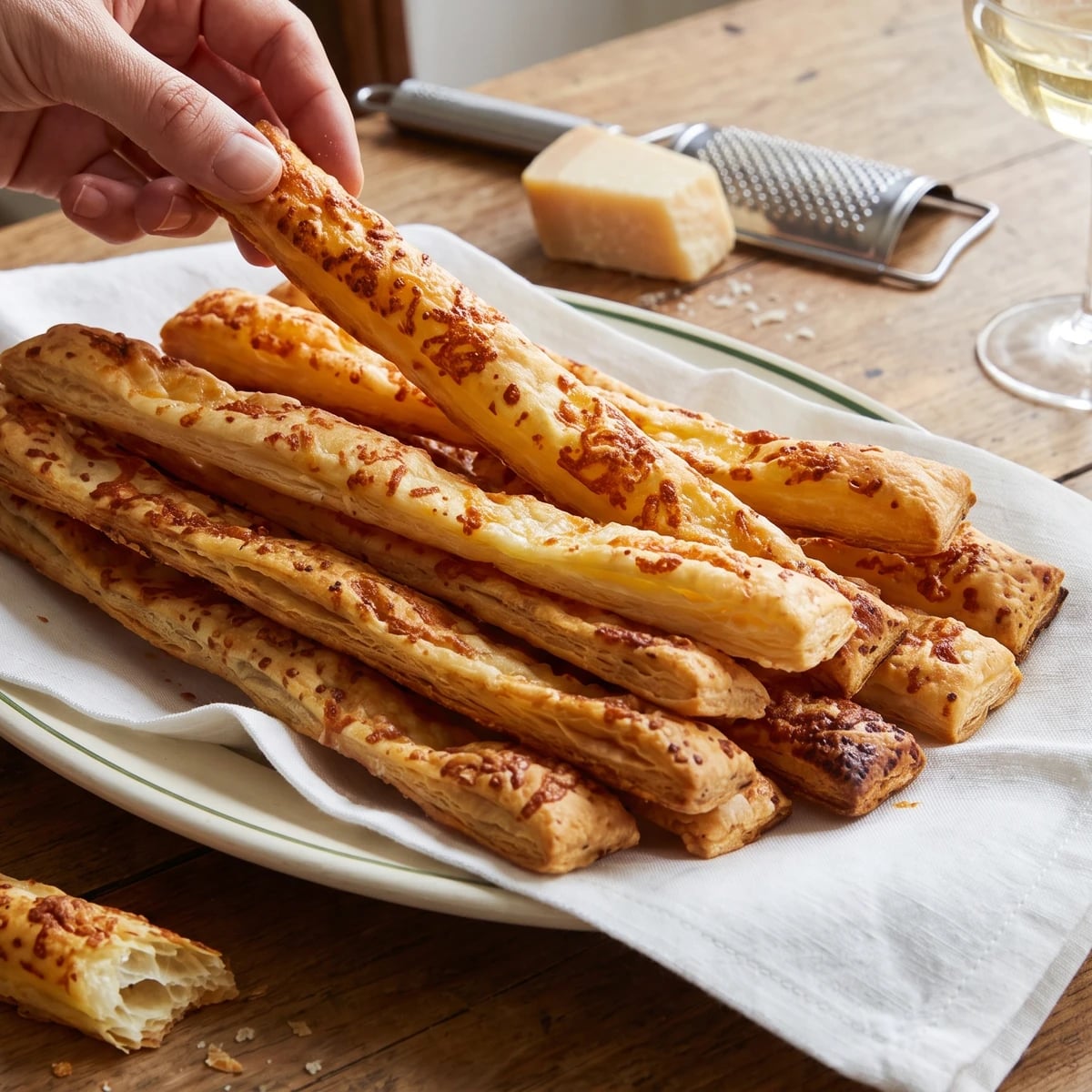
Ten Parmesan-and-cayenne turns, one cold sheet of puff paste, and a fiercely hot oven: these slender, deeply bronzed paillettes prove that lamination is patience made visible, crisp layer by crisp layer.

Pastries & Cookies
French
Dinner Party
Make Ahead
Celebration
55 min
Active Time
18 min cook3 hr 45 min total
YieldAbout 180 paillettes (6 to 8 appetizer servings)

Paillettes au Parmesan (Parmesan puff-pastry straws) teach the stern little law of feuilletage, the laminated puff paste: chilled butter must meet a fully heated oven. Get that right and the narrow ribbons rise into fine, crisp layers, with Parmesan in the seams and cayenne flickering at the finish. Put them into a merely warm oven and the butter runs out before the structure sets.

The original entry assumes a pastry bench, several buttered trays, and an oven kept fiercely hot while many hands roll. At home, its two-thirds pound of butter becomes a quarter batch of 75 grams, enough for a generous dinner party and two home trays. The pastry bench and brigade quantity are scaffolding. A rolling pin, a ruler, and planned rests in the cold replace them honestly. The ten Parmesan-and-cayenne turns are the dish, so they stay.

Work in pairs of turns, chilling whenever the butter begins to soften, then cut the four-inch squares into true one-eighth-inch ribbons. The one step that decides everything is waiting at the end: preheat the oven for a full half hour, and keep the shaped feuilletage cold until it goes in. One cook, one stove, one evening.

Paillettes au Parmesan sit in the Parisian grand-kitchen repertory of pâtisserie salée, then traveled neatly to bourgeois dinner tables as crisp morsels served on a folded napkin with the apéritif or a clear soup. Parmesan was a practical pantry choice rather than a regional claim: its dry, concentrated character could be worked into feuilletage without soaking the layers. The name refers to the pastry's straw-fine cut, while the repeated cheese turns distinguish this formula from simpler puff pastry merely sprinkled with cheese.

The technique, the tradition, and the story behind every dish.

Discover Culinary Explorer

Ingredients

all-purpose flour

Quantity

⅔ cup (160 ml / 83 g)

divided, with 75 g for the dough and the remainder for initial shaping

fine sea salt

Quantity

¼ teaspoon (1.25 ml / 1.5 g)

ice water

Quantity

3 tablespoons (45 ml / 45 g)

added only as needed

cold unsalted butter

Quantity

⅓ cup (80 ml / 75 g)

Parmesan

Quantity

⅔ cup (160 ml / 55 g)

finely grated

cayenne pepper

Quantity

⅛ teaspoon (0.6 ml / 0.25 g)

softened unsalted butter

Quantity

2 teaspoons (10 ml / 9 g)

for the trays

Equipment Needed

  • Rolling pin
  • Ruler and sharp pastry wheel
  • Two light-coloured 13 by 18-inch (33 by 46 cm) metal baking trays
  • Wire cooling rack
  • Baking paper

Instructions

  1. 1

    Make the détrempe

    Mix 75 g of the flour with the salt. Add about 2½ tablespoons of the ice water and toss with a fork until moist clumps form, adding the remaining water a few drops at a time only if dry flour remains. Press the dough together and knead it against the bowl four or five times, just until cohesive. This détrempe, the water dough, should feel firm and cool, not wet. If it sticks, use a pinch of the reserved flour; if it crumbles, wet your fingertips and press again. Shape it into a small square, wrap it, and chill for 30 minutes.

    Flour absorbs water differently from one kitchen to another. Stop as soon as the dough holds together; excess water makes the later turns sticky and tough.
  2. 2

    Lock in butter

    Place the cold butter between two sheets of baking paper and tap it with the rolling pin into a neat 3½-inch (9 cm) square. It must bend without cracking while still holding its shape. Roll the détrempe on the lightly floured bench into a 6-inch (15 cm) square, set the butter diagonally in its centre, and fold the four corners over it like an envelope. Pinch every seam closed. If the butter cracks under the pin, wait three minutes before rolling; if it looks greasy, chill the packet for 15 minutes. Dough and butter must have the same pliability or they won't travel together.

  3. 3

    Give ten tours simples

    Mix the Parmesan and cayenne, then divide the mixture into ten small portions. Scatter half of one portion beneath the pastry packet and half over it. Roll away from you into a rectangle about 4 by 12 inches (10 by 30 cm), sweeping every loose fleck of cheese back onto the surface so the paste absorbs as much as possible. Fold the bottom third upward and the top third down over it. This is one tour simple, a single letter fold. Rotate the packet a quarter turn and repeat. Chill it flat for 15 minutes after turns two, four, six, and eight, then complete turns nine and ten and chill for 45 minutes. Use Parmesan, not loose flour, to dust every turn after the butter is enclosed. If butter begins to smear or break through, stop wherever you are and chill the pastry flat for 15 to 20 minutes. Ça se rattrape. Continue only when the packet is cool and firm again.

    Mark each completed turn on the wrapping paper. Ten turns are easy to miscount once the rolling begins, and this recipe depends on every one.
  4. 4

    Heat the oven

    Set a rack slightly above the oven's centre and heat the oven to 450°F (230°C), or 425°F (220°C) with convection, for at least 30 minutes. Brush two light-coloured metal baking trays very thinly with the softened butter. The fierce, stored heat is not ceremony. It sets the layers before their butter escapes, which is the principle that decides the dish.

  5. 5

    Cut the paillettes

    Work with half the cold pastry while the remainder stays chilled. Roll it evenly to ⅛ inch (3 mm) thick, keeping the edges square without pressing hard enough to crush the lamination. Trim the sheet into 4-inch (10 cm) squares, then use a ruler and sharp pastry wheel to cut each square into ribbons exactly ⅛ inch (3 mm) wide. Lay them flat on the buttered trays with a little room between them. Do not twist them. Repeat with the second half, layering any trimmings rather than kneading them. If the sheet springs back or the ribbons shrink as you cut, chill it flat for 10 minutes and try again. Chill both filled trays for 15 minutes before baking.

  6. 6

    Bake fiercely hot

    Bake one tray at a time for 6 to 9 minutes, leaving the oven closed for the first five. The paillettes are ready when their layers have lifted, the Parmesan is deeply golden, and the narrow centres feel dry rather than pliant. Rotate the tray once only if your oven browns unevenly. A small bead of butter around an edge is harmless. If the pastry floods the tray before it rises, the oven or dough was too warm: keep that batch baking until thoroughly bronzed, drain it on a rack, and give the oven another 10 minutes to recover while the remaining tray stays cold. Ça se rattrape, though the first batch will be flatter.

  7. 7

    Cool and serve

    Lift the paillettes onto a wire rack and leave them for five minutes, until crisp enough to hold without bending. Pile them generously on a clean folded linen napkin, as the original directs, and serve warm or at room temperature. Never cover them while they are still warm or their own moisture will soften the layers. À table!

Chef Tips

  • Grate the Parmesan as finely as possible and trust its weight rather than its volume. Coarse shards tear the pastry; a fine, dry grate disappears between the layers and leaves toasted freckles throughout.
  • Butter temperature matters more than speed. Properly conditioned butter bends under the rolling pin without cracking or shining. If the packet resists, give it a few minutes; if it softens, return it to the cold.
  • A ruler and pastry wheel are useful here, not fussy. The source asks for ribbons only one-eighth inch wide, and that narrow cut gives the paillettes their dry, delicate crispness.
  • Serve them with brut Champagne or a lean white Burgundy. The acidity clears the butter and Parmesan, while the cayenne keeps the next handful interesting.

Advance Preparation

  • The pastry can be completed through all ten turns, wrapped tightly, and chilled for up to 24 hours before its final rolling and cutting.
  • Cut paillettes can be frozen in a single layer until firm, then stored airtight for up to one month. Bake them directly from frozen in the fully heated oven, allowing an extra minute or two.
  • Baked paillettes keep for two days in an airtight tin once completely cool. Restore their crispness for 3 to 4 minutes in a 400°F (200°C) oven, then cool briefly before serving.

Frequently Asked Questions

Nutrition Information

1 serving (about 28g)

Calories
160 calories
Total Fat
12 g
Saturated Fat
7 g
Trans Fat
0 g
Unsaturated Fat
4 g
Cholesterol
31 mg
Sodium
210 mg
Total Carbohydrates
9 g
Dietary Fiber
0 g
Sugars
0 g
Protein
4 g

Note: Chef personas and recipes are created with AI assistance. Cook with care: follow safe food-handling practices, check doneness with a thermometer when needed, and adapt for allergies and your kitchen.

Where cooking meets culture.

Culinary guides, cultural storytelling, and the editorial depth that makes cooking meaningful.

Discover Culinary Explorer

More from Savouries

Browse the full collection