
Chef Juliette
John Dory (St. Pierre)
John Dory has the delicacy of sole and the firmness of turbot. A light flouring, a quick butter sauté, and nut-brown beurre noisette show exactly why looks never mattered.
A cooking platform built around craft, culture, and the stories behind what we eat.
Created by Chef Juliette
Based on No. 2290, Macaroni aux Truffes Blanches, from Le Guide Culinaire (1907) by Auguste Escoffier
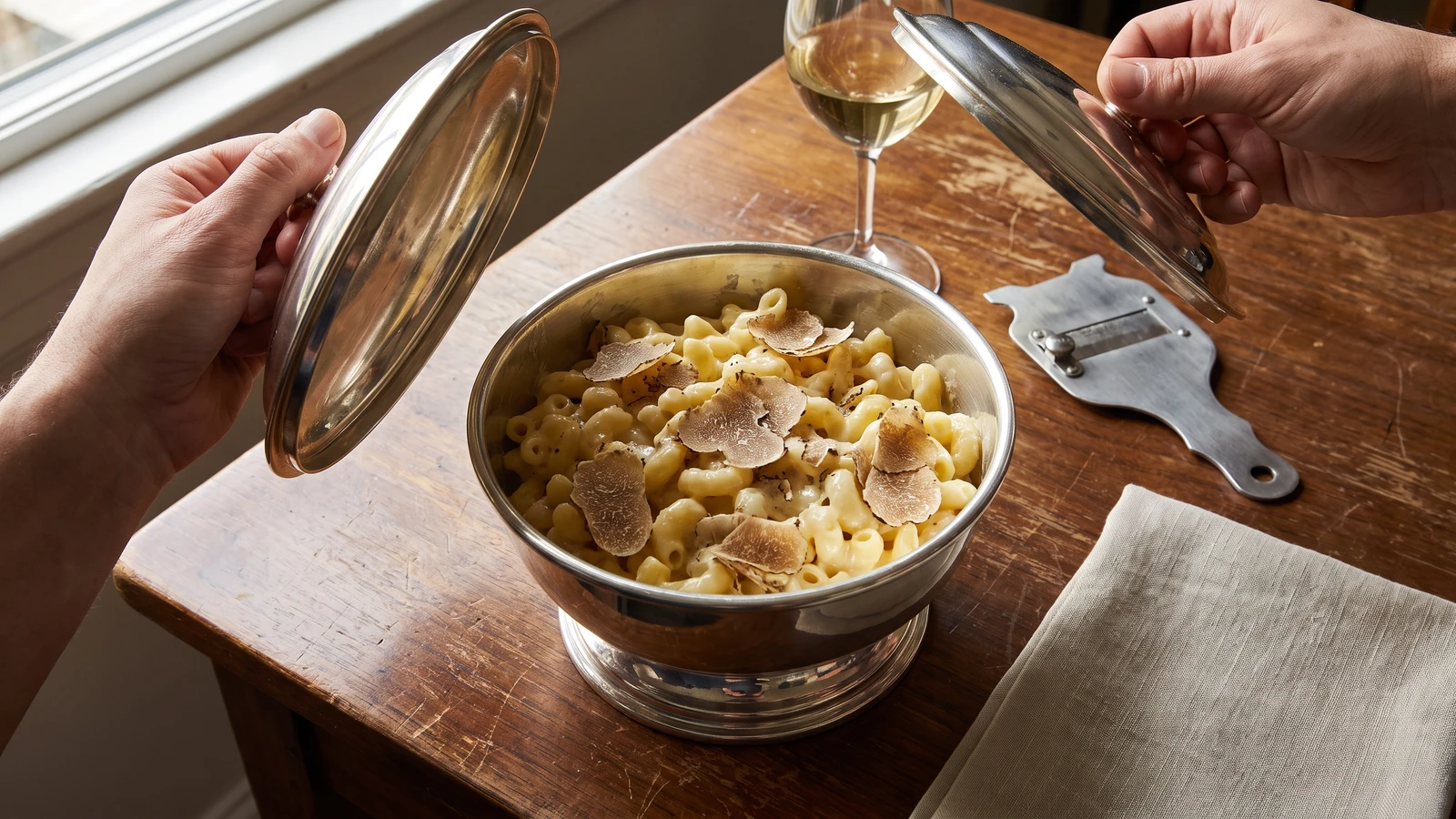
Hot macaroni bound with Gruyère, Parmesan, and butter carries white Piedmont truffle without smothering it. Five covered minutes, with no further cooking, turn residual heat into fragrance for the celebration table.
Macaroni aux Truffes Blanches (macaroni with white truffles) teaches the most expensive form of restraint: white truffle wants heat, fat, and confinement, but no cooking. The hot macaroni carries its perfume, the butter-and-cheese liaison, the binding that coats each piece, holds it, and a close lid keeps it from escaping into the room before it reaches the paste.
The original entry calls for none of the usual grand-kitchen machinery: no saucier at the elbow, no stockpot kept on the fire, no salamander. It assumes instead a full pound of macaroni already finished as Macaroni à l’Italienne (No. 2285), six ounces of white Piedmont truffle, and a timbale waiting for service. For four, the macaroni becomes a 12-ounce batch and the truffle 4½ ounces, preserving the source ratio exactly. A lidded sauté pan and a warmed serving bowl provide the honest home equivalent.
The separate service station is brigade scaffolding and can go. The liaison of the referenced macaroni cannot, and neither can the covered rest. One cook, one stove, one evening. Take the pan completely off the heat before the truffle enters, cover it for five full minutes, and don't peek. That is the step that decides the dish.
Macaroni aux truffes blanches sits in the French classical repertoire at the meeting point of Italian macaroni and the white truffles of Piedmont. Its truffle belongs specifically to Piedmont, especially the Langhe around Alba, not Provence or Burgundy, while the French treatment is strikingly spare: cheese, butter, residual heat, and a covered timbale. The dish corrects a persistent misconception about luxury cooking, because generations of service practice protected this costly aroma by doing less, not more.
Quantity
1 batch Macaroni à l’Italienne (No. 2285), made from ¾ lb (12 oz / 340 g) dry macaroni
Quantity
4½ oz (128 g)
gently brushed clean and shaved paper-thin at the pan
| Ingredient | Quantity |
|---|---|
| hot prepared Macaroni à l’Italienne | 1 batch Macaroni à l’Italienne (No. 2285), made from ¾ lb (12 oz / 340 g) dry macaroni |
| fresh white Piedmont trufflesgently brushed clean and shaved paper-thin at the pan | 4½ oz (128 g) |
Warm a deep serving timbale or bowl with just-boiled water, then empty and dry it thoroughly. Brush the truffles gently, working dirt from their creases without peeling away the aromatic outer surface. If a damp cloth is needed, use it sparingly and dry the truffles at once. Set the slicer to make translucent shavings, thin enough to bend rather than stand stiff.
Prepare the Macaroni à l’Italienne (No. 2285) according to its own entry, keeping its Gruyère, Parmesan, butter, salt, pepper, and nutmeg in the prescribed proportions. Its liaison should coat the macaroni evenly, glossy from butter but without a greasy pool beneath it. Work in a wide sauté pan with a close-fitting lid, and as soon as the macaroni is finished, remove the pan completely from the burner.
Shave all the white Piedmont truffles directly over the hot macaroni, turning each truffle as you work so the shavings remain broad and thin. Lift the macaroni from underneath once or twice to carry the truffle through it, but don't beat or toss away its heat. If the macaroni begins binding into a mass, don't return it to the flame. Ça se rattrape: cover it for 30 seconds, then rock the pan and lift gently with two spoons so the trapped warmth softens the butter without cooking the truffle.
Cover the pan immediately and leave it undisturbed for five full minutes, counting from the moment the lid first closes. No further cooking. Residual heat releases the truffle's aroma, while the lid gives that aroma nowhere to go but into the macaroni. If the lid fits loosely, place a sheet of parchment over the pan before closing it, keeping the paper well away from the burner. Don't lift the lid to inspect matters. The clock is doing the work.
Lift the lid only when the warmed timbale is beside you. Turn the macaroni into it, using two spoons to distribute the truffle shavings without crushing them, and bring it straight to the table. Add no herbs, extra cheese, truffle oil, or pepper at service; the seasoning already belongs to the referenced macaroni, and everything added now stands between you and the white truffle. À table!
1 serving (about 285g)
Culinary guides, cultural storytelling, and the editorial depth that makes cooking meaningful.
Discover Culinary ExplorerChef Juliette
John Dory has the delicacy of sole and the firmness of turbot. A light flouring, a quick butter sauté, and nut-brown beurre noisette show exactly why looks never mattered.

Chef Juliette
Fresh haddock proves its delicacy in the meunière pan: a fine flour crust, moist pearly flakes, and beurre noisette sharpened with lemon and parsley, ready from one skillet in half an hour.

Chef Juliette
Éperlans à l’Anglaise turns small fish into a lesson in disciplined coating: boned smelts under a close, crisp crumb, pan-fried in clarified butter and finished with bright, half-melted maître d’hôtel butter.

Chef Juliette
Tiny smelts, shallot, mushrooms, white wine, gratin sauce, and fine bread raspings meet a fierce oven, where the fish must turn tender in the same breath the buttered crust bronzes.