Culinary Explorer

A cooking platform built around craft, culture, and the stories behind what we eat.
Discover Culinary Explorer
Macaroni à la Napolitaine

Macaroni à la Napolitaine

Created by Chef Juliette

Based on No. 2289, Macaroni à la Napolitaine, from Le Guide Culinaire (1907) by Auguste Escoffier

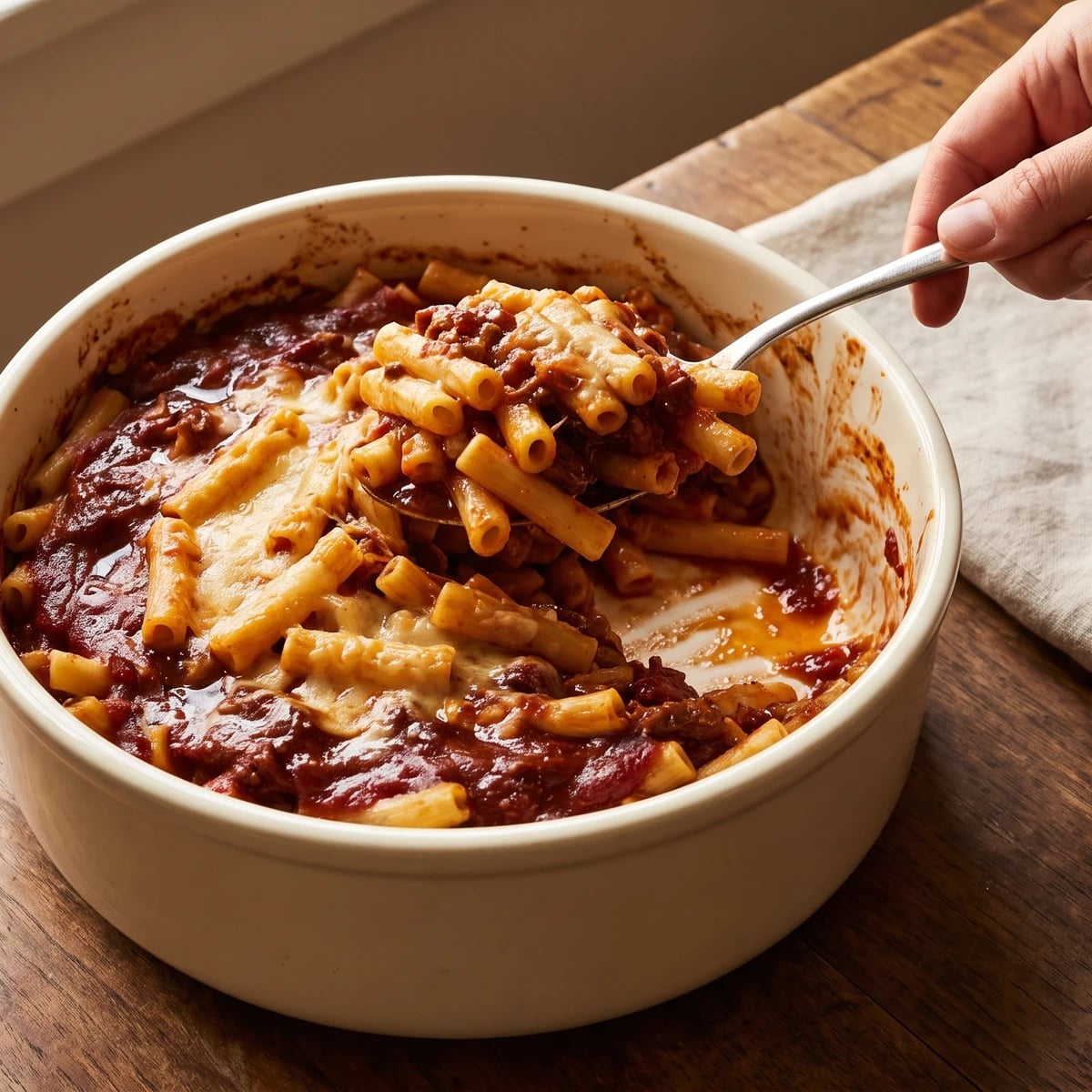
Thick macaroni, butter, cheese, and a red-wine tomato estouffade cooked down until beef and sauce become one: a generous French timbale whose patient reduction is the whole dish.

Main Dishes
French
Comfort Food
Make Ahead
Batch Cooking
30 min
Active Time
4 hr 15 min cook4 hr 45 min total
Yield4 servings

Macaroni à la Napolitaine (French macaroni layered with beef, tomato, wine, and cheese) teaches reduction. The one true thing to know before touching a pan is that the long reduction isn't preparation for the sauce. It is the sauce. Beef, red wine, and tomato must cook until their separate edges disappear into an estouffade (slow-cooked beef braise) dense enough to hold the trail of a spoon.

The source recipe assumed a brigade-sized pot watched for ten to twelve hours, a strong arm for forcing the finished stew through a sieve, and a large timbale ready for service. At home, smaller cubes of beef, a compact cocotte, and a gentle oven achieve the same collapse in several hours; an immersion blender removes the brigade labor, while the final sieve stays because its silken finish belongs to the dish. I have scaled the timbale down to a deep two-quart serving dish for four. The parboiling, buttering, sieving, and order of cheese, estouffade, then macaroni remain untouched. Those steps aren't scaffolding.

When it is right, the purée will be wine-dark and glossy, the buttered macaroni firm beneath the teeth, and the cheese melted quietly between the hot layers without a broiled crust. If the reduction catches, don't surrender the whole pot. Ça se rattrape, and the rescue waits in the method. The step that matters most is the uncovered reduction: stop only when the spoon leaves a clean trail and the beef, wine, and tomato have become one.

Macaroni à la Napolitaine belongs to the French classical table, where Naples named a family of preparations built around macaroni, tomato, and grated cheese rather than a single Neapolitan household recipe. French kitchens carried those ingredients through their own sauce grammar, turning a red-wine beef estouffade into a sieved purée and arranging it in a timbale. This is not macaroni merely dressed with tomato, but a French layered main whose long meat reduction gives the preparation its identity.

The technique, the tradition, and the story behind every dish.

Discover Culinary Explorer

Ingredients

boneless beef chuck

Quantity

1 1/2 pounds (680 g)

cut into 1-inch (2.5 cm) cubes

unsalted butter

Quantity

6 tablespoons (90 ml / 85 g)

divided

yellow onion

Quantity

1 medium (about 1 1/2 cups / 355 ml / 200 g)

finely diced

carrots

Quantity

2 medium (about 1 cup / 240 ml / 130 g)

finely diced

garlic

Quantity

2 cloves

lightly crushed

canned whole peeled tomatoes with their juices

Quantity

2 cups (475 ml / 480 g)

crushed by hand

dry medium-bodied red wine

Quantity

2 cups (475 ml / 475 g)

bouquet garni (bay, parsley, and thyme)

Quantity

1

fine sea salt

Quantity

2 teaspoons (10 ml / 12 g)

divided

freshly ground black pepper

Quantity

1 teaspoon (5 ml / 2 g)

divided

water

Quantity

3 quarts (2.8 L / 2.8 kg)

for boiling the macaroni

fine sea salt

Quantity

1 tablespoon (15 ml / 18 g)

for the pasta water

dried thick tubular macaroni, such as ziti

Quantity

3 1/2 cups (830 ml / 340 g)

Parmesan cheese

Quantity

2 cups (475 ml / 180 g)

finely grated

Equipment Needed

  • 4 to 5-quart (3.8 to 4.7 L) heavy cocotte or Dutch oven
  • Immersion blender or food mill
  • Fine-mesh sieve and sturdy ladle
  • Large pasta pot
  • 2-quart (1.9 L) deep heatproof serving dish

Instructions

  1. 1

    Build the fond

    Heat the oven to 300°F (150°C). Dry the beef thoroughly and season it with half the fine sea salt and pepper. Melt 2 tablespoons (30 ml / 28 g) of the butter in a heavy cocotte over medium-high heat. Brown the beef in three uncrowded batches, turning each cube only after its first face has taken a deep chestnut color. Transfer the browned pieces to a bowl. The brown glaze left on the pot is the fond, the concentrated foundation of the estouffade; pale meat cannot give you one.

    If the butter begins turning black, lower the heat and wipe away the burnt milk solids before continuing. Brown is flavor. Black is bitterness, and no amount of wine will persuade it otherwise.
  2. 2

    Braise the estouffade

    Lower the heat to medium. Add the onion and carrots to the remaining fat and cook for 8 to 10 minutes, stirring until softened and lightly colored. Add the garlic for 1 minute. Pour in the red wine, scrape every bit of fond from the pot floor, and boil for 4 minutes. Return the beef and its juices, then add the tomatoes, bouquet garni, and remaining salt and pepper. Bring the liquid just to a simmer, cover, and place the cocotte in the oven for 2 1/2 to 3 hours. Turn the beef once midway through. It is ready when the pieces collapse under a wooden spoon and the wine has lost its raw edge.

  3. 3

    Reduce it patiently

    Discard the bouquet garni and set the uncovered cocotte over low heat. Press the collapsing beef against the side of the pot as you stir, then let the estouffade reduce for 40 to 60 minutes. Stir more frequently as it thickens. Stop when a spoon drawn across the bottom leaves a clean path for several seconds and the mixture settles back slowly, not like soup. This reduction is the dish, so don't hurry it with fierce heat.

    If the bottom catches, stop stirring at once. Lift the clean upper portion into another saucepan, leaving the scorched layer behind, loosen it with 2 tablespoons (30 ml / 30 g) hot water, and continue over lower heat. Ça se rattrape.
  4. 4

    Pass the purée

    Blend the hot estouffade directly in the cocotte until no pieces of beef remain, then press it through a fine-mesh sieve into a clean saucepan. Work patiently with the back of a ladle and discard only the dry fibers left behind. If the purée is too stiff to pass, loosen it with hot water a tablespoon at a time. If it runs from the spoon once sieved, return it to low heat and reduce again until it holds a soft mound. Keep it covered and hot.

  5. 5

    Parboil the macaroni

    Bring the measured water to a rolling boil and add the pasta-water salt. Cook the macaroni until flexible and cooked at the edges but still distinctly firm at its center, about 2 minutes short of the package time. Drain thoroughly. If using long, thick macaroni, cut it into 2-inch (5 cm) lengths; short ziti has already done that bit of brigade work for you. Return the pasta to the warm pot and toss it with the remaining 4 tablespoons (60 ml / 57 g) butter until every tube gleams. If it clumps, loosen it with one spoonful of its cooking water and toss again.

  6. 6

    Layer the timbale

    Warm a 2-quart (1.9 L) deep heatproof serving dish, the home equivalent of the large timbale. Divide the cheese, hot estouffade purée, and buttered macaroni roughly into thirds. Sprinkle one-third of the cheese across the bottom, cover it with one-third of the purée, and spread one-third of the macaroni over that. Repeat twice in precisely the same order, ending with macaroni. Work briskly and don't stir the layers together; their order belongs to the preparation.

  7. 7

    Serve as it stands

    Cover the timbale for 5 minutes so the cheese softens between the hot layers, but don't bake, brown, or unmold it. Bring the dish directly to the table and serve with a deep spoon, cutting straight down so each helping catches macaroni, cheese, and the wine-dark estouffade. Cooking well is not cooking fancy. À table!

Chef Tips

  • Chuck is the right beef here. Its connective tissue softens into the sauce while lean steak only dries out, and the long cooking would waste the dearer cut. Technique first, always.
  • Use good canned whole tomatoes unless fresh tomatoes are fully ripe and dense with flavor. The classical pantry solved the season neatly; a preserved tomato picked ripe is better than a fresh one that tastes of wet paper.
  • Choose a dry, medium-bodied red with enough acidity for the tomato. Cook with a bottle you would willingly pour at the table, but keep the grand bottles for drinking because the reduction will not send a thank-you note.
  • Parmesan gives the clean, savory finish this French idea of Naples requires. Mozzarella changes the structure, forming ropes between the layers instead of melting quietly into the estouffade.
  • The finished purée should resemble a very thick meat sauce, not a loose tomato sauce. When uncertain, put a spoonful on a cold plate: it should spread slowly and leave no watery rim.

Advance Preparation

  • The estouffade purée can be prepared up to 3 days ahead. Cool it promptly in a shallow container, cover, and refrigerate; reheat it gently with a spoonful of water before layering.
  • For batch cooking, double the estouffade in a 6 to 7-quart (5.7 to 6.6 L) cocotte and freeze the extra purée for up to 2 months. Allow additional uncovered reduction time because a larger volume sheds water more slowly.
  • Cook and butter the macaroni only shortly before assembling. An overnight rest makes the pasta absorb too much sauce, so make the long braise ahead and save the quick work for the evening.
  • Leftovers keep for up to 3 days when covered and chilled. Reheat them covered at gentle heat with a spoonful of water around the edge of the dish.

Frequently Asked Questions

Nutrition Information

1 serving (about 525g)

Calories
1090 calories
Total Fat
55 g
Saturated Fat
28 g
Trans Fat
2 g
Unsaturated Fat
25 g
Cholesterol
205 mg
Sodium
2600 mg
Total Carbohydrates
82 g
Dietary Fiber
6 g
Sugars
11 g
Protein
62 g

Note: Chef personas and recipes are created with AI assistance. Cook with care: follow safe food-handling practices, check doneness with a thermometer when needed, and adapt for allergies and your kitchen.

Where cooking meets culture.

Culinary guides, cultural storytelling, and the editorial depth that makes cooking meaningful.

Discover Culinary Explorer

More from Vegetables and Farinaceous Products - Farinaceous Products

Browse the full collection