
Chef Juliette
John Dory (St. Pierre)
John Dory has the delicacy of sole and the firmness of turbot. A light flouring, a quick butter sauté, and nut-brown beurre noisette show exactly why looks never mattered.
A cooking platform built around craft, culture, and the stories behind what we eat.
Created by Chef Juliette
Based on No. 2284, Macaroni, from Le Guide Culinaire (1907) by Auguste Escoffier
Macaroni teaches the rule behind every paste in its family: salt the water precisely, cook until supple, drain at once, and never cool it before the sauce.
Macaroni (tubular pasta boiled in salted water) teaches the governing method for the entire family the book places beneath this name, from spaghetti-sized strands to broad cannelloni. Know the one true thing before touching the pot: cooled paste turns gluey. Salt the cooking water at one-third ounce per quart, cook the macaroni until supple, and drain it without rinsing so its surface remains ready for the preparation that follows.
The original entry assumed a professional range, capacious pans, and a cook able to send every batch straight onward. It needs no saucier, stockpot, or salamander because this is a governing preparation, not a dressed macaroni dish. At home, an 8-quart pot, a waiting colander, and twelve ounces of pasta for four are the honest equivalents. Only the scale changes; the salt ratio and the no-cooling rule remain exactly as written. One cook, one stove, one evening.
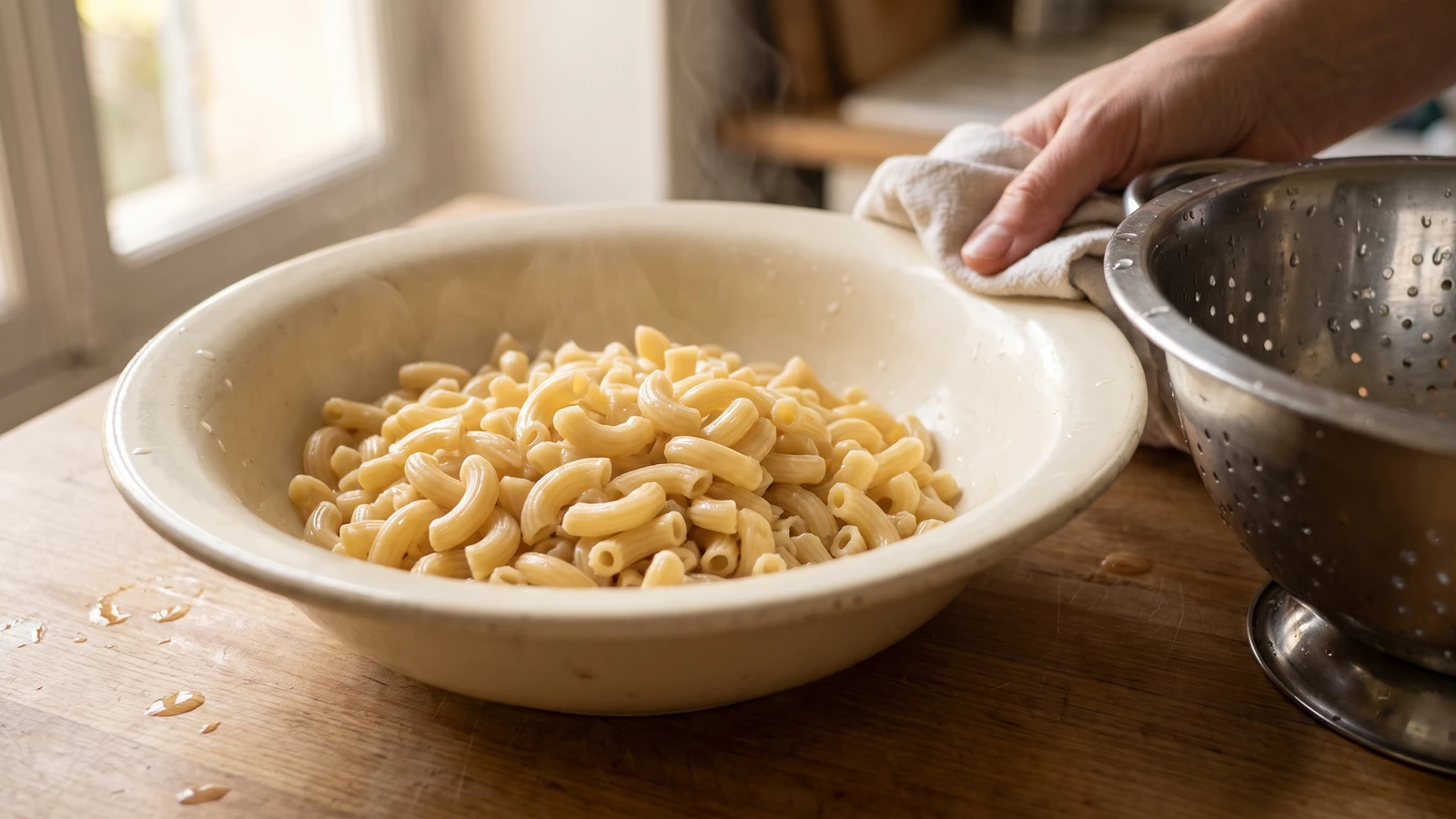
Properly cooked macaroni is tender through the centre yet keeps the clean shape of each tube, with a moist, lightly starchy surface rather than a washed, slippery one. If service is delayed, cold water goes into the saucepan only long enough to stop the boil, then the pot comes off the heat and the pasta is drained promptly. The step that decides everything is the last one: drain at once, and never rinse.
Macaroni entered Parisian classical cooking from Italian paste-making, then settled into cuisine bourgeoise as both a family of dried pastes and the foundation of gratins and garnished preparations. The book’s sweep from spaghetti-sized strands to cannelloni records its classification by diameter and bore, broader than the narrower names used by pasta makers. Its refusal to cool the cooked paste reflects classical service practice: macaroni moved hot into the preparation that completed it, with its surface still able to receive sauce.
Quantity
4 quarts (3.8 L / 3.8 kg)
Quantity
2 tablespoons plus ⅓ teaspoon (32 ml / 38 g)
Quantity
3 cups (710 ml / 340 g)
Quantity
1 cup (240 ml / 240 g)
reserved only if the cooking must be stopped
| Ingredient | Quantity |
|---|---|
| water | 4 quarts (3.8 L / 3.8 kg) |
| fine sea salt | 2 tablespoons plus ⅓ teaspoon (32 ml / 38 g) |
| dried macaroni tubes | 3 cups (710 ml / 340 g) |
| cold water (optional)reserved only if the cooking must be stopped | 1 cup (240 ml / 240 g) |
Put the 4 quarts of water into an 8-quart pot and add the 38 grams of salt. This is the book’s governing proportion, one-third ounce of salt for every quart of water, or almost exactly 10 grams per litre. Crystal sizes vary, so weigh the salt if you can; the ratio seasons the macaroni through without turning the cooking water into brine.
Bring the salted water to a full rolling boil before adding the macaroni. The generous pot is useful, not ceremonial; the tubes need enough room for water to circulate through and around them without the boil collapsing into a starchy simmer.
Add the macaroni in one steady pour and stir immediately, sweeping across the pot floor so no tube sticks before the water returns to the boil. Cook uncovered, stirring several times during the first two minutes and occasionally thereafter. Begin tasting two minutes before the package’s shortest time. The macaroni is à point, at its exact doneness, when it is tender through the centre but still holds its shape; a chalky core needs more time, while split walls and collapsed openings mean it has gone too far.
The moment the macaroni reaches à point, remove the pot from the heat and drain it. Do not run water over it. If the cooking must be stopped before you can drain, pour the reserved cup of cold water directly into the saucepan and take it off the burner immediately. Ça se rattrape: this checks the boil and buys a brief minute, but it is a brake, not a holding method, so drain promptly. Once macaroni has softened too far, no rinse can make it firm again.
Shake the colander only until water stops pouring from it; do not leave the macaroni sitting there to dry or clump. Transfer it immediately to a warm serving bowl or into the finished preparation waiting for it. Add no oil and do not rinse, because the hot, lightly starchy surface is what receives sauce properly. Cooking well is not cooking fancy. À table!
1 serving (about 210g)
Culinary guides, cultural storytelling, and the editorial depth that makes cooking meaningful.
Discover Culinary ExplorerChef Juliette
John Dory has the delicacy of sole and the firmness of turbot. A light flouring, a quick butter sauté, and nut-brown beurre noisette show exactly why looks never mattered.

Chef Juliette
Fresh haddock proves its delicacy in the meunière pan: a fine flour crust, moist pearly flakes, and beurre noisette sharpened with lemon and parsley, ready from one skillet in half an hour.

Chef Juliette
Éperlans à l’Anglaise turns small fish into a lesson in disciplined coating: boned smelts under a close, crisp crumb, pan-fried in clarified butter and finished with bright, half-melted maître d’hôtel butter.

Chef Juliette
Tiny smelts, shallot, mushrooms, white wine, gratin sauce, and fine bread raspings meet a fierce oven, where the fish must turn tender in the same breath the buttered crust bronzes.