
Chef Juliette
Stuffed Onions
Oignons farcis teach the discipline of the shell: mild onions hollowed without weakness, filled with their own flesh and Duxelle, braised in butter and stock, then glazed until the tops bronze.
A cooking platform built around craft, culture, and the stories behind what we eat.
Created by Chef Juliette
Based on No. 2224, Pommes de Terre Gratinées, from Le Guide Culinaire (1907) by Auguste Escoffier
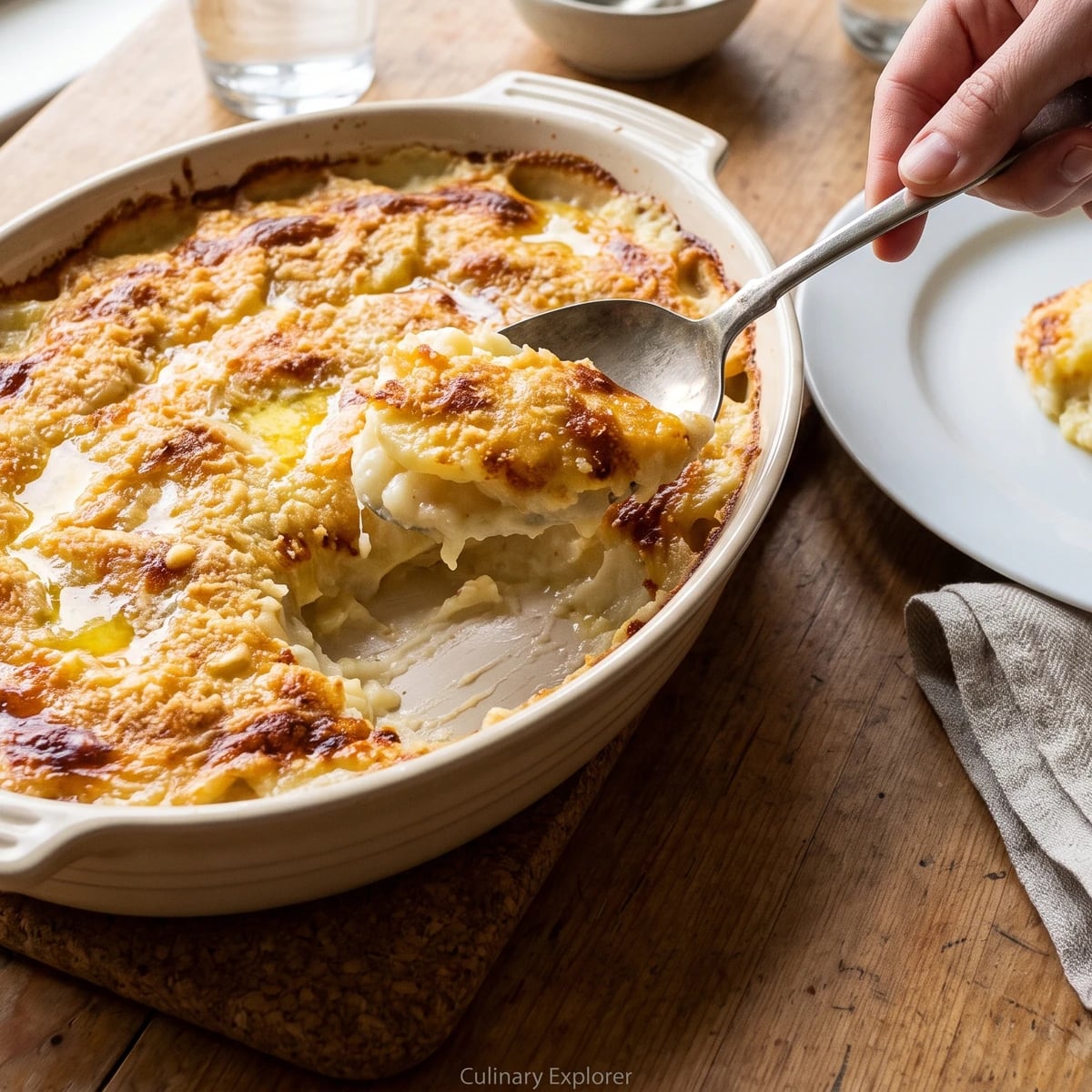
Smooth potato purée beneath a fierce, bronzed crown of cheese and fine bread raspings: pommes de terre gratinées teach that a gratin is quick heat at the finish, not a long bake.
Pommes de terre gratinées (potato purée beneath a browned cheese crust) teach the true purpose of a gratin: the potatoes are cooked before the final fierce heat. The oven doesn't cook them twice. It forms a quick, savoury crown while the purée remains soft beneath it. Begin with hot, thoroughly dried potatoes. That is the one true thing to know before touching the pan.
The source assumed a service kitchen where purée could be passed through a drum sieve, a fierce oven never lost heat, and a salamander waited to colour the surface at the last moment. At home, a potato ricer replaces the sieve, an upper oven rack and a brief broiler finish replace the salamander, and the brigade batch becomes four generous portions. Equipment and quantity changed. The smooth purée, grated cheese mixed with fine bread raspings, melted butter, and immediate service remain, because those steps are the dish. One cook, one stove, one evening.
Choose the buttered gratin dish for weeknight ease, or refill the baked half-shells when you want each person to receive a crisp-edged portion. Both forms depend on the same point: dry the cooked potatoes before adding the milk and butter. Get that right and the purée stays light beneath its bronzed crust.
Pommes de terre gratinées belong to the national classical repertoire shaped in the grand kitchens of Paris and carried readily into cuisine bourgeoise, where freshly made purée received a crisp finish just before service. This is a rapid gratin, a surface operation of cheese, fine bread raspings, butter, and fierce heat, rather than a long casserole. It should not be confused with gratin dauphinois from the Dauphiné, whose sliced raw potatoes cook slowly in milk or cream and traditionally require no cheese.
Quantity
4 large, about 2 pounds (900 g)
scrubbed; peel only for the gratin-dish version
Quantity
¾ cup (180 ml / 185 g)
heated until very hot
Quantity
7 tablespoons (105 ml / 100 g)
divided
Quantity
¾ cup (180 ml / 75 g), for Gratins (No. 268)
Quantity
⅓ cup (80 ml / 30 g)
Quantity
1 teaspoon (5 ml / 6 g), plus more for the boiling water if needed
| Ingredient | Quantity |
|---|---|
| floury baking potatoesscrubbed; peel only for the gratin-dish version | 4 large, about 2 pounds (900 g) |
| whole milkheated until very hot | ¾ cup (180 ml / 185 g) |
| unsalted butterdivided | 7 tablespoons (105 ml / 100 g) |
| finely grated Gruyère | ¾ cup (180 ml / 75 g), for Gratins (No. 268) |
| fine dry bread raspings | ⅓ cup (80 ml / 30 g) |
| fine sea salt | 1 teaspoon (5 ml / 6 g), plus more for the boiling water if needed |
For one family-style gratin, butter a 1½-quart (1.4-litre) gratin dish with 1 tablespoon of the butter and heat the oven to 475°F (245°C), with a rack in the upper third. For filled half-shells, leave the potatoes whole, line a sturdy baking tray with parchment, and heat the oven to 425°F (220°C). The ingredients and finish remain the same; only the vessel changes.
For the gratin-dish version, peel the potatoes, cut them into even 2-inch (5 cm) pieces, and cover them with cold water. Salt the water, bring it to a gentle boil, and simmer for 18 to 22 minutes, until a knife enters without resistance. Drain thoroughly, return the potatoes to the dry pan, and shake them over low heat for 1 to 2 minutes, until the surfaces look chalky and no moisture remains on the pan floor. For the half-shell version, prick the whole potatoes and bake them directly on the tray for 50 to 60 minutes, until they yield completely when pressed with a folded towel. Split them lengthwise at once and scoop out the pulp, leaving a ¼-inch (5 mm) wall so the skins hold their shape. Keep the pulp hot. In either method, drying is the dish's foundation: wet potatoes make loose, heavy purée.
Pass the hot potato through a ricer or food mill into the warm pan. Fold in 4 tablespoons of butter for the gratin-dish version, or 5 tablespoons for the half-shell version, then add the hot milk in three additions. Work gently with a wooden spoon until the purée is smooth, supple, and able to hold a soft mound; season with the measured salt. Never use a blender or food processor, which tears open the starch and turns the potato gluey. If the purée is lumpy, don't beat it harder. Ça se rattrape: pass it through the ricer or a fine sieve once more while it is hot. If it is loose, fold it over low heat for a minute so the excess moisture can escape; if it is stiff, loosen it with another spoonful of hot milk.
Spoon the hot purée into the buttered gratin dish and smooth the surface lightly without packing it down. For the second form, mound the purée generously into the eight half-shells and arrange them snugly on the prepared tray. Make shallow ridges across the surface with a fork or spoon; the raised points catch the heat and give the crust more places to bronze.
Combine the Gruyère for Gratins (No. 268) with the fine bread raspings, then scatter the mixture evenly over the purée, right to the edges. Melt the remaining 2 tablespoons of butter and bedew the whole surface with it in a thin, even thread. Dry raspings burn before the cheese melts; butter gives them the crisp, deep-gold finish the source intends.
Finish by Gratins (No. 268): raise the oven for the half-shell version to 475°F (245°C), then place either form on the upper rack for 6 to 10 minutes, until the cheese has melted and the raspings are deeply bronzed. If your oven lacks the fierce top heat of the old service oven, use the broiler for the final 30 to 90 seconds, provided the dish is broiler-safe, and watch without wandering away. If one patch darkens before the rest, rotate the dish and shield that spot with a small piece of foil. If the top colours while the centre is still cool, lower the oven to 400°F (200°C), cover loosely for 5 minutes, then uncover and restore the crust under fierce heat. Ça se rattrape.
Let the gratin stand for only 2 minutes, just long enough for the bubbling butter at the rim to settle. Bring the family dish straight to the table, or arrange the filled half-shells on a warm platter. The crust softens as it waits, so this is not the moment to finish the salad or carve the roast. Everything else should already be ready. À table!
1 serving (about 270g)
Culinary guides, cultural storytelling, and the editorial depth that makes cooking meaningful.
Discover Culinary Explorer
Chef Juliette
Oignons farcis teach the discipline of the shell: mild onions hollowed without weakness, filled with their own flesh and Duxelle, braised in butter and stock, then glazed until the tops bronze.

Chef Juliette
Oignons frits prove that frying is temperature before timing: thin onion rings, lightly floured and cooked in very hot oil until crisp outside, yielding within, then drained and salted at once.

Chef Juliette
Oignons glacés in two classical finishes, one ivory and clear, one butter-gold, prove that gentle heat and a final turn of the pan can make the smallest onion worthy of a holiday table.

Chef Juliette
Scalded onions, dried well and stewed slowly in butter until sweet but still pale, then bound with Béchamel and passed fine: Soubise proves that deep onion flavor does not require browning.