
Chef Juliette
Stuffed Onions
Oignons farcis teach the discipline of the shell: mild onions hollowed without weakness, filled with their own flesh and Duxelle, braised in butter and stock, then glazed until the tops bronze.
A cooking platform built around craft, culture, and the stories behind what we eat.
Created by Chef Juliette
Based on No. 2216, Pommes de Terre Chatouillard, from Le Guide Culinaire (1907) by Auguste Escoffier
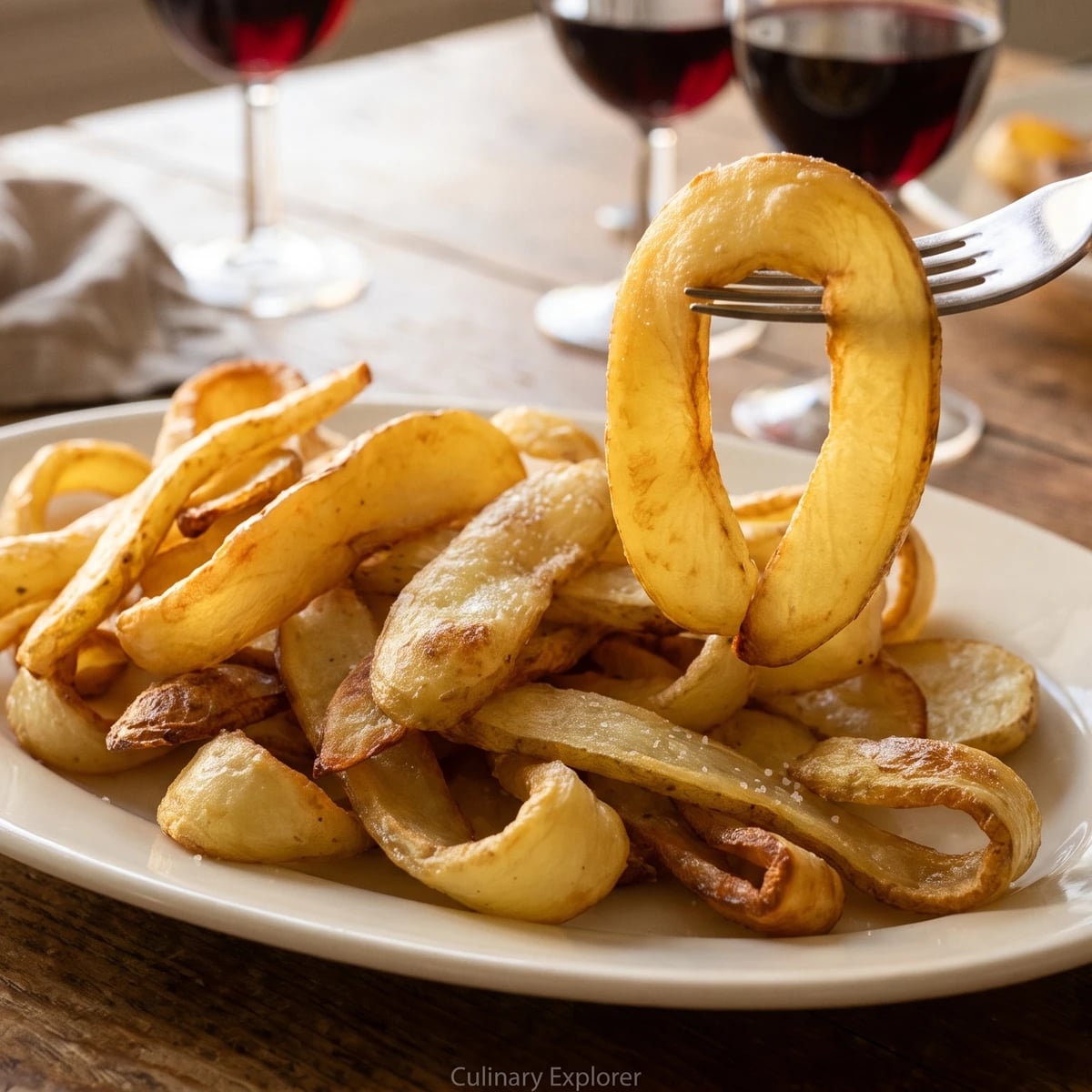
Long potato ribbons, washed, dried, and fried in two baths until they billow into crisp golden curls: a demanding little lesson in thickness, temperature, and the courage to transfer them at once.
Pommes de Terre Chatouillard (long puffed potato ribbons) teaches one clean principle: the first bath cooks and sets the ribbon; the second, hotter bath can only puff what the first has prepared. Begin with uneven or damp potatoes and no flourish of the fryer can repair the geometry. Exact thickness matters more than bravado.
The original recipe assumed a dedicated frying station, two cauldrons of fat, a basket, stretched linen, and a hand free to make the transfer without delay. For one cook, one stove, one evening, two heavy saucepans, two thermometers, a wire spider, and a rack do the same work. Perfectly squaring every potato, maintaining separate baskets, and draining on stretched linen are brigade scaffolding. The long cut, the washing, the thorough drying, and the two distinct oil baths from Pommes de Terre Soufflées (No. 2221) are the dish and must stay.
When they succeed, the ribbons curl into crisp, hollow lengths with pale golden walls and bronzed tips, splendid beside a roast and gone from the platter almost immediately. The step that decides everything is the first bath: wait until each ribbon is flexible, cooked through, and floating, then carry it directly into oil that is fully hot.
Pommes de Terre Chatouillard sits within the Paris-centered classical repertoire, whose professional kitchens named potato garnishes as precisely as sauces and cuts. The preparation takes the two-bath mechanism of pommes soufflées and changes the geometry from neat slices to long ribbons, turning the same controlled expansion into dramatic curls for the formal table. It is not a regional farmhouse specialty; its home is the codified grand-kitchen service, now entirely workable on a home stove.
Quantity
4 large, about 2 lb (900 g)
peeled and lightly trimmed
Quantity
2 qt (1.9 L / 1.9 kg)
for washing the ribbons
Quantity
3 qt (2.8 L / about 2.6 kg) for Pommes de Terre Soufflées (No. 2221)
divided between two pans
Quantity
1 tsp (5 ml / 6 g)
| Ingredient | Quantity |
|---|---|
| straight-sided starchy potatoes, preferably Russetpeeled and lightly trimmed | 4 large, about 2 lb (900 g) |
| cold waterfor washing the ribbons | 2 qt (1.9 L / 1.9 kg) |
| refined peanut or sunflower oildivided between two pans | 3 qt (2.8 L / about 2.6 kg) for Pommes de Terre Soufflées (No. 2221) |
| fine salt | 1 tsp (5 ml / 6 g) |
Trim the potatoes only enough to remove their taper and give the cutter a steady surface; save every sound trimming for a soup or purée. With a vegetable sheet cutter, or a very sharp paring knife while slowly turning the potato, cut continuous ribbons exactly ⅛ inch (3 mm) thick and as long and even as each potato permits. Measure the first few with a ruler. A thin patch cooks hard before the rest is ready, while a thick patch cannot expand evenly.
Lower the ribbons into the cold water without knotting them and move them gently until the loose surface starch washes away and they no longer feel slippery. Lift them out rather than pouring them into a colander, which can split the long lengths. Lay the ribbons between clean towels and press them completely dry, then leave them uncovered for 10 minutes. Water and frying fat are dangerous companions, and surface moisture also prevents the skin from setting evenly.
Divide the oil between two heavy pans, keeping each pan no more than half full and turning the handles inward. Set the first bath at 300°F (150°C) and the second, fresh bath at 375°F (190°C). This is the home setup for the two-stage treatment of Pommes de Terre Soufflées (No. 2221): moderate fat cooks the potato, then intense fresh fat expands the moisture trapped inside its set walls. Keep both thermometers where you can read them before beginning.
Lower one or two ribbons into the moderate oil with the spider, moving them gently so they stay separate. Increase the heat gradually and hold the oil between 300°F and 325°F (150°C and 165°C). Cook for 4 to 6 minutes, until the ribbons are flexible, pale, lightly blistered, and floating at the surface. They must cook without browning. Drain each batch over the first pan for only a few seconds; the hotter bath should already be waiting.
Transfer the pale ribbons immediately into the fresh oil at 375°F (190°C), never crowding the pan. Nudge and turn them with the spider as their walls swell and the lengths curl, 20 to 45 seconds, then let them crisp to a light, even gold. If a pale ribbon stays flat, return it to the first bath for another 30 to 60 seconds, drain it, let the second oil recover fully, and try again. Ça se rattrape. Once a ribbon has browned and hardened, it will not inflate; serve that one as a crisp and lower the first bath slightly for the next batch.
Lift the puffed ribbons onto a wire rack set over a sheet pan and leave space around them so their crisp walls remain dry. Salt moderately while the surface is still faintly glossy, then transfer them to a warm serving dish without covering or compressing the curls. Serve within five minutes. À table!
1 serving (about 145g)
Culinary guides, cultural storytelling, and the editorial depth that makes cooking meaningful.
Discover Culinary Explorer
Chef Juliette
Oignons farcis teach the discipline of the shell: mild onions hollowed without weakness, filled with their own flesh and Duxelle, braised in butter and stock, then glazed until the tops bronze.

Chef Juliette
Oignons frits prove that frying is temperature before timing: thin onion rings, lightly floured and cooked in very hot oil until crisp outside, yielding within, then drained and salted at once.

Chef Juliette
Oignons glacés in two classical finishes, one ivory and clear, one butter-gold, prove that gentle heat and a final turn of the pan can make the smallest onion worthy of a holiday table.

Chef Juliette
Scalded onions, dried well and stewed slowly in butter until sweet but still pale, then bound with Béchamel and passed fine: Soubise proves that deep onion flavor does not require browning.