
Chef Juliette
Stuffed Onions
Oignons farcis teach the discipline of the shell: mild onions hollowed without weakness, filled with their own flesh and Duxelle, braised in butter and stock, then glazed until the tops bronze.
A cooking platform built around craft, culture, and the stories behind what we eat.
Created by Chef Juliette
Based on No. 2221, Pommes de Terre Soufflées, from Le Guide Culinaire (1907) by Auguste Escoffier
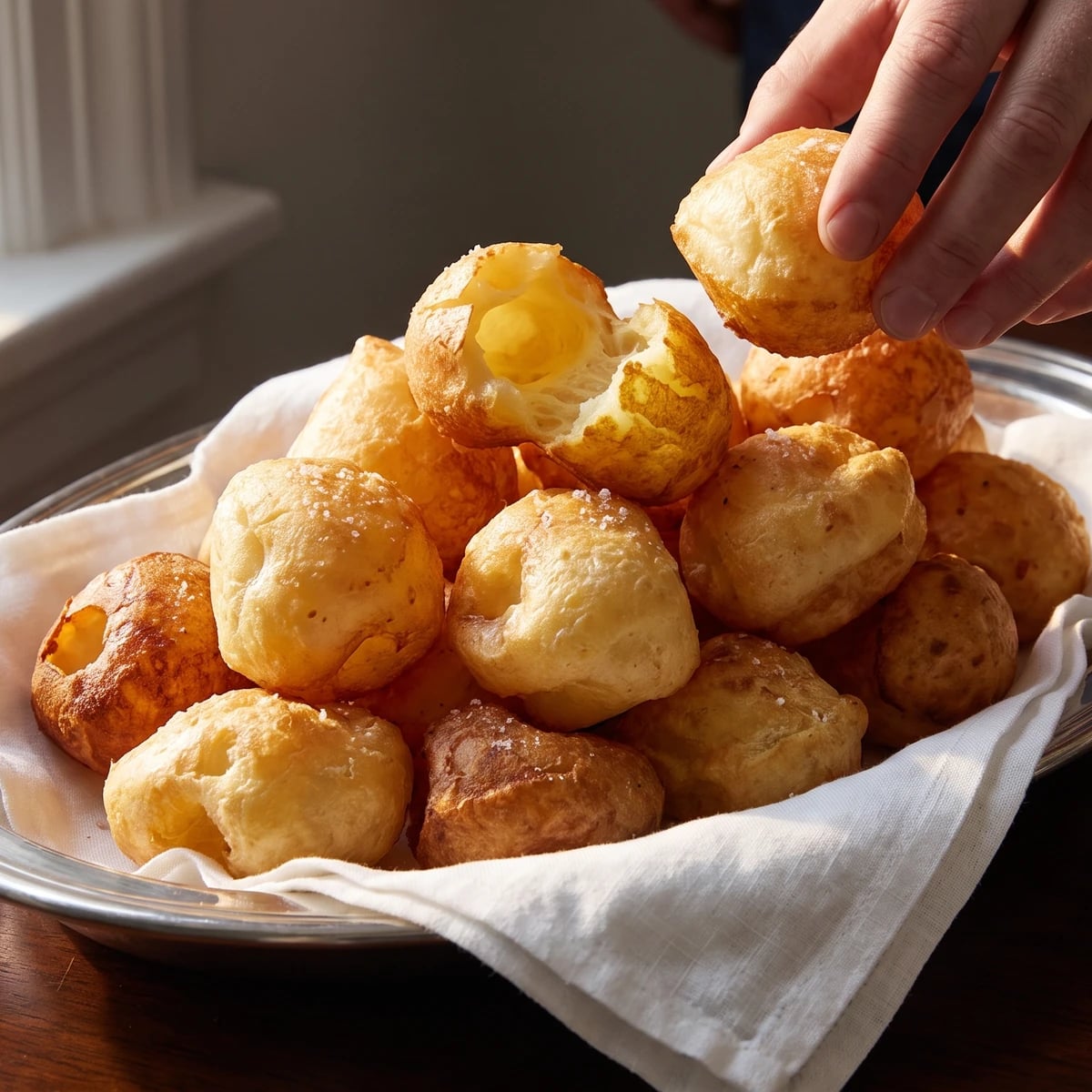
Exact eighth-inch slices, a dry surface, and two baths of fresh fat turn plain potatoes into crisp golden cushions, hollow at the center. The first bath cooks them; the hotter second bath gives them their proud rise.
Pommes de terre soufflées (hollow puffed potatoes) teach the cleanest lesson in frying: the rise comes from controlled contrast, not luck. One true thing before you touch a pan: moisture belongs inside the potato, while the surface must be absolutely dry. The moderate bath cooks each slice into a flexible envelope; the fresh hotter bath expands what is trapped within and lifts the two faces apart.
The source entry assumed a brigade station with two deep vats of fat, a frying basket, stretched linen, and enough hands to fry and serve at once. Your honest equivalent is two small heavy saucepans on adjacent burners, two thermometers, a spider, and a wire rack. Three potatoes feed four people generously. The basket and linen are brigade scaffolding, so they go; the exact cut, separate baths, rising temperature, and immediate transfer are the dish, so they stay. One cook, one stove, one evening.
The first slice is your scout, not a sacrifice. Watch it rise in the moderate bath, then test it in the hotter one before committing the rest; if it lies flat, the method tells you what to correct. Before that first slice meets the fat, dry every one twice. That dry surface is the step that decides the dish.
Pommes de terre soufflées belong to the grand kitchens around Paris, and Saint-Germain-en-Laye is the place most often attached to their birth. The familiar story credits a delayed dining party: potato slices were lifted from their first frying, then returned to hotter fat and unexpectedly swelled, though the neat accident is harder to prove than the technique is to repeat. What endured is the two-bath discipline, carried from formal dining rooms to celebratory home tables.
Quantity
3 large (about 2 lb / 910 g before trimming)
peeled and trimmed into neat oblong blocks
Quantity
8 cups (1.9 L / 1.9 kg)
for washing the slices
Quantity
8 cups (1.9 L / 1.72 kg)
divided evenly between two baths
Quantity
1 teaspoon (5 ml / 6 g), plus a little more if needed
| Ingredient | Quantity |
|---|---|
| large mature Russet potatoespeeled and trimmed into neat oblong blocks | 3 large (about 2 lb / 910 g before trimming) |
| cold waterfor washing the slices | 8 cups (1.9 L / 1.9 kg) |
| fresh high-heat frying fat, such as refined peanut oildivided evenly between two baths | 8 cups (1.9 L / 1.72 kg) |
| fine sea salt | 1 teaspoon (5 ml / 6 g), plus a little more if needed |
Set two heavy 3-quart (2.8 L) saucepans on adjacent burners and divide the frying fat evenly between them. Neither pan should be more than half full. Fit each with a thermometer, heat the first bath to 300°F (150°C), and heat the second to 375°F (190°C). Keep fitted lids nearby and keep every drop of water away from the pans; if fat ever smokes, turn off the heat and let it settle before continuing.
Slice the squared potatoes lengthwise exactly ⅛ inch (3 mm) thick, preferably with a mandoline and its hand guard. Wash the slices in the cold water, swishing them gently until the loose surface starch lifts away. Spread them in one layer between clean lint-free towels and press firmly. Wait two minutes, then move them to a fresh dry section and press again. If moisture beads on a slice while it waits, blot it once more before frying. Wet potato spits, sticks, and refuses to inflate.
Working with 6 to 8 slices at a time, lower the potatoes individually into the 300°F (150°C) fat. Move them continuously but gently with the spider so they neither stick together nor settle against the pan. Increase the heat gradually, allowing the bath to climb toward 325°F (165°C) over 4 to 6 minutes. The slices are ready when they look opaque and supple, develop fine surface blisters, and rise freely to the surface, exactly the signal given by the source entry. They should remain pale straw, not brown. If they are still stiff or sinking, keep cooking them in this bath; sending an undercooked slice onward only gives you a flat crisp. Move each batch directly to the hotter bath before starting another.
Lift the first batch, drain it over the moderate bath for 10 seconds, and immediately lower it into the fresh fat at 375°F (190°C). Nudge the slices apart and bathe their upper surfaces with the hot fat. They should swell within 5 to 15 seconds, separating into hollow cushions. Turn the inflated potatoes and fry for another 30 to 45 seconds, just until evenly crisp and golden. If the first tester stays flat, stop before sacrificing the batch. Return the flat slices to the moderate bath for 30 to 60 seconds, until fully buoyant and lightly blistered, restore the hotter bath to 375°F (190°C), drain, and try again. Ça se rattrape. A slice already brown and rigid won't inflate, so salt it as the cook's crisp and correct the temperature or thickness before continuing.
Lift each puffed batch with the spider and hold it over the pan until the rapid dripping stops. Spread the potatoes in one layer on a wire rack set over an absorbent towel, the home equivalent of stretched linen. Salt moderately while their surface still carries a fine sheen, then transfer them to a warm serving dish without covering or crushing them. Serve the moment the final batch is ready. Pommes soufflées wait for the guests; the guests do not wait for pommes soufflées. À table!
1 serving (about 80g)
Culinary guides, cultural storytelling, and the editorial depth that makes cooking meaningful.
Discover Culinary Explorer
Chef Juliette
Oignons farcis teach the discipline of the shell: mild onions hollowed without weakness, filled with their own flesh and Duxelle, braised in butter and stock, then glazed until the tops bronze.

Chef Juliette
Oignons frits prove that frying is temperature before timing: thin onion rings, lightly floured and cooked in very hot oil until crisp outside, yielding within, then drained and salted at once.

Chef Juliette
Oignons glacés in two classical finishes, one ivory and clear, one butter-gold, prove that gentle heat and a final turn of the pan can make the smallest onion worthy of a holiday table.

Chef Juliette
Scalded onions, dried well and stewed slowly in butter until sweet but still pale, then bound with Béchamel and passed fine: Soubise proves that deep onion flavor does not require browning.