Chef Juliette
Suet Dumpling
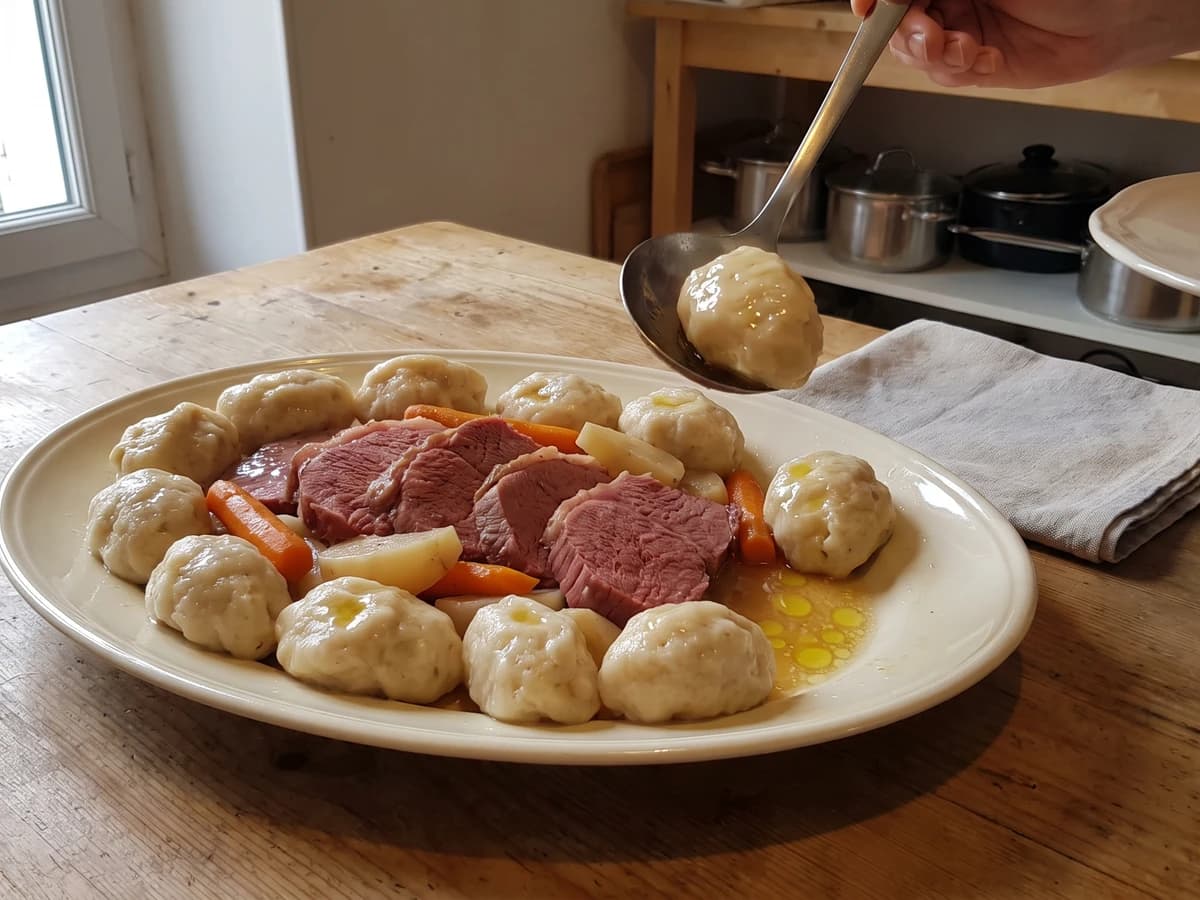
Boulettes au suif, poached beside salt beef, turn equal weights of flour and finely chopped suet into tender, rich dumplings. Keep the beef liquor at a bare tremble and the old garnish works beautifully at home.
A cooking platform built around craft, culture, and the stories behind what we eat.
Created by Chef Juliette
Based on No. 2161, Laitues à la Moelle>, from Le Guide Culinaire (1907) by Auguste Escoffier
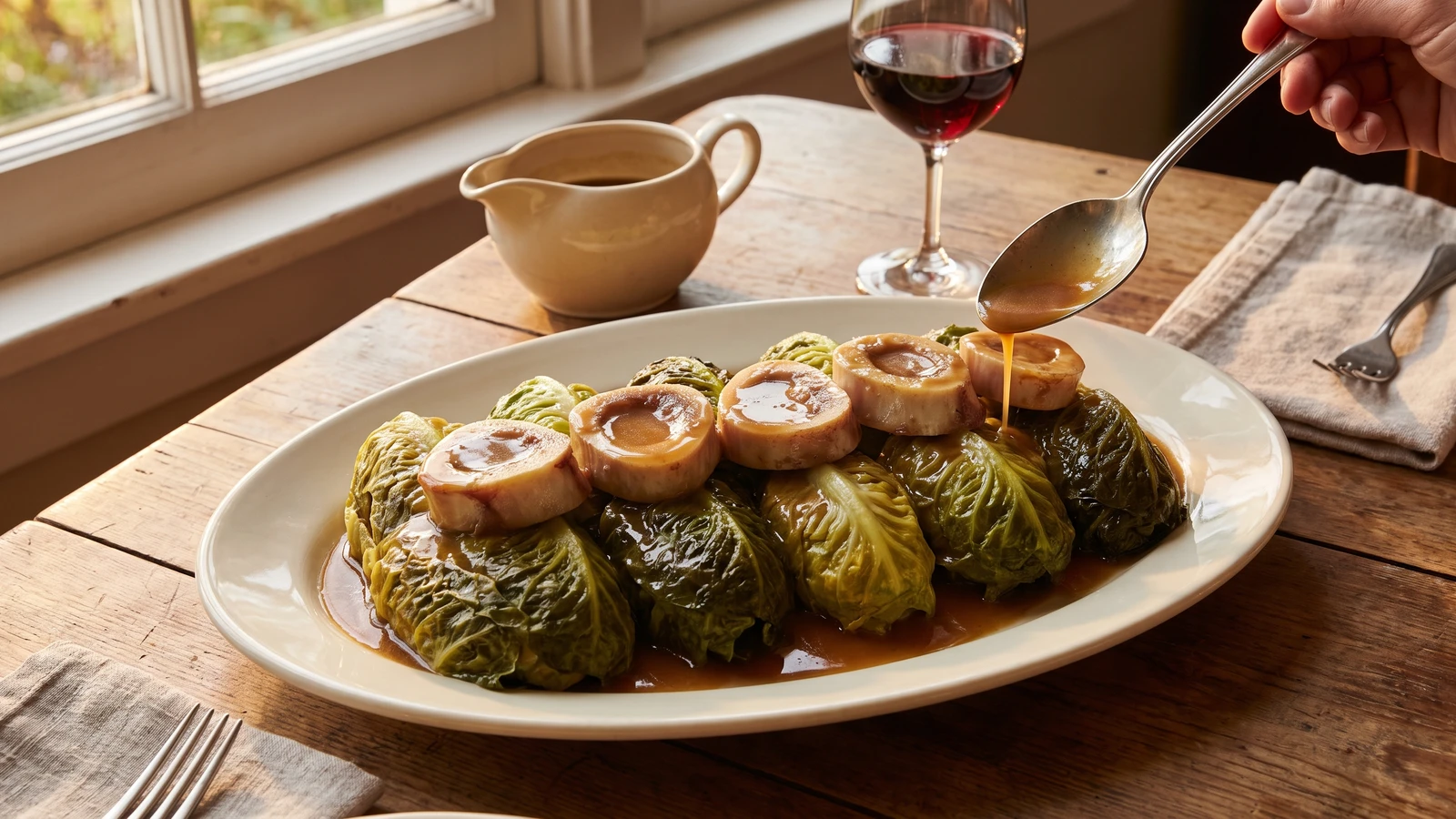
Laitues à la Moelle turns humble lettuce into a proper dinner-party dish: tender braised hearts in a shining gravy, crowned with marrow poached gently enough to remain rich, whole, and trembling.
Laitues à la Moelle (braised lettuces with marrow) teaches a useful classical truth: delicacy is made by controlling water. Press the blanched lettuces dry so they can drink the braising stock, then poach the marrow where the water only quivers. The one true thing to know before touching a pan is that boiling water will render your beautiful marrow crown into nothing.
The classical entry could be brief because it assumed braised lettuces waiting for service, a saucier tending moderately thick gravy, and a stockpot never off the fire. At home, four small butterheads braise over carrot, onion, and salt pork, then their own liquor becomes the gravy. The separate holding pans and service hands were brigade scaffolding, so they go. Blanching, pressing, braising in stock, the gentle marrow poach, and the final butter finish are the dish itself, so they stay. One cook, one stove, one evening.
Done correctly, the lettuces are silken but still shaped, the gravy clings in an amber gloss, and each pale slice of marrow trembles without collapsing. Watch the marrow water more closely than the clock. It must remain below a simmer, because that quiet poach decides the whole dish.
Laitues à la Moelle belongs to the classical and bourgeois tables of Paris, where firm lettuces were commonly blanched, shaped, and braised as vegetables rather than confined to the salad bowl. The grand kitchen formalized that household practice by arranging the lettuces as a turban and crowning them with carefully poached marrow. Marrow was not merely decoration: taken from the butcher's joint bones, it brought richness and substance to a vegetable dish while making use of a prized part that careful kitchens never wasted.
Quantity
4 (about 1 pound 12 ounces / 800 g total)
damaged outer leaves removed
Quantity
3 quarts (2.8 L / 2.8 kg)
Quantity
1 tablespoon (15 ml / 18 g)
Quantity
6 tablespoons (90 ml / 85 g)
divided
Quantity
3 ounces / 85 g
cut into thin batons
Quantity
1 (about 3½ ounces / 100 g)
thinly sliced
Quantity
1 (about 5 ounces / 140 g)
thinly sliced
Quantity
1
2 parsley stems, 1 thyme sprig, and 1 small bay leaf
Quantity
2 cups (480 ml / 500 g)
Quantity
1 tablespoon (15 ml / 8 g)
Quantity
½ teaspoon (2.5 ml / 3 g)
divided
Quantity
¼ teaspoon (1.25 ml / 0.6 g)
Quantity
6 ounces / 170 g
cut into twelve ⅜-inch / 1 cm slices
Quantity
4 cups (960 ml / 960 g)
Quantity
1 teaspoon (5 ml / 6 g)
| Ingredient | Quantity |
|---|---|
| small butterhead lettucesdamaged outer leaves removed | 4 (about 1 pound 12 ounces / 800 g total) |
| water for blanching | 3 quarts (2.8 L / 2.8 kg) |
| fine sea salt for blanching | 1 tablespoon (15 ml / 18 g) |
| unsalted butterdivided | 6 tablespoons (90 ml / 85 g) |
| salt pork or unsmoked baconcut into thin batons | 3 ounces / 85 g |
| medium carrotthinly sliced | 1 (about 3½ ounces / 100 g) |
| medium yellow onionthinly sliced | 1 (about 5 ounces / 140 g) |
| bouquet garni2 parsley stems, 1 thyme sprig, and 1 small bay leaf | 1 |
| unsalted, gelatin-rich beef or veal stock | 2 cups (480 ml / 500 g) |
| all-purpose flour | 1 tablespoon (15 ml / 8 g) |
| fine sea saltdivided | ½ teaspoon (2.5 ml / 3 g) |
| finely ground white pepper | ¼ teaspoon (1.25 ml / 0.6 g) |
| chilled beef marrow in intact logscut into twelve ⅜-inch / 1 cm slices | 6 ounces / 170 g |
| water for poaching the marrow | 4 cups (960 ml / 960 g) |
| fine sea salt for poaching the marrow | 1 teaspoon (5 ml / 6 g) |
Bring the blanching water and its salt to a full boil. Trim each lettuce root without removing the core, halve the heads lengthwise, and rinse carefully between the leaves. Lower the halves into the water and blanch for 3 to 4 minutes, just until the leaves collapse and the cores begin to soften. Cool them at once under very cold running water, drain cut-side down, then press each gently between clean towels until no more water runs out. Wet lettuce cannot absorb the braising stock. Fold any loose leaves around the core, shape each half into a compact oval, and secure it with kitchen twine.
Heat the oven to 325°F / 165°C. Melt 2 tablespoons of the butter in a wide, ovenproof sauté pan over medium-low heat. Add the salt pork, carrot, and onion, then cook for 6 to 8 minutes until the vegetables soften without browning. Set the lettuce packets in one snug layer over this bed, season them with half the remaining salt and half the white pepper, and tuck in the bouquet garni. Pour in the stock, which should reach about two-thirds of the way up the lettuces.
Cover the lettuces directly with a cartouche (a round of baking parchment), then cover the pan. Braise in the oven for 40 to 50 minutes, turning the packets once, until a small knife enters each core without resistance. The liquid should murmur, never boil hard. If the pan begins to dry before the cores are tender, add a few spoonfuls of hot water or stock; the lettuces must braise, not fry against the pan floor.
Lift the lettuces onto a tray and keep them covered. Strain the braising liquid into a saucepan, pressing lightly on the vegetables, then discard the salt pork, vegetables, and bouquet garni. Boil the liquid until reduced to about 1¼ cups / 300 ml. Knead 1 tablespoon of the butter with the flour to make beurre manié (kneaded butter), then whisk it into the simmering liquid in small pieces. Simmer for 5 minutes, until the gravy coats the back of a spoon in an even, moderately thick film. Remove it from the heat and whisk in 2 tablespoons of cold butter. Season with the remaining salt and white pepper. If the gravy looks oily, whisk in 1 teaspoon of cold water away from the heat; if it becomes too thick, loosen it with a spoonful of stock. Ça se rattrape.
Remove the twine from the lettuces and trim away any ragged outer leaves. Melt the final tablespoon of butter in the cleaned sauté pan, return the lettuce packets, and warm them gently under a lid for about 5 minutes. Arrange the eight ovals in an overlapping ring, the classical turban, on a warmed oval platter with their rounded sides facing outward. Spoon a little gravy over them to keep their surfaces glossy.
While the lettuces warm, heat the marrow-poaching water with its salt to 175 to 180°F / 80 to 82°C. The surface may quiver, but it must not bubble. Lower in the chilled marrow slices and poach for 2 to 3 minutes, until their edges are softly translucent and the slices are warmed through but still intact. Lift them with a slotted spoon and drain for a few seconds on a clean towel. If the water begins bubbling, pull the pan off the heat immediately. If a slice starts to fray, lift it onto a cool plate for 20 seconds so it firms enough to transfer.
Set the poached marrow slices in an even crown along the top of the lettuce turban. Spoon the hot buttered gravy over the lettuces and marrow, coating them generously without flooding the platter, and send the remaining gravy to the table in a warmed sauceboat. Serve immediately, while the marrow is tender and the sauce holds its gloss. À table!
1 serving (about 350g)
Culinary guides, cultural storytelling, and the editorial depth that makes cooking meaningful.
Discover Culinary ExplorerChef Juliette
Boulettes au suif, poached beside salt beef, turn equal weights of flour and finely chopped suet into tender, rich dumplings. Keep the beef liquor at a bare tremble and the old garnish works beautifully at home.

Chef Juliette
Bread, flour, frangipane, and rice become four cool, supple panades for binding forcemeats, each changing body and flavor while preserving tenderness. The finest Mousselines need none, and knowing that distinction is the lesson.

Chef Juliette
Panade au pain is bread, milk, salt, heat, and attention: stir until the paste releases cleanly, butter it against a skin, and you have the quiet binder behind tender French farces.

Chef Juliette
Panade de farine teaches the drying stroke behind pâte à choux: flour meets boiling buttered water, then stays over the fire until the paste gathers, smooths, and quits the pan cleanly.