Chef Juliette
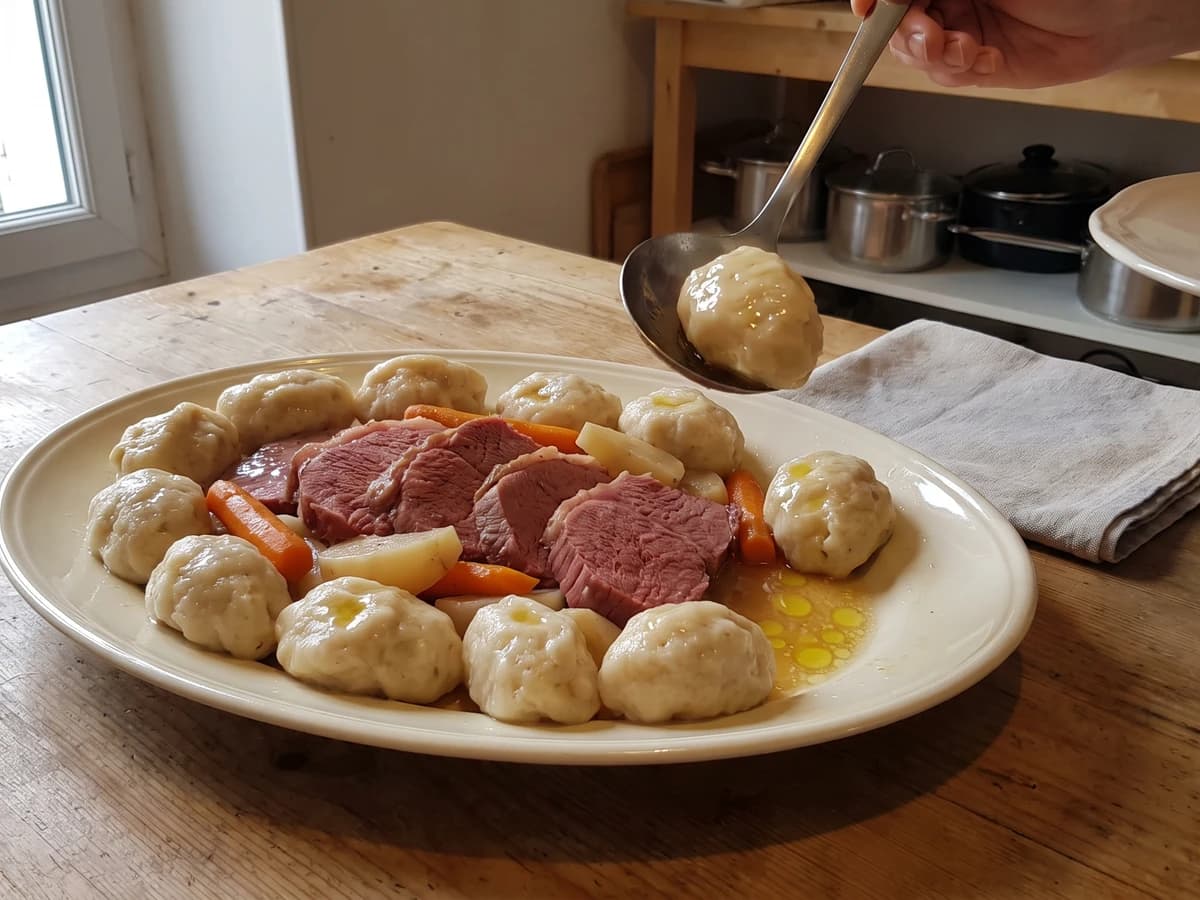
Suet Dumpling
Boulettes au suif, poached beside salt beef, turn equal weights of flour and finely chopped suet into tender, rich dumplings. Keep the beef liquor at a bare tremble and the old garnish works beautifully at home.
A cooking platform built around craft, culture, and the stories behind what we eat.

Created by Chef Juliette
Based on No. 2139, Soufflé aux Épinards, from Le Guide Culinaire (1907) by Auguste Escoffier
Soufflé aux Épinards teaches the essential soufflé rhythm: concentrated spinach, properly soaked anchovies, and egg whites folded with restraint, then baked into a savory dome that waits for no one.
Soufflé aux Épinards (spinach soufflé) teaches the discipline common to every hot soufflé: flavor must be concentrated before the whites go in. Here that discipline begins with the anchovies. They must be cleaned, soaked, tasted, and dried, because a salt-hard fillet does not season spinach, it flattens it.
The source entry assumes that a cook can call for Soufflé de Chicorée (No. 2092) as a known composition, exchange spinach for chicory, layer it in a buttered timbale, and send it into an oven judged by feel. It has no need of a saucier on staff, a stock never off the fire, or a salamander. At home, a straight-sided one-quart dish and a preheated baking sheet provide the honest equivalent. The referenced three-egg proportion already gives four generous side servings, so it stays intact. The separate station is brigade scaffolding and can go; the proportion, gentle folding, anchovy lattices, and immediate baking are the dish and must stay. One cook, one stove, one evening.
When it is right, the soufflé rises green and gold around its crossed anchovy crown, with measured seams of salinity running through the tender spinach. Layer it lightly and have the table ready before it enters the oven, but first taste an anchovy after soaking. That is the one step that protects the whole dish.
Soufflé belongs to the Parisian classical table, where vegetable purées were enriched with yolks, lightened with beaten whites, and baked in timbales as an entremets or a garnish. Soufflé aux Épinards borrows its construction from Soufflé de Chicorée (No. 2092), replacing chicory with spinach and carrying the grand-kitchen practice of arranging anchovy fillets in lattices between the layers. The anchovies are not decoration alone; properly cleaned and soaked, they season the mild spinach in controlled seams rather than one blunt salty mass.
Quantity
1 home batch Soufflé de Chicorée (No. 2092), using 8 packed cups (1.9 L / 225 g) spinach
prepared through the folded-white stage
Quantity
12 fillets (about 45 g)
cleaned
Quantity
2 cups (475 ml / 475 g), plus more if needed
for soaking the anchovies
Quantity
1 tablespoon (15 ml / 14 g)
softened
Quantity
2 tablespoons (30 ml / 12 g)
finely grated
| Ingredient | Quantity |
|---|---|
| Soufflé de Chicorée composition, prepared with spinach replacing chicory and left unbakedprepared through the folded-white stage | 1 home batch Soufflé de Chicorée (No. 2092), using 8 packed cups (1.9 L / 225 g) spinach |
| salt-packed anchovy filletscleaned | 12 fillets (about 45 g) |
| cold waterfor soaking the anchovies | 2 cups (475 ml / 475 g), plus more if needed |
| unsalted buttersoftened | 1 tablespoon (15 ml / 14 g) |
| Parmesanfinely grated | 2 tablespoons (30 ml / 12 g) |
Rinse the anchovy fillets under cold water, inspect them for fine bones, and soak them in the measured cold water for 30 minutes, changing the water twice. Taste a small piece from the thick end. It should be distinctly savory but no longer strike the tongue with raw salt. If it does, ça se rattrape: give the fillets another 10 minutes in fresh water and taste again. Drain and dry them thoroughly between clean towels; wet fillets would weigh down the soufflé and streak water through the spinach.
Heat a conventional oven to 375°F (190°C), with a rack in the lower third and a rimmed baking sheet heating on it. Butter a 1-quart (950 ml) straight-sided soufflé dish with upward strokes, then coat the bottom and sides with the Parmesan, tapping out only the loose excess. This is the home timbale, a deep straight-sided mould, and the hot sheet beneath it gives the base immediate heat.
Prepare the unbaked composition from Soufflé de Chicorée (No. 2092), substituting spinach for chicory and stopping once the beaten whites have been folded in. The cooked spinach must be squeezed until a firm handful releases no water before it enters that composition. If the spinach purée still looks wet, warm it alone in a dry saucepan until it turns matte, then cool it completely before continuing. Once the whites are folded, move directly to the dish; waiting spends the air you have just worked to build.
Spoon one-third of the soufflé composition into the prepared dish and ease it level without pressing. Arrange four anchovy fillets over it, two parallel in one direction and two crossing them, to form a loose lattice. Add another third of the composition, repeat with four more fillets, then cover with the remaining composition and shape it gently into a dome. Lay the final four fillets on top as two crossed rows. Keep every movement broad and light; if you have flattened the surface, lift and loosen only the upper layer with two gentle turns of a spatula, then restore the dome. Do not beat it.
Set the dish on the hot baking sheet and bake for 25 to 30 minutes. Do not open the oven during the first 20 minutes. The soufflé is ready when it has risen above the rim, the spinach dome is set and lightly bronzed, and the centre gives a small, living tremble rather than a liquid wave. If the top colors before the centre sets, lay a loose foil cap over it after the first 20 minutes. If the centre remains fluid, bake for another 3 minutes and check again.
Carry the Soufflé aux Épinards directly to the table and serve it within two minutes, cutting straight down with a broad spoon so each helping receives spinach and both anchovy layers. It will settle as it is served because every hot soufflé does. That is movement, not failure. À table!
1 serving (about 175g)
Culinary guides, cultural storytelling, and the editorial depth that makes cooking meaningful.
Discover Culinary ExplorerChef Juliette
Boulettes au suif, poached beside salt beef, turn equal weights of flour and finely chopped suet into tender, rich dumplings. Keep the beef liquor at a bare tremble and the old garnish works beautifully at home.

Chef Juliette
Bread, flour, frangipane, and rice become four cool, supple panades for binding forcemeats, each changing body and flavor while preserving tenderness. The finest Mousselines need none, and knowing that distinction is the lesson.

Chef Juliette
Panade au pain is bread, milk, salt, heat, and attention: stir until the paste releases cleanly, butter it against a skin, and you have the quiet binder behind tender French farces.

Chef Juliette
Panade de farine teaches the drying stroke behind pâte à choux: flour meets boiling buttered water, then stays over the fire until the paste gathers, smooths, and quits the pan cleanly.