Chef Juliette
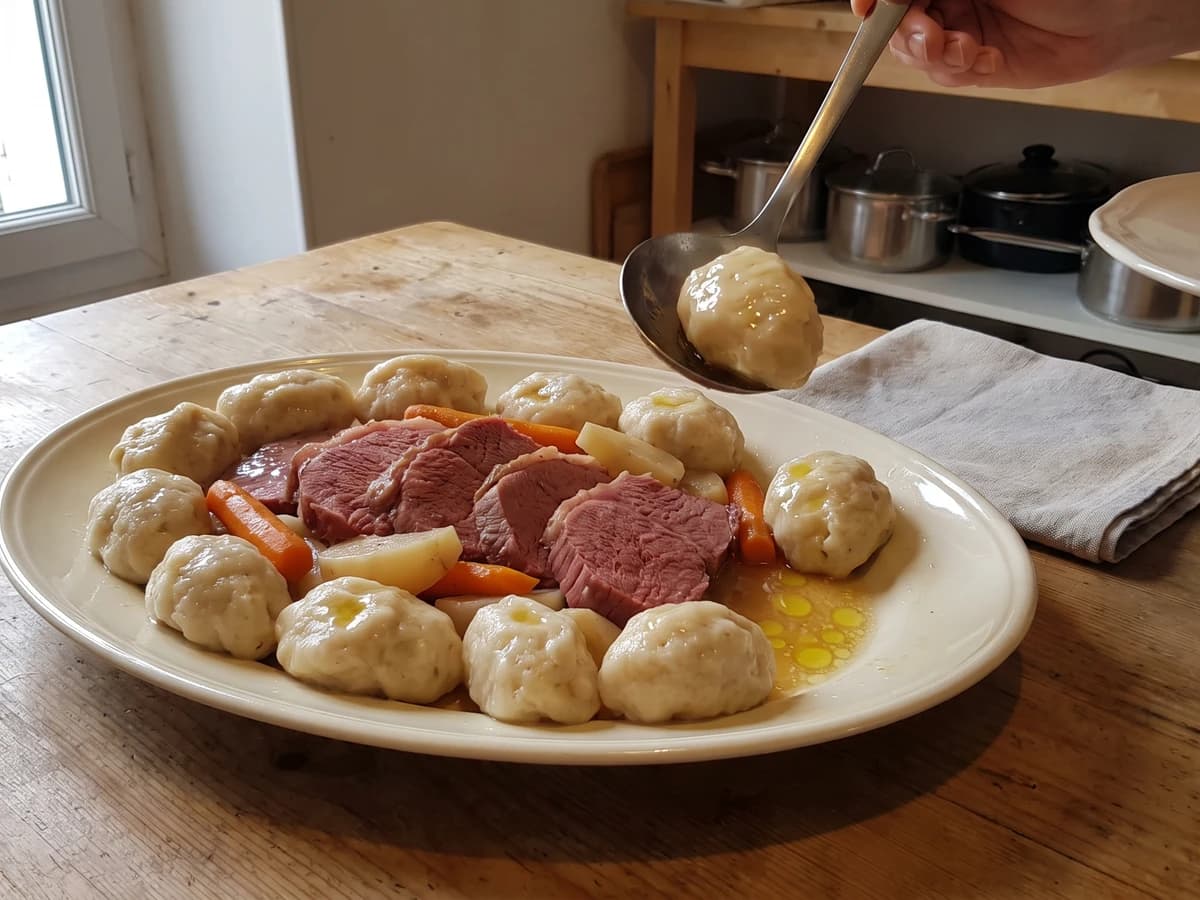
Suet Dumpling
Boulettes au suif, poached beside salt beef, turn equal weights of flour and finely chopped suet into tender, rich dumplings. Keep the beef liquor at a bare tremble and the old garnish works beautifully at home.
A cooking platform built around craft, culture, and the stories behind what we eat.

Created by Chef Juliette
Based on No. 2092, Soufflé de Chicorée, from Le Guide Culinaire (1907) by Auguste Escoffier
Soufflé de Chicorée rises on one discipline: a dry chicory base, enriched with yolks and Parmesan, folded with firm whites, and baked until the crown turns bronze while the center stays tender.
Soufflé de Chicorée (braised chicory soufflé) teaches the first law of every vegetable soufflé: the base must be drier than seems reasonable. Chicory brings bitterness and water in equal measure. Drive off that water before the egg whites enter, and they can lift the purée into a tall, tender crown; leave it wet, and no heroic whisking will save it.
The classical entry assumed a cook already fluent in the ordinary Soufflé, a buttered timbale at hand, and an oven whose hot spots were known by instinct. It asks for no saucier, no stockpot kept alive, and no salamander. The honest home equivalents are a 1-quart straight-sided dish, a fully preheated oven, and a kitchen timer. Its proportions are already right for four side servings, so nothing has been cut. The brigade scaffolding is only the shorthand. The braising, sieving, drying, and folding are the dish, and they remain intact: one cook, one stove, one evening.
When the Soufflé is right, its Parmesan crown stands bronzed above the rim while the center stays pale, tender, and gently bitter. Before you touch the whites, press the chicory through the sieve and dry it in the pan until it holds a furrow. That is the step that matters most.
Soufflé de Chicorée belongs to the French classical vegetable-soufflé family, preparations that traveled between the grand kitchen and the bourgeois dining room as light entrées, side dishes, and garnishes. Chicory places this version in the northern larder of Picardy and French Flanders, where cultivated chicories are prized for their clean bitterness, while Parmesan reflects the national canon's ready use of the Italian cheese as a seasoning. The source's suggestion to bake it in small cases for veal or ham corrects a common misconception: savory soufflés were not only centerpieces, but practical companions to larger dishes.
Quantity
3 medium, about 8 ounces / 225 g after trimming
trimmed and thinly sliced
Quantity
2 tablespoons (30 ml / 28 g)
softened and divided
Quantity
1 tablespoon (15 ml / 15 g)
Quantity
1/4 teaspoon (1.25 ml / 1.5 g)
divided
Quantity
3
separated and at room temperature
Quantity
1/2 cup plus 1 tablespoon (135 ml / 57 g)
Quantity
2 tablespoons (30 ml / 10 g)
| Ingredient | Quantity |
|---|---|
| Belgian endives (chicory)trimmed and thinly sliced | 3 medium, about 8 ounces / 225 g after trimming |
| unsalted buttersoftened and divided | 2 tablespoons (30 ml / 28 g) |
| water | 1 tablespoon (15 ml / 15 g) |
| fine sea saltdivided | 1/4 teaspoon (1.25 ml / 1.5 g) |
| large eggsseparated and at room temperature | 3 |
| finely grated Parmesan | 1/2 cup plus 1 tablespoon (135 ml / 57 g) |
| finely grated Parmesan for the crown | 2 tablespoons (30 ml / 10 g) |
Set a rack in the lower third of the oven and heat it to 400°F (200°C). Use about 1 teaspoon of the softened butter to coat the bottom and upright walls of a 1-quart (1-liter) straight-sided soufflé dish. Butter the rim as carefully as the base, because one dry patch can catch the rising mixture and pull the crown sideways.
Melt the remaining butter in a wide covered skillet over medium-low heat. Add the sliced chicory, the water, and half the salt, then turn everything until the leaves gleam with butter. Cover and braise for 10 to 12 minutes, stirring twice, until the chicory yields beneath a spoon but retains some body. Uncover and cook for another 3 to 5 minutes, stirring, until no liquid remains on the pan floor. The aim is tender chicory, not waterlogged leaves.
While the chicory is warm, rub it firmly through a fine-mesh sieve with a sturdy spoon or flexible spatula, scraping the smooth purée from the underside. Return the purée to the skillet and stir over medium-low heat until it gathers into a thick paste and a spatula drawn across the pan leaves a furrow that stays open for several seconds. If moisture beads around the purée or the furrow closes at once, keep drying it. Ça se rattrape. This is the dish's decisive step, because a wet base cannot carry the whites upward. Transfer the purée to a mixing bowl and cool it until merely lukewarm.
Beat the yolks into the lukewarm chicory one at a time, mixing each in completely before adding the next. Stir in the 1/2 cup plus 1 tablespoon (135 ml / 57 g) Parmesan and the remaining salt. The base should be thick but pliable, holding a soft mound on the spatula. If it becomes loose after the yolks enter, set the bowl over barely warm water and stir until it regains body, taking care not to scramble the eggs.
In a spotless, grease-free bowl, whisk the egg whites until they make stiff, glossy peaks whose tips stand upright. Stop before they turn dry or clumpy, since cottony whites resist folding and leave pale knots in the Soufflé. Stir one-quarter of the whites briskly into the chicory base to loosen it, then fold in the remainder in two additions with broad strokes from the bottom of the bowl. Turn the bowl as you fold and stop as soon as no large white streaks remain. A few fine streaks do less harm than ten unnecessary strokes.
Spoon the mixture into the buttered dish without knocking it against the counter. Level the surface lightly, sprinkle it evenly with the remaining 2 tablespoons (30 ml / 10 g) Parmesan, then run a clean thumb around the inside edge to free a narrow channel between the mixture and the rim. Bake immediately for 20 to 24 minutes without opening the oven during the first 18 minutes. It is ready when the crown stands above the dish, the Parmesan is butter-gold with bronzed ridges, and the center gives a small, resilient tremble rather than a liquid slosh.
Carry the Soufflé straight to the table in its dish and serve it with a broad spoon, reaching through the bronzed crown into the tender center. It will settle as it waits, because every hot Soufflé does. That is not failure, only timing. Never apologize at your own table. À table!
1 serving (about 105g)
Culinary guides, cultural storytelling, and the editorial depth that makes cooking meaningful.
Discover Culinary ExplorerChef Juliette
Boulettes au suif, poached beside salt beef, turn equal weights of flour and finely chopped suet into tender, rich dumplings. Keep the beef liquor at a bare tremble and the old garnish works beautifully at home.

Chef Juliette
Bread, flour, frangipane, and rice become four cool, supple panades for binding forcemeats, each changing body and flavor while preserving tenderness. The finest Mousselines need none, and knowing that distinction is the lesson.

Chef Juliette
Panade au pain is bread, milk, salt, heat, and attention: stir until the paste releases cleanly, butter it against a skin, and you have the quiet binder behind tender French farces.

Chef Juliette
Panade de farine teaches the drying stroke behind pâte à choux: flour meets boiling buttered water, then stays over the fire until the paste gathers, smooths, and quits the pan cleanly.