Chef Juliette
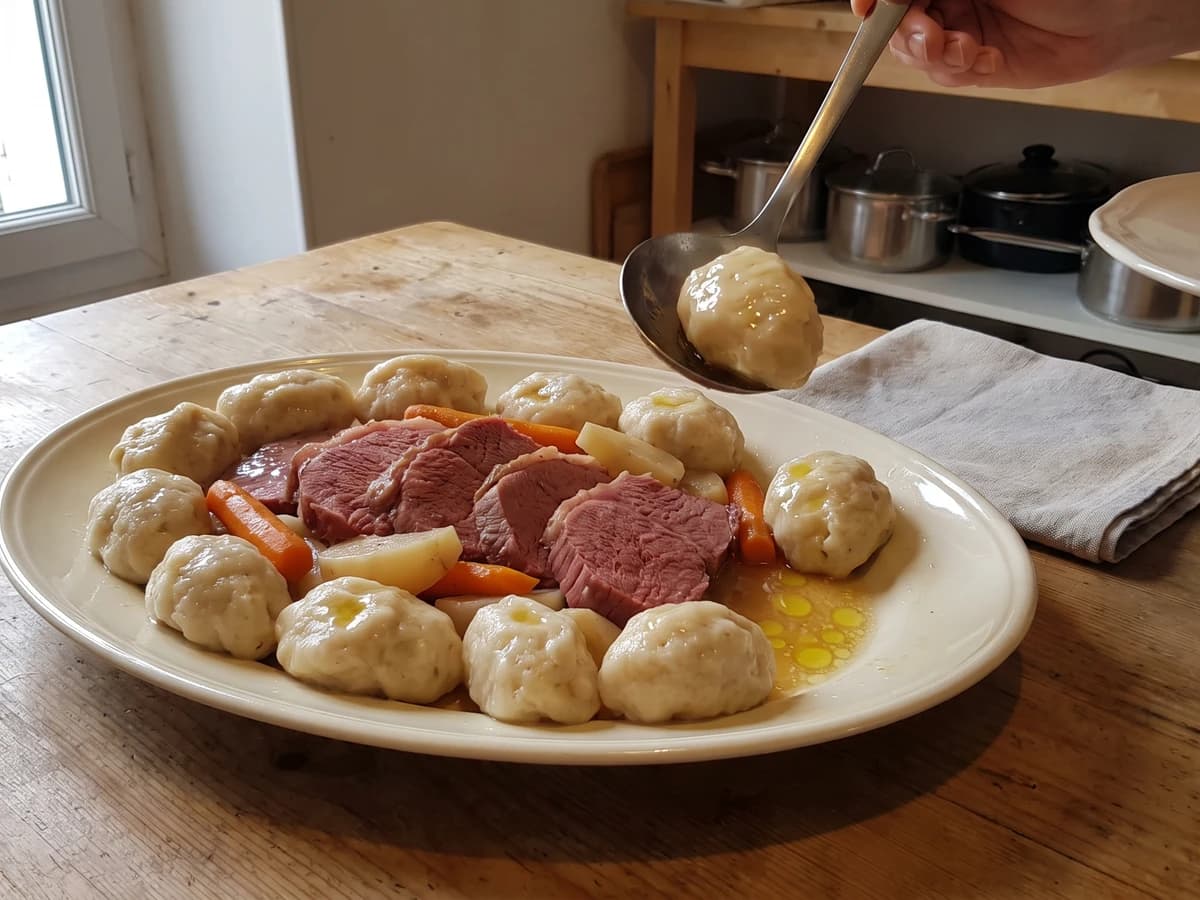
Suet Dumpling
Boulettes au suif, poached beside salt beef, turn equal weights of flour and finely chopped suet into tender, rich dumplings. Keep the beef liquor at a bare tremble and the old garnish works beautifully at home.
A cooking platform built around craft, culture, and the stories behind what we eat.

Created by Chef Juliette
Based on No. 2136, Épinards à la Viroflay, from Le Guide Culinaire (1907) by Auguste Escoffier
Whole spinach leaves become supple wrappers for crisp-edged, croûton-studded subrics, all covered in Mornay and glazed fiercely until the Gruyère blisters and the sauce catches gold at the rim.
Épinards à la Viroflay (spinach leaves wrapped around croûton-studded spinach fritters and glazed with cheese sauce) teaches a beautiful bit of classical grammar: a leaf can be both vegetable and wrapper, but only when it is made supple without being cooked to collapse. The one true thing to know before touching a pan is this: the mature leaves must stay whole, then be drained and dried with care. A wet leaf tears, slips, and waters the sauce.
The original kitchen assumed a vegetable cook shaping the subrics, a saucier holding Mornay, and a salamander waiting to deliver fierce heat from above. At home, make the components in sequence, arrange eight small parcels in a shallow gratin dish, and use a fully heated broiler. The Mornay’s roux and milk are the foundation; a stockpot doesn’t belong here. We cut only the station choreography, the brigade scaffolding. The intact leaves, butter-fried croûtons inside the subrics, complete covering of Mornay, grated cheese, and melted butter are the dish and must stay. One cook, one stove, one evening.
Before the first subric meets a leaf, spread every leaf flat on a clean towel and blot until no moisture shines. That drying is the step that decides whether the parcels hold their shape beneath the sauce.
Viroflay, west of Paris beside Versailles, was celebrated for market gardens that produced unusually broad, tender spinach leaves, including the type known as Monstrueux de Viroflay. The place-name in this dish points first to the vegetable itself, not to a separate sauce, and the generous leaves made natural wrappers for a composed gratin. Classical kitchens carried that market-garden identity to the Parisian table by enclosing spinach subrics and glazing them under Mornay.
Quantity
20 leaves (about 8 oz / 225 g), including 4 spare, prepared according to Blanchings (No. 273)
stems trimmed, cooled, drained, and kept whole
Quantity
½ cup (120 ml / 35 g)
cut into ¼-inch cubes for croûtons
Quantity
1½ tablespoons (22 ml / 21 g)
Quantity
8 small Subrics d’Épinards (No. 2137)
prepared with the cooled croûtons folded into the mixture before frying
Quantity
1½ cups (360 ml / 375 g)
kept warm
Quantity
Up to 2 tablespoons (30 ml / 31 g)
Quantity
1 teaspoon (5 ml / 5 g)
softened
Quantity
½ cup (120 ml / 50 g)
finely grated
Quantity
1½ tablespoons (22 ml / 21 g)
melted
| Ingredient | Quantity |
|---|---|
| large mature spinach leavesstems trimmed, cooled, drained, and kept whole | 20 leaves (about 8 oz / 225 g), including 4 spare, prepared according to Blanchings (No. 273) |
| day-old fine white breadcut into ¼-inch cubes for croûtons | ½ cup (120 ml / 35 g) |
| unsalted butter for the croûtons | 1½ tablespoons (22 ml / 21 g) |
| croûton-studded spinach subricsprepared with the cooled croûtons folded into the mixture before frying | 8 small Subrics d’Épinards (No. 2137) |
| Mornay saucekept warm | 1½ cups (360 ml / 375 g) |
| whole milk (optional) | Up to 2 tablespoons (30 ml / 31 g) |
| unsalted butter for the gratin dishsoftened | 1 teaspoon (5 ml / 5 g) |
| Gruyèrefinely grated | ½ cup (120 ml / 50 g) |
| unsalted butter for finishingmelted | 1½ tablespoons (22 ml / 21 g) |
Set an oven rack about 6 inches from the broiler and butter a shallow 2-quart gratin dish. Warm the Mornay over low heat until it flows slowly from a spoon and coats what it touches. Never let it boil. If it has tightened during reheating, whisk in the milk a teaspoon at a time; if it looks grainy or greasy, take it off the heat first, add a teaspoon of cold milk, and whisk firmly until it comes together.
Lay the spinach leaves prepared according to Blanchings (No. 273) smooth side down on clean kitchen towels. Open every fold and blot both sides until the towels remain nearly dry. Sort out the sixteen broadest leaves for wrapping and keep four as patches. Do not squeeze them together in a bundle; that bruises the leaves and makes small tears larger.
Melt the butter in a small skillet over medium heat. Add the bread cubes and toss until every face is buttered, pale gold, and crisp, about 3 to 5 minutes. These are croûtons, tiny butter-fried bread cubes, and their toasted corners must remain distinct inside the soft subrics. Drain them on paper and cool completely before they meet the egg-bound spinach mixture.
Prepare the Subrics d’Épinards (No. 2137) according to their own formula. Once its seasoned spinach mixture is complete and off the heat, fold in the cooled croûtons, then portion and fry eight small subrics by that method, keeping each about 2½ inches across so it can be wrapped neatly. If the first one spreads instead of holding, stop and chill the remaining mixture for 10 minutes before continuing. Do not bury the problem under flour; the subrics should remain tender.
For each parcel, overlap two spinach leaves top-to-tail, smooth sides against the towel and veined sides facing you. Set one subric in the centre, fold the side lobes over it, then bring up the stem ends and tips to enclose it snugly without pulling. Place the parcel seam-side down in the buttered dish. If a leaf splits, overlap a spare beneath it and continue. Ça se rattrape. Arrange all eight parcels in a single close layer.
Heat the broiler fully. Spoon the warm Mornay over the parcels, covering every leaf so exposed edges do not dry. Scatter the Gruyère evenly over the sauce and trickle the melted butter across the cheese. Broil for 3 to 6 minutes, watching without leaving the stove, until the sauce bubbles around the rim and the cheese blisters deep gold. Rotate the dish if one side colours faster. If the cheese darkens before the sauce bubbles, move the dish down one rack and give it another 2 minutes.
Rest the gratin for 3 minutes, just long enough for the sauce to settle around the parcels. Serve two per guest with a generous spoonful of Mornay and the browned cheese from the edge of the dish. Bring the gratin dish straight to the table. À table!
1 serving (about 250g)
Culinary guides, cultural storytelling, and the editorial depth that makes cooking meaningful.
Discover Culinary ExplorerChef Juliette
Boulettes au suif, poached beside salt beef, turn equal weights of flour and finely chopped suet into tender, rich dumplings. Keep the beef liquor at a bare tremble and the old garnish works beautifully at home.

Chef Juliette
Bread, flour, frangipane, and rice become four cool, supple panades for binding forcemeats, each changing body and flavor while preserving tenderness. The finest Mousselines need none, and knowing that distinction is the lesson.

Chef Juliette
Panade au pain is bread, milk, salt, heat, and attention: stir until the paste releases cleanly, butter it against a skin, and you have the quiet binder behind tender French farces.

Chef Juliette
Panade de farine teaches the drying stroke behind pâte à choux: flour meets boiling buttered water, then stays over the fire until the paste gathers, smooths, and quits the pan cleanly.