Culinary Explorer

A cooking platform built around craft, culture, and the stories behind what we eat.
Discover Culinary Explorer
Épinards au Gratin

Épinards au Gratin

Created by Chef Juliette

Based on No. 2135, Épinards au Gratin, from Le Guide Culinaire (1907) by Auguste Escoffier

Épinards au Gratin teaches the decisive heat of gratiner: butter-rich spinach beneath a copious cheese crust, rushed through a fierce oven so the top bronzes before the tender leaves surrender their moisture.

Side Dishes
French
Comfort Food
Weeknight
Make Ahead
25 min
Active Time
25 min cook50 min total
Yield4 servings

Épinards au Gratin (spinach under a browned cheese crust) teaches what gratiner means: the oven forms the crust, it does not cook the dish beneath it. Know the one true thing before touching a pan: the spinach must enter the gratin hot, concentrated, and free of loose water. If it is wet, the butter and cheese slide into a puddle; if the oven must dry it, the leaves tire before the top colors.

The short formula assumed a vegetable station had already blanched, pressed, and chopped spinach in quantity, plus a fierce service oven with a salamander, the overhead grill, waiting if the crust lagged. This is not a dish that needs a saucier on staff or a stock never off the fire. At home, a wide skillet, a shallow broiler-safe dish, and a fully heated 475°F oven do the work. This version scales the entry to 1½ pounds of spinach while preserving its defining proportion: three ounces of butter and two and one-half ounces of grated cheese for every pound. Brigade batch handling is scaffolding and can go; drying the spinach in butter, working in the cheese, and forming a rapid gratin are the dish, so they stay.

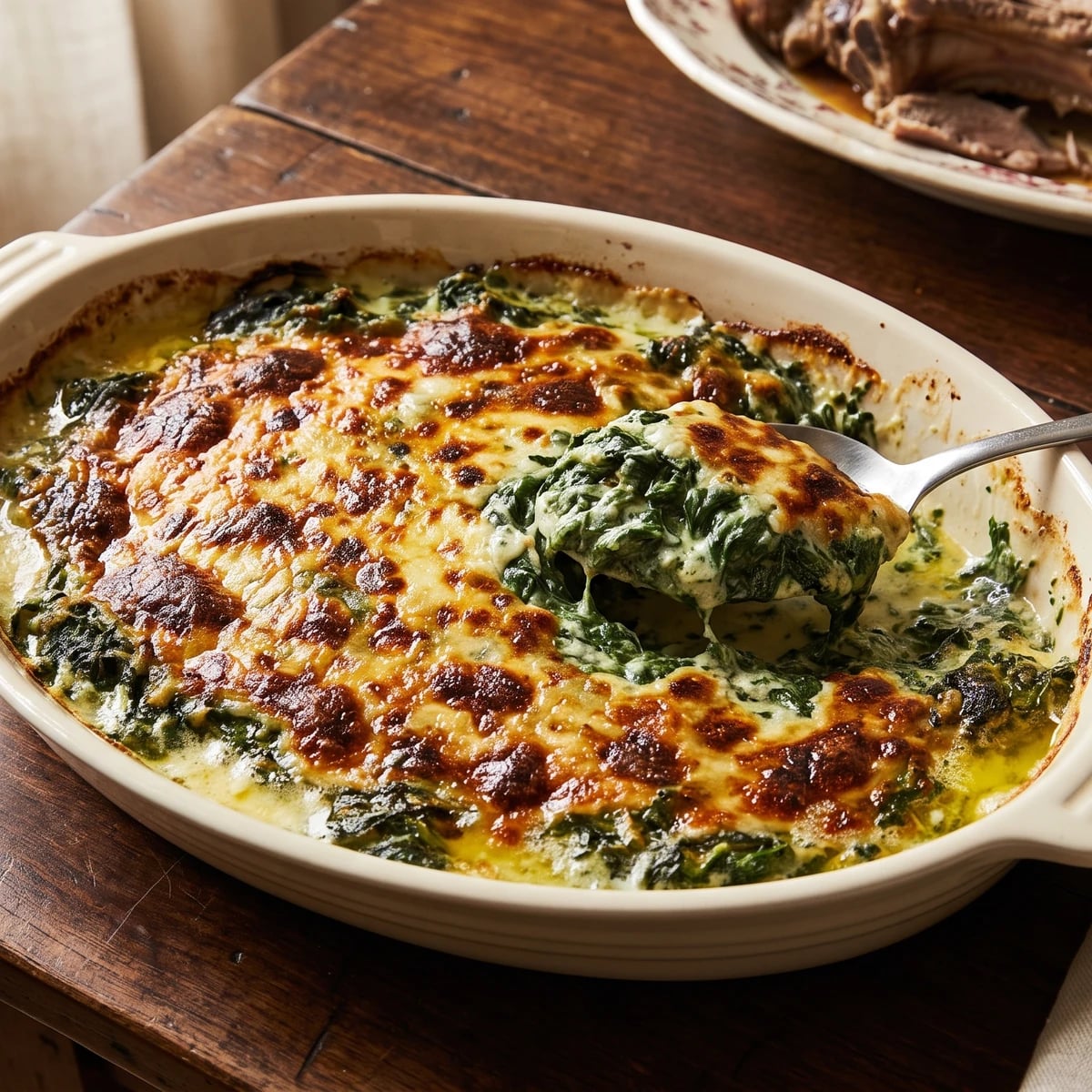
The finished spinach should be deep green and supple beneath a mottled golden crust, with butter shining at the bubbling rim. Your decisive step is the pan-drying: keep working until a spoon drawn through the spinach reveals no loose water underneath.

Épinards au gratin belongs to the Parisian classical repertoire and the cuisine bourgeoise table, where buttered spinach could serve as a vegetable course or accompany a roast. Gratin names the browned crust and the operation that forms it, not a heavy casserole; classical kitchens distinguished several forms, and this entry calls for the rapid gratin produced by fierce heat. Contrary to later versions, this formula contains no béchamel, because spinach dried in butter and worked with grated cheese supplies its own body.

The technique, the tradition, and the story behind every dish.

Discover Culinary Explorer

Ingredients

fresh spinach leaves

Quantity

24 lightly packed cups (5.7 L / 680 g), about 1½ pounds

tough stems removed and leaves washed well

fine sea salt

Quantity

1 tablespoon (15 ml / 18 g)

for the blanching water

unsalted butter

Quantity

9 tablespoons (135 ml / 128 g)

for drying the spinach

fine sea salt

Quantity

¼ teaspoon (1.25 ml / 1.5 g), or as needed

Gruyère

Quantity

1 firmly packed cup (240 ml / 106 g)

finely grated, for working into the spinach

unsalted butter

Quantity

1 tablespoon (15 ml / 14 g)

softened, for the gratin dish

Gruyère

Quantity

¾ firmly packed cup (180 ml / 80 g)

finely grated, for the crust

unsalted butter

Quantity

2 tablespoons (30 ml / 28 g)

melted, for finishing

Gratins

Quantity

1 Rapid Gratin application (No. 268)

the referenced finishing operation

Equipment Needed

  • 6-quart pot
  • Large colander
  • Clean lint-free kitchen towel
  • 12-inch wide skillet
  • Wooden spoon
  • Shallow 1½-quart broiler-safe gratin dish
  • Fine or medium cheese grater

Instructions

  1. 1

    Prepare the spinach

    Set a rack in the upper third of the oven and heat it to 475°F (245°C). Bring a large pot of water to a rolling boil and add the tablespoon of salt. Blanch the spinach in two or three batches, pressing the leaves beneath the water, until they collapse and turn vivid green, about 45 seconds per batch. Lift each batch into cold water, drain it well, then twist it firmly in a clean kitchen towel until no more water runs out. Chop the pressed spinach medium-fine. Squeeze first, chop second; chopping wet leaves only gives the water more places to hide.

    This blanching and pressing is the service preparation the brief source entry takes for granted. It may be done ahead, but the spinach must be squeezed with conviction before it meets the butter.
  2. 2

    Dry it in butter

    Melt the 9 tablespoons of butter in a wide skillet over medium heat. When it foams, add the chopped spinach and separate it with a wooden spoon. Raise the heat to medium-high and work the spinach continuously for 8 to 12 minutes, turning and pressing it across the broad surface of the pan. It is ready when a spoon drawn through the middle leaves a clean track with no watery liquid, and the sound changes from a wet hiss to the gentle sizzle of butter. If water pools, do not add flour or cream. Raise the heat slightly and keep folding. Ça se rattrape. Season with the remaining salt only after the water is gone.

  3. 3

    Work in the cheese

    Lower the heat and add the 1 cup of Gruyère in three additions, folding each through before adding the next. Work just until the cheese melts into the spinach and the mixture gathers softly around the spoon, about 2 minutes. Do not cook it into a stiff paste. Taste for salt, remembering that the cheese on top will bring more seasoning.

  4. 4

    Build the gratin

    Coat a shallow 1½-quart broiler-safe gratin dish with the softened butter. Spread the hot spinach evenly in the dish without packing it hard, keeping the layer about 1 inch deep. Use the Rapid Gratin operation from Gratins (No. 268): cover the surface copiously with the remaining Gruyère, taking it right to the edges, then trickle the melted butter over the cheese. The spinach is already cooked; this arrangement exists only to form a swift, generous crust.

  5. 5

    Gratiner with fierce heat

    Put the dish immediately into the fully heated oven and bake for 6 to 9 minutes, until the cheese has melted into a mottled deep-gold crust and butter bubbles visibly around the rim. If the edges are bubbling before the center colors, move the dish beneath the broiler for 30 to 60 seconds and watch without looking away. This is the home salamander, and it works quickly. Rest the gratin for 2 minutes, just long enough for the butter to settle, then bring the whole dish to the table. À table!

Chef Tips

  • Choose mature bunch spinach when it looks good. Its flavor and structure stand up to the butter better than very tender baby leaves, though baby spinach will still work if you squeeze it thoroughly.
  • Grate the Gruyère yourself. Pre-grated cheese is often coated to prevent clumping, which also prevents the smooth, close crust this gratin needs.
  • The source proportion is deliberate: for each pound of spinach, three ounces of butter dry and enrich it, then two and one-half ounces of cheese are worked through. The additional cheese and butter belong to the crust. We don't apologize for butter.
  • A gratin dish must be shallow. A deep casserole forces the oven to reheat a thick mass while the surface waits to brown, and waiting is precisely what dries the spinach.
  • Serve beside roast chicken, lamb, veal, or baked ham. If the dish is part of a lighter supper, a dry Aligoté has enough freshness to meet the butter and Gruyère.

Advance Preparation

  • Blanch, squeeze, and chop the spinach up to 24 hours ahead. Chill it in a covered container, then proceed with the butter-drying shortly before serving.
  • The spinach may be dried in butter and worked with its first measure of cheese up to 8 hours ahead. Chill it promptly, then reheat it gently in the skillet until hot before transferring it to the dish, adding the crust, and gratinating. The fierce oven should brown, not slowly reheat, the spinach.

Frequently Asked Questions

Nutrition Information

1 serving (about 180g)

Calories
535 calories
Total Fat
50 g
Saturated Fat
31 g
Trans Fat
2 g
Unsaturated Fat
16 g
Cholesterol
145 mg
Sodium
670 mg
Total Carbohydrates
6 g
Dietary Fiber
4 g
Sugars
1 g
Protein
19 g

Note: Chef personas and recipes are created with AI assistance. Cook with care: follow safe food-handling practices, check doneness with a thermometer when needed, and adapt for allergies and your kitchen.

Where cooking meets culture.

Culinary guides, cultural storytelling, and the editorial depth that makes cooking meaningful.

Discover Culinary Explorer

More from Vegetables and Farinaceous Products - Cabbages

Browse the full collection