
Chef Juliette
Carottes Glacées pour Garnitures
Carottes Glacées prove that a garnish can teach a whole sauce lesson: carrots cook in butter, sugar, salt, and water until their own liquor reduces to a brilliant, clinging coat.
A cooking platform built around craft, culture, and the stories behind what we eat.
Created by Chef Juliette
Based on No. 2061, Carottes à la Vichy, from Le Guide Culinaire (1907) by Auguste Escoffier
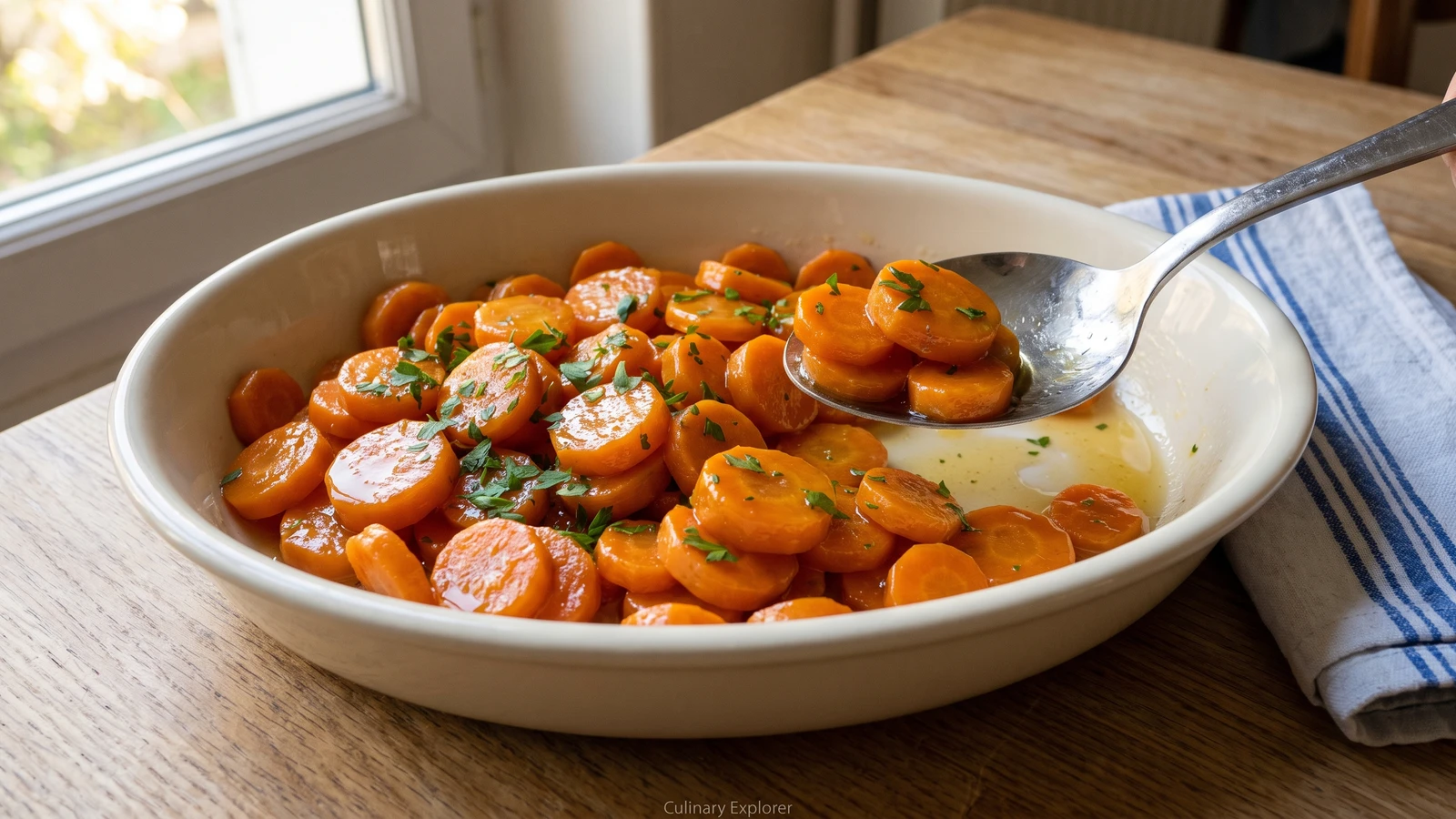
Carottes à la Vichy prove that a glaze is made by reduction, not decoration: even carrot coins cooked until tender and brilliant, then finished with parsley at the last moment.
Carottes à la Vichy (Vichy-style glazed carrots) teaches controlled reduction in its clearest form. The one true thing to know before touching a pan is that every carrot coin must have the same thickness. Butter, sugar, salt, and water can glaze them together only if they become tender together; uneven slices leave hard centers beside collapsing edges.
The old entry assumed a saucier tending garnish pans and a timbale waiting at service. At home, that becomes 1½ pounds of carrots, a broad 10-inch pan, and a warmed serving bowl, while the linked garnish formula and its proportions remain intact. Turning carrots into olive shapes belongs to the general garnish preparation, not this dish; Carottes à la Vichy explicitly asks for slices. The optional parboil for old carrots, the controlled reduction, the final sauté in the syrup, and the parsley must stay. One cook, one stove, one evening.
When it is right, each coin is tender but distinct, lacquered in butter-gold syrup, and brightened by parsley added after the heat. If the glaze tightens before the carrots soften, a spoonful of hot water restores the balance. Ça se rattrape. Before you begin, set a ruler beside the knife: every coin should be ¼ inch thick, from the first carrot to the last.
Carottes à la Vichy takes its name from Vichy, the spa town in Bourbonnais whose mineral-rich waters became part of the town's culinary identity. Many versions insist that bottled Vichy water defines the dish, but this canonical entry directs sliced carrots through the classical glazed-carrot preparation and distinguishes them with chopped parsley. The method traveled easily from the grand-kitchen garnish station to the bourgeois table because its polish comes from careful reduction, not special equipment.
Quantity
1 home-scale batch, about 4 cups (950 ml / 700 g), Carottes Glacées pour Garnitures (No. 2059)
prepared from 1½ pounds (680 g) carrots cut crosswise into ¼-inch (5 mm) coins
Quantity
8 cups (1.9 liters / 1.9 kilograms)
for parboiling old carrots only
Quantity
2 tablespoons (30 ml / 8 g)
finely chopped
| Ingredient | Quantity |
|---|---|
| Carottes Glacées pour Garnituresprepared from 1½ pounds (680 g) carrots cut crosswise into ¼-inch (5 mm) coins | 1 home-scale batch, about 4 cups (950 ml / 700 g), Carottes Glacées pour Garnitures (No. 2059) |
| water (optional)for parboiling old carrots only | 8 cups (1.9 liters / 1.9 kilograms) |
| flat-leaf parsleyfinely chopped | 2 tablespoons (30 ml / 8 g) |
Before preparing the linked component, peel or thoroughly scrub the carrots and trim their ends. Cut them crosswise into ¼-inch (5 mm) coins, checking several slices against a ruler. This uniformity is the dish, not decoration: equal coins become tender together and meet the glaze at the same moment.
Skip this step for young, juicy carrots. If the carrots are large, fibrous, or long-stored, lower the coins into gently boiling water and parboil for 3 to 5 minutes, just until the chalky rawness begins to leave their centers. Drain thoroughly. They should remain firm because their cooking will finish in the glaze; if they become fully tender here, they will break later.
Prepare the sliced carrots as one home-scale batch of Carottes Glacées pour Garnitures (No. 2059), following that linked formula without changing its proportions. Use a broad pan so the cooking liquid can reduce evenly. When the linked method brings the liquid to a syrup, sauté the coins gently in it until every surface wears a brilliant coat. If the liquid disappears before the carrots are tender, add 1 tablespoon (15 ml) hot water and lower the heat. If the carrots soften while the liquid remains watery, lift them out, reduce the liquid alone until syrupy, then return them for the final toss. Ça se rattrape.
Transfer the glazed carrots immediately to a warmed shallow serving bowl, spooning every drop of syrup over them. Shower with the chopped parsley and turn the coins once or twice so the green stays visible throughout. Do not cook the parsley in the glaze; its freshness is the final contrast. Serve at once. À table!
1 serving (about 177g)
Culinary guides, cultural storytelling, and the editorial depth that makes cooking meaningful.
Discover Culinary ExplorerChef Juliette
Carottes Glacées prove that a garnish can teach a whole sauce lesson: carrots cook in butter, sugar, salt, and water until their own liquor reduces to a brilliant, clinging coat.

Chef Juliette
Carottes à la Crème teaches the order that makes the dish: glaze the carrots to a syrup first, add the cream boiling, then reduce until each piece wears a shining ivory coat.

Chef Juliette
Purée de Carottes turns humble carrots and rice into a butter-glossed, perfectly stable purée: sieve it fine, dry it fiercely, then loosen it until the spoon leaves one soft furrow.

Chef Juliette
A pale short-paste shell holds silken, lightly sweet carrot purée beneath neat glazed half-discs, their butter syrup catching the light: a classical tart poised between vegetable course and sweet.