
Chef Juliette
Artichauts à la Barigoule
Artichauts à la Barigoule turns tender artichokes into little braising vessels, packed with mushrooms and fat bacon, wrapped, wine-braised, then dressed with only a spoonful of dark, concentrated sauce.
A cooking platform built around craft, culture, and the stories behind what we eat.
Created by Chef Juliette
Based on No. 2058, Cœur de Cardon aux Fines Herbes, from Le Guide Culinaire (1907) by Auguste Escoffier
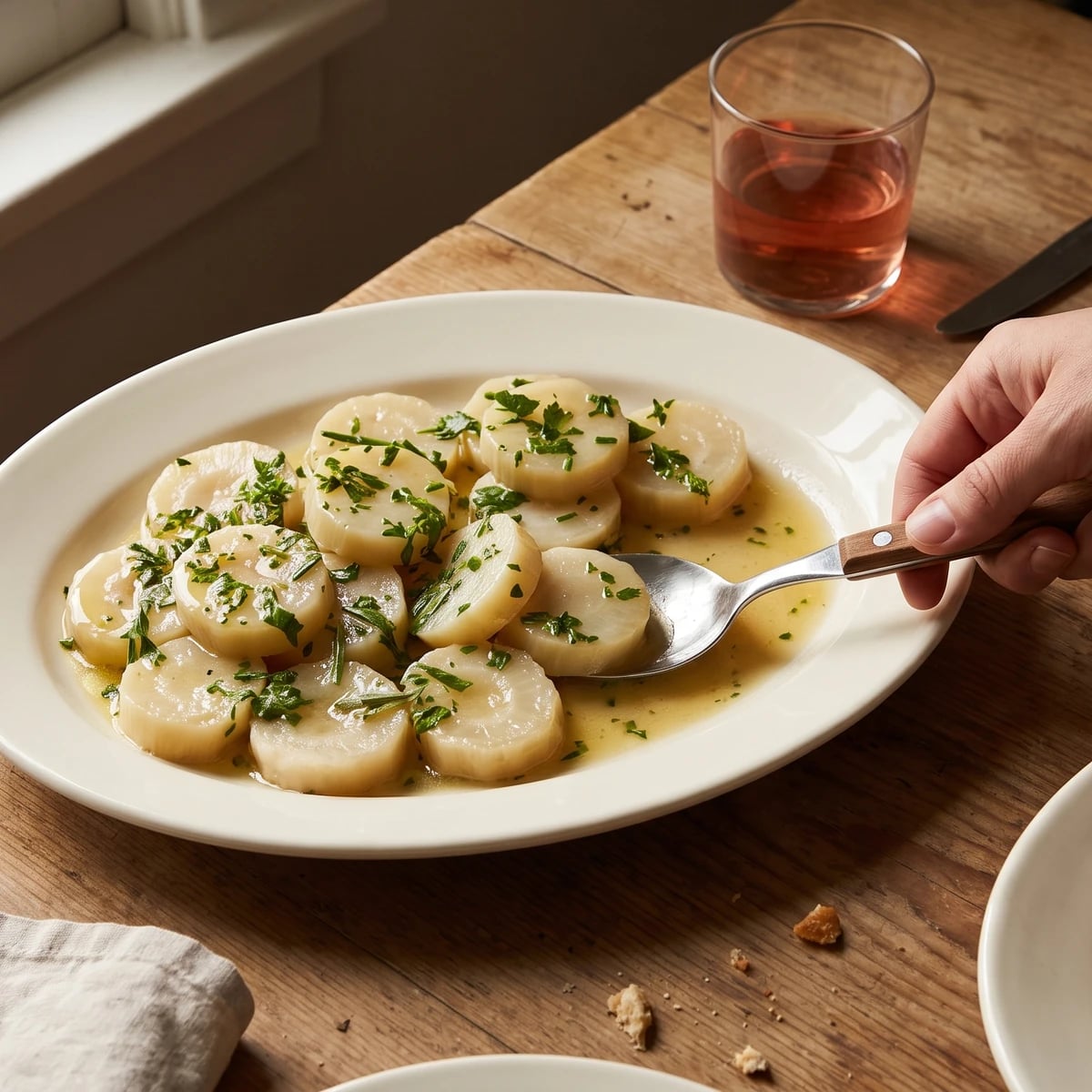
Cardoon heart, simmered tender, shaped into precise roundels, then rolled in a pale buttered meat glaze and fresh herbs: a small classical garnish that teaches the difference between cooking and finishing.
Cœur de Cardon aux Fines Herbes (cardoon heart glazed with fine herbs) teaches the difference between cooking and finishing. The heart must be fully tender before it reaches the sauté pan; that final minute in the glaze can give a cardoon sheen and perfume, but it cannot soften a tough one. Know this before you touch the pan and the whole dish becomes calm.
The original begins with the cardoon already cooked and assumes a saucier beside a pale meat glaze drawn from stock never off the fire. At home, one heart simmers in a blanc de cuisson, an acidulated poaching liquid, while one saucepan reduces rich unsalted stock to the proper body. A little gelatin restores the natural structure if carton stock needs it. There is no work here for a salamander. The standing stockpot and brigade quantities are scaffolding and can go; the cylindrical heart, one-third-inch roundels, pale buttered glaze, and fines herbes are the dish and must stay. One cook, one stove, one evening.
Cook the heart until a skewer passes through its thickest part without a raw squeak, yet the center still holds together for slicing. That tenderness, neither fibrous nor collapsing, is the step that decides everything.
Cardoon has a particular home at Lyon tables and in the market gardens of Vaulx-en-Velin, where its blanched ribs remain a cherished cold-season and holiday vegetable. Classical kitchens carried it from the household gratin into formal service by reserving the compact heart, shaping it into roundels, and glazing it as a garnish for tournedos and sautéed chicken. Despite its celery-like appearance, cardoon is kin to the artichoke, and its faint bitterness and thistle flavor explain why a restrained meat glaze suits it so well.
Quantity
1 large bunch (about 3 lb / 1.35 kg), yielding 1 compact heart about 1¼ lb / 570 g
outer ribs removed and reserved for another use
Quantity
10 cups (2.4 L / 2.4 kg)
Quantity
¼ cup (60 ml / 30 g)
Quantity
¼ cup (60 ml / 60 g)
Quantity
1 tablespoon (15 ml / 18 g)
Quantity
3 cups (720 ml / 720 g)
preferably gelatin-rich
Quantity
½ teaspoon (2.5 ml / 1.5 g)
Quantity
3 tablespoons (45 ml / 42 g)
cut into small cubes
Quantity
1 tablespoon (15 ml / 4 g)
finely chopped
Quantity
1 tablespoon (15 ml / 3 g)
finely chopped
Quantity
2 teaspoons (10 ml / 2 g)
finely sliced
Quantity
1 teaspoon (5 ml / 1 g)
finely chopped
| Ingredient | Quantity |
|---|---|
| cardoonsouter ribs removed and reserved for another use | 1 large bunch (about 3 lb / 1.35 kg), yielding 1 compact heart about 1¼ lb / 570 g |
| cold water | 10 cups (2.4 L / 2.4 kg) |
| all-purpose flour | ¼ cup (60 ml / 30 g) |
| fresh lemon juice | ¼ cup (60 ml / 60 g) |
| fine sea salt | 1 tablespoon (15 ml / 18 g) |
| rich unsalted chicken or white veal stockpreferably gelatin-rich | 3 cups (720 ml / 720 g) |
| powdered unflavored gelatin (optional) | ½ teaspoon (2.5 ml / 1.5 g) |
| cold unsalted buttercut into small cubes | 3 tablespoons (45 ml / 42 g) |
| flat-leaf parsley leavesfinely chopped | 1 tablespoon (15 ml / 4 g) |
| chervil leavesfinely chopped | 1 tablespoon (15 ml / 3 g) |
| chivesfinely sliced | 2 teaspoons (10 ml / 2 g) |
| tarragon leavesfinely chopped | 1 teaspoon (5 ml / 1 g) |
Strip away the tough outer ribs until a compact, pale heart remains, keeping its base intact so the inner ribs stay together. Reserve the outer ribs for another dish. Trim away the leafy tips, pull off only the obvious coarse strings, and tie the heart across its width in two places with kitchen twine. Whisk the flour with 1 cup of the measured cold water in a nonreactive pot until smooth, then add the remaining water, lemon juice, and salt. This is the blanc de cuisson. Add the heart, cover it with a cartouche, a parchment lid, and bring the liquid to a bare simmer. Cook for 45 to 60 minutes, turning once, until a skewer passes through the thickest part without crunching but the heart still holds its shape. If it floats, set a small heatproof plate over the parchment. If it softens too far, lift it out immediately and chill it for 20 minutes before trimming. Ça se rattrape.
While the cardoon cooks, reserve ¼ cup of the stock for adjustments. If your stock lacks natural gelatin, sprinkle the powdered gelatin over 1 tablespoon of that cold reserve and leave it to bloom. Bring the remaining stock to a lively simmer in a small wide saucepan and reduce it to about ⅔ cup, roughly 25 to 35 minutes. It should be pale gold and translucent, leaving a light coat on a spoon rather than a dark, sticky syrup. Whisk in the bloomed gelatin, if using, and hold the reduction off the heat. If it becomes too tight or salty, loosen it spoonful by spoonful with the reserved stock. This is the honest home equivalent of the pale meat glaze that once waited beside the saucier.
Lift the tender heart from the blanc and let it drain for 5 minutes, then remove the twine. With a sharp paring knife, trim it evenly all around into a compact cylinder, removing loose fibers and irregular ribs without carving away the tender center. Save the trimmings with the outer ribs. Cut laterally across the cylinder into roundels exactly ⅓ inch, or 8 mm, thick. Pat every surface dry. The cylinder matters because it gives clean, even roundels; lathe-like perfection does not.
Warm the reduced glaze over low heat only until it flows freely, then pull the pan from the heat. Whisk in the cold butter a few cubes at a time until the glaze is pale, thin, and glossy. Stir in the parsley, chervil, chives, and tarragon. Add the warm, dry cardoon roundels in a single layer and rock the sauté pan gently, turning each piece with a spoon until every surface wears a translucent coat. Return the pan to the lowest heat for no more than a minute if the roundels need warming, but do not let the glaze boil or brown. If butter beads around the edge, transfer the cardoon to a warm plate and whisk 1 teaspoon of cold reserved stock into the glaze off the heat until smooth, then return the roundels. Ça se rattrape.
Arrange four or five glazed roundels beside each tournedos or portion of sautéed chicken, or overlap them loosely in a warm shallow serving dish. Spoon every trace of the herb-flecked glaze over them. Serve immediately, while the butter still gleams and the herbs remain green. A mounted glaze waits poorly, and there is no virtue in making it wait. À table!
1 serving (about 190g)
Culinary guides, cultural storytelling, and the editorial depth that makes cooking meaningful.
Discover Culinary Explorer
Chef Juliette
Artichauts à la Barigoule turns tender artichokes into little braising vessels, packed with mushrooms and fat bacon, wrapped, wine-braised, then dressed with only a spoonful of dark, concentrated sauce.

Chef Juliette
Artichoke hearts, spring peas, and carrot settle into one buttered cocotte, cooking gently until tender before Manied Butter (No. 151) gives their clear vegetable liquor the lightest gloss.

Chef Juliette
Artichauts aux sauces diverses bring one generous lesson to the table: tie, boil, and drain the vegetables properly, then let one well-made sauce turn each leaf and heart into supper.

Chef Juliette
Artichauts à la Provençale turns a tight lid into technique: small artichokes, sweet peas, and lettuce soften in olive oil and their own juices, emerging tender, green, and quietly glossy.