Chef Juliette
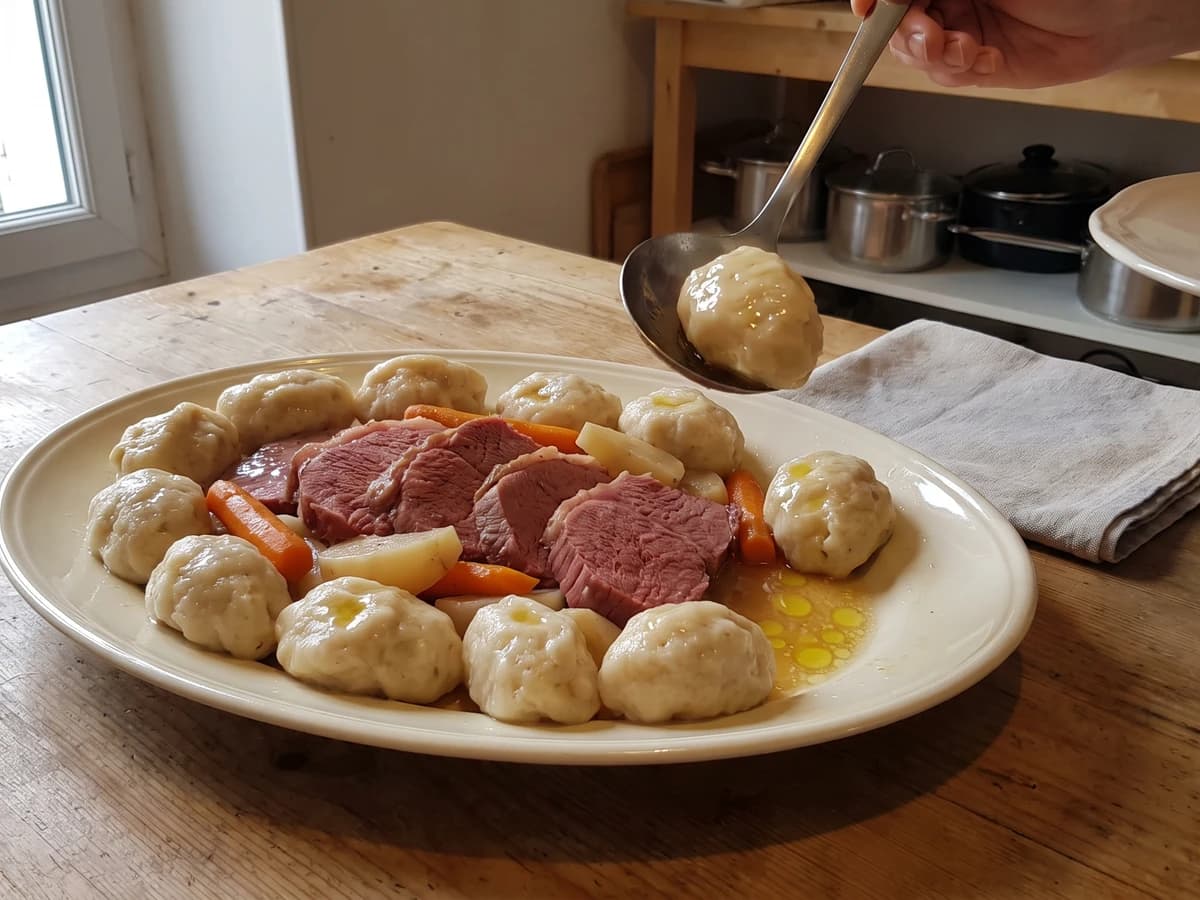
Suet Dumpling
Boulettes au suif, poached beside salt beef, turn equal weights of flour and finely chopped suet into tender, rich dumplings. Keep the beef liquor at a bare tremble and the old garnish works beautifully at home.
A cooking platform built around craft, culture, and the stories behind what we eat.

Created by Chef Juliette
Based on No. 2048, Aubergines Frites, from Le Guide Culinaire (1907) by Auguste Escoffier
Aubergines frites prove that frying is a matter of heat and timing: thin rounds, a dry veil of flour, bronze crusts, and a straight journey from oil to waiting plates.
Aubergines frites (fried aubergine roundels) teach one unforgiving truth: crispness has a clock. The flour must meet a dry slice, the slice must meet properly hot oil, and the finished round must meet its eater without delay. Get that rhythm right and the crust is thin and lightly cragged, while the aubergine inside turns soft and almost creamy.
The source assumed a deep pan of oil already at frying heat, one cook working in batches, and another pair of hands ready to carry the dish on its napkin. The home equivalent is a heavy saucepan, a thermometer, a wire rack, and four diners called to the table before the first batch goes in. The home batch uses two aubergines and one litre of oil, enough for four as a side. The permanent fryer and service runner were brigade scaffolding, so they go; the sequence and immediate service are the dish, so they stay. One cook, one stove, one evening.
The source's smoking oil was a heat test, not an invitation to fill the kitchen with acrid smoke. Bring refined oil to 185°C / 365°F, just below its smoke point, and let the thermometer supply the certainty once provided by a practiced fryer cook. The step that matters most is maintaining that heat between batches; let it fall and the aubergines drink oil before the flour can set.
Aubergines frites sit most naturally in Mediterranean France, especially Provence and the coast, where aubergines belong to the everyday vegetable larder and frying in oil suits the region's cooking. From southern household pans, plainly fried slices passed into the national classical repertory as a vegetable garnish, kept bare so texture remained the measure of the cook. The napkin in classical service was practical rather than decorative: it caught surface oil during the brief journey from pan to table, because waiting, not simplicity, is the dish's true enemy.
Quantity
2 (about 1½ lb / 700 g)
stems trimmed and cut crosswise into 3/16-inch (5 mm) roundels
Quantity
1¼ teaspoons (6 ml / 7 g)
Quantity
½ teaspoon (2.5 ml / 1 g)
Quantity
¾ cup (180 ml / 90 g)
Quantity
4 cups (1 L / about 920 g)
for frying
| Ingredient | Quantity |
|---|---|
| medium auberginesstems trimmed and cut crosswise into 3/16-inch (5 mm) roundels | 2 (about 1½ lb / 700 g) |
| fine sea salt | 1¼ teaspoons (6 ml / 7 g) |
| freshly ground black pepper | ½ teaspoon (2.5 ml / 1 g) |
| all-purpose flour | ¾ cup (180 ml / 90 g) |
| refined peanut or sunflower oilfor frying | 4 cups (1 L / about 920 g) |
Set a wire rack over a sheet pan, place absorbent paper beside it, and have the serving platter waiting. Cut the aubergines crosswise into even 3/16-inch (5 mm) roundels, then blot both faces thoroughly. Uniform thickness matters: thick slices remain spongy when the thin ones are already dark, while surface moisture spits in the oil and turns flour to paste.
Pour the oil into a heavy 3-quart (3-litre) saucepan, where it should stand about 1¼ inches (3 cm) deep and fill no more than one-third of the vessel. Clip on the thermometer and heat over medium-high heat to 185°C / 365°F. Visible smoke means the oil has gone too far: remove the pan from the burner, let the temperature fall below 190°C / 375°F, then return it over gentler heat. Never put food into smoking oil.
Work with only four or five roundels at a time. Season both faces lightly with a proportional share of the salt and pepper, then dredge them in flour and shake off every loose patch; the coating should look like a veil, not armor. Put each round directly into the oil. If a coated slice waits and turns gummy, brush off the damp flour, blot the aubergine again, and dredge it afresh.
Lower four or five roundels into the oil one by one, moving away from yourself, and keep the temperature between 180°C and 185°C / 355°F and 365°F. Fry for 2½ to 3 minutes, turning once, until both faces are deep gold with chestnut edges and the centres yield when pressed with the spoon. Let the oil recover fully before the next batch. If a batch emerges pale and oily, the oil was too cool; drain it, bring the oil to 190°C / 375°F, and refry those slices for 20 to 30 seconds until the crust sets. Ça se rattrape.
Lift each batch with a wire skimmer, give it two firm shakes over the pan, and drain it on the rack for about 20 seconds. Touch the undersides briefly to absorbent paper, then carry the aubergines to the dry platter without stacking or covering them. The classical napkin performed this same practical job. Serve each batch while the next one fries, because holding everything until the end sacrifices the very quality the recipe protects. À table!
1 serving (about 180g)
Culinary guides, cultural storytelling, and the editorial depth that makes cooking meaningful.
Discover Culinary ExplorerChef Juliette
Boulettes au suif, poached beside salt beef, turn equal weights of flour and finely chopped suet into tender, rich dumplings. Keep the beef liquor at a bare tremble and the old garnish works beautifully at home.

Chef Juliette
Bread, flour, frangipane, and rice become four cool, supple panades for binding forcemeats, each changing body and flavor while preserving tenderness. The finest Mousselines need none, and knowing that distinction is the lesson.

Chef Juliette
Panade au pain is bread, milk, salt, heat, and attention: stir until the paste releases cleanly, butter it against a skin, and you have the quiet binder behind tender French farces.

Chef Juliette
Panade de farine teaches the drying stroke behind pâte à choux: flour meets boiling buttered water, then stays over the fire until the paste gathers, smooths, and quits the pan cleanly.