Chef Juliette
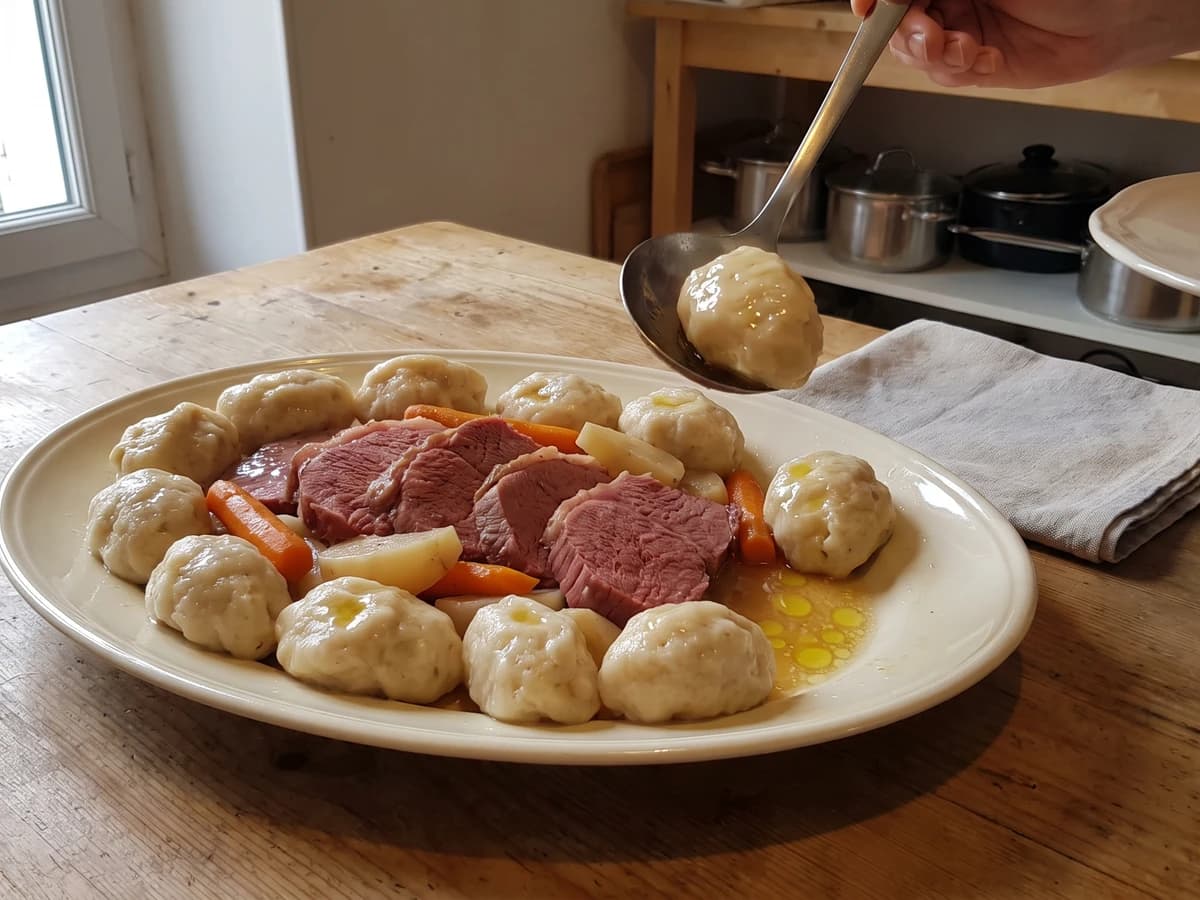
Suet Dumpling
Boulettes au suif, poached beside salt beef, turn equal weights of flour and finely chopped suet into tender, rich dumplings. Keep the beef liquor at a bare tremble and the old garnish works beautifully at home.
A cooking platform built around craft, culture, and the stories behind what we eat.

Created by Chef Juliette
Based on No. 2032, Quartiers d’Artichauts à l’Italienne, from Le Guide Culinaire (1907) by Auguste Escoffier
Artichoke quarters, lemoned before they can darken, are sweated over aromatics, braised in white wine and brown stock, then glossed with Sauce Italienne for a generous classical side dish.
Quartiers d’Artichauts à l’Italienne (artichoke quarters with Sauce Italienne) teaches a small but unforgiving principle: an artichoke must meet lemon the instant the knife opens it. Leave a cut surface bare and it blackens before the pan is warm. Keep the lemon in your working hand, and the rest becomes a calm sequence of sweating, reducing, and braising.
The original entry assumed a saucier with Sauce Italienne ready, brown stock never off the fire, and quantities meant for a dining room rather than four plates. Here the separate sauce station is brigade scaffolding, so the Sauce Italienne arrives as a finished component and the stockpot becomes a measured quantity of prepared brown stock. A wide, lidded sauté pan handles the oven braise. One cook, one stove, one evening.
What remains is the dish itself and must not be compressed: parboil the quarters, sweat them for the full seven or eight minutes, reduce the wine before adding stock, then strain, clear, and reduce the cooking liquor before it meets the sauce. The finished quarters should be spoon-tender, still distinctly artichokes, under a brown sauce that gleams rather than smothers. Have the lemon ready before the first cut. That is the moment this dish is won.
Quartiers d’Artichauts à l’Italienne belongs to the Parisian grammar of grande cuisine, where vegetables were turned with precision, braised over aromatics, and finished with a named sauce before entering the dining room. Here à l’italienne does not claim an Italian regional recipe; in the French classical canon it points to Sauce Italienne, a brown-sauce preparation marked by white wine, mushrooms, shallot, herbs, and often ham. The treatment passed readily to the bourgeois table because its logic is domestic at heart: tender artichokes, concentrated braising liquor, and enough sauce to pass around.
Quantity
4 large (about 4 lb 14 oz / 2.2 kg whole)
turned, quartered, and chokes removed
Quantity
2 (about 8 oz / 225 g)
halved
Quantity
12 cups (2.8 L / 2.8 kg), plus more for parboiling
Quantity
1 tablespoon (15 ml / 18 g), plus more to season
Quantity
2 tablespoons (30 ml / 28 g)
Quantity
1/2 cup (120 ml / 75 g)
finely diced
Quantity
1/3 cup (80 ml / 50 g)
finely diced
Quantity
1/3 cup (80 ml / 45 g)
finely diced
Quantity
6
Quantity
1 small
Quantity
1
Quantity
3/4 cup (180 ml / 180 g)
Quantity
1 1/2 cups (360 ml / 360 g)
kept ready for the braise
Quantity
1 cup (240 ml / 250 g)
Quantity
1/4 teaspoon (1.25 ml / 0.6 g)
| Ingredient | Quantity |
|---|---|
| large globe artichokesturned, quartered, and chokes removed | 4 large (about 4 lb 14 oz / 2.2 kg whole) |
| medium lemonshalved | 2 (about 8 oz / 225 g) |
| cold water | 12 cups (2.8 L / 2.8 kg), plus more for parboiling |
| fine sea salt | 1 tablespoon (15 ml / 18 g), plus more to season |
| unsalted butter | 2 tablespoons (30 ml / 28 g) |
| onionfinely diced | 1/2 cup (120 ml / 75 g) |
| carrotfinely diced | 1/3 cup (80 ml / 50 g) |
| celeryfinely diced | 1/3 cup (80 ml / 45 g) |
| parsley stems | 6 |
| thyme sprig | 1 small |
| bay leaf | 1 |
| dry white wine | 3/4 cup (180 ml / 180 g) |
| unsalted brown veal or beef stockkept ready for the braise | 1 1/2 cups (360 ml / 360 g) |
| finished Sauce Italienne | 1 cup (240 ml / 250 g) |
| freshly ground white pepper | 1/4 teaspoon (1.25 ml / 0.6 g) |
Fill a large bowl with the cold water and place it beside your cutting board. Keep the lemon halves within reach, then heat the oven to 325°F (165°C). The water is only a temporary shelter; the lemon touching every fresh cut is what prevents the artichokes from blackening.
Pull away the tough outer leaves until the tender pale leaves appear. Shorten each stem to about 1 inch (2.5 cm), peel the stem and dark green base with a paring knife, then cut away the top third of the leaves. Quarter the artichoke lengthwise and scoop out every hairy trace of choke. Rub all exposed flesh immediately with lemon and lower each finished quarter into the water before starting the next. If an edge begins to gray, shave off the thinnest possible layer, rub it again with lemon, and submerge it at once.
Bring a large pot of fresh water to a rolling boil and add the measured salt. Drain the quarters from their holding water and parboil them for 6 to 8 minutes, until the thin leaf tips bend but the thick bases still resist a knife. Drain them cut-side down and blot away excess water. This first cooking is part of the source method, not expendable brigade ceremony: it begins the dense bases evenly before the wine and stock enter.
Melt the butter in a wide 12-inch (30 cm) oven-safe sauté pan. Spread the onion, carrot, celery, parsley stems, thyme, and bay leaf across the bottom to make the litter of aromatics, then season lightly with white pepper. Arrange the artichoke quarters in one layer over them, cover, and place the pan in the oven for 7 to 8 minutes. They should sweat gently while the vegetables soften without browning; colour here would muddy the fresh, faintly nutty character of the artichokes.
Set the pan over medium-high heat and pour the white wine around the artichokes. Boil uncovered until the wine has reduced to about 3 tablespoons (45 ml), its sharp alcoholic smell has disappeared, and the pan is nearly dry without the aromatics catching, about 5 to 7 minutes. This reduction is the backbone of the dish. If the pan catches, add a spoonful of stock and scrape gently until the browned patch releases. Ça se rattrape.
Add enough brown stock to reach halfway up the artichoke quarters, reserving any excess. Cover and return the pan to the oven. Braise gently for 25 to 35 minutes, until a fine knife passes through the thick base of a quarter without force but the leaves still hold their shape. If the liquor falls below a shallow layer before the artichokes are tender, add another splash of stock. Do not flood the pan; braising concentrates flavour, while boiling washes it away.
Lift the tender quarters carefully into a warmed shallow vegetable dish. Strain the cooking liquor through a fine sieve into a small saucepan, discard the aromatics, and skim away the surface fat. Boil the liquor until reduced to about 1/2 cup (120 ml), then add the finished Sauce Italienne and hold it at a bare simmer for 3 to 5 minutes, until it coats the back of a spoon and falls in a glossy ribbon. If it tightens into a paste, loosen it one spoonful at a time with reserved stock; if it runs like broth, reduce it before it reaches the artichokes. Taste for salt, spoon the sauce generously over the quarters, and serve at once. À table!
1 serving (about 325g)
Culinary guides, cultural storytelling, and the editorial depth that makes cooking meaningful.
Discover Culinary ExplorerChef Juliette
Boulettes au suif, poached beside salt beef, turn equal weights of flour and finely chopped suet into tender, rich dumplings. Keep the beef liquor at a bare tremble and the old garnish works beautifully at home.

Chef Juliette
Bread, flour, frangipane, and rice become four cool, supple panades for binding forcemeats, each changing body and flavor while preserving tenderness. The finest Mousselines need none, and knowing that distinction is the lesson.

Chef Juliette
Panade au pain is bread, milk, salt, heat, and attention: stir until the paste releases cleanly, butter it against a skin, and you have the quiet binder behind tender French farces.

Chef Juliette
Panade de farine teaches the drying stroke behind pâte à choux: flour meets boiling buttered water, then stays over the fire until the paste gathers, smooths, and quits the pan cleanly.