Chef Juliette
Mayonnaise de Volaille
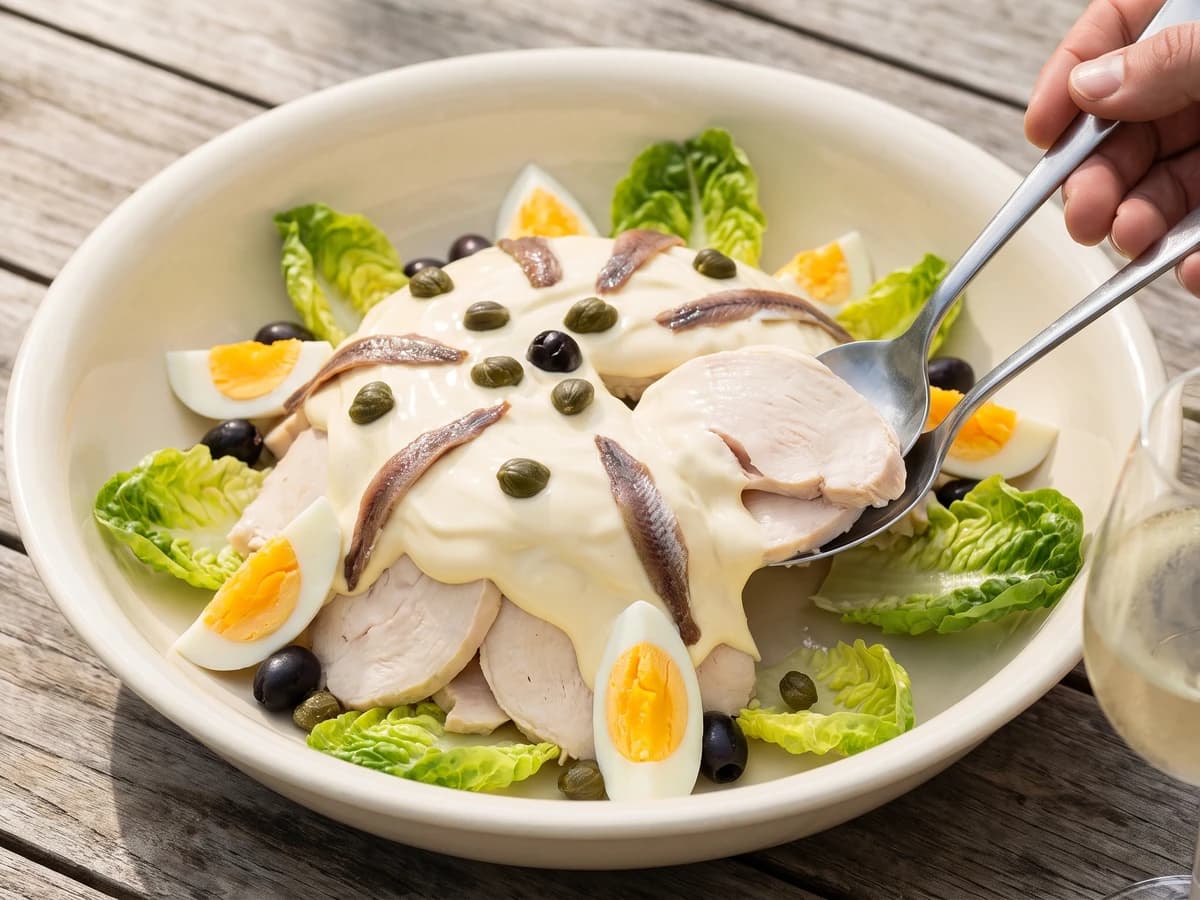
Cold roast chicken, ciseled lettuce, and a shining coat of homemade mayonnaise, arranged with capers, olives, anchovies, eggs, and lettuce hearts, then tossed at the table as the canon intends.
A cooking platform built around craft, culture, and the stories behind what we eat.
Created by Chef Juliette
Based on No. 2027, Salade Waldorf, from Le Guide Culinaire (1907) by Auguste Escoffier
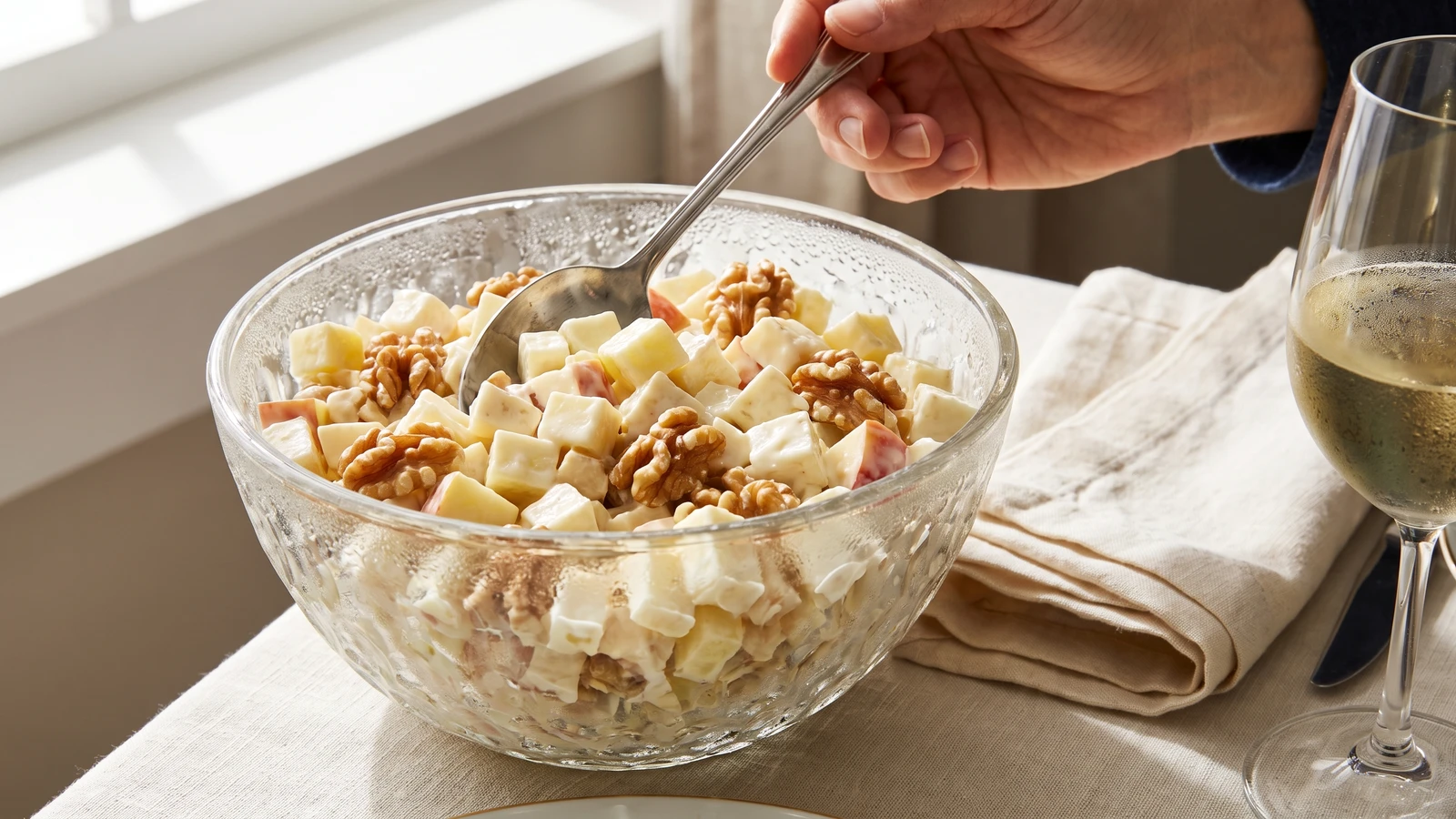
Equal parts russet apple, raw celeriac, and peeled walnuts, bound lightly with mayonnaise claire. Soaking draws off bitterness, neat dice preserve crunch, and the whole salad belongs at a generous cold table.
Salade Waldorf (Waldorf salad) teaches proportion before ornament. Know this before the knife comes out: russet apple, raw celeriac, and peeled walnuts meet in equal prepared weights, while mayonnaise claire (a loose mayonnaise) should glaze them, never bury them. The precision is the pleasure: sweet-tart apple, earthy crunch, mild walnut, cool ivory sauce.
The formula assumed a garde-manger with mayonnaise already whisked, a commis peeling walnut halves, and quantities meant for service. At home, you make one small emulsion and weigh three 170-gram portions. Peeling and soaking the walnuts for a quarter hour are the dish; surplus sauce and extra hands were brigade scaffolding, so they go.
The finished salad should be crisp and distinct, with every cube wearing only a thin sheen. Dry the soaked walnuts completely before folding them through. Water carried into the bowl weakens the emulsion, and that careful drying is the one step that decides the dish.
Salade Waldorf belongs first to a grand hotel dining room in New York City, not to any French region, and it entered the French classical repertoire through international hotel kitchens where named salads traveled readily between cities. This codified French version uses equal prepared quantities of russet apple, raw celeriac, and peeled walnut, all coated in mayonnaise claire. Grapes and celery stalks appear in many household versions, but neither belongs to this formula.
Quantity
1½ cups (355 ml / 170 g)
peeled, soaked for 15 minutes, and drained well
Quantity
4 cups (950 ml / 950 g)
divided, for scalding and soaking the walnuts
Quantity
About ½ small, yielding 1⅛ cups (265 ml / 170 g)
peeled, trimmed, and cut into 8 mm dice
Quantity
About 2 medium, yielding 1⅓ cups (315 ml / 170 g)
peeled, cored, and cut into 8 mm dice
Quantity
1 large
at room temperature
Quantity
2 teaspoons (10 ml / 10 g)
divided
Quantity
⅓ cup (80 ml / 74 g)
at room temperature
Quantity
1 to 2 tablespoons (15 to 30 ml / 15 to 30 g)
Quantity
½ teaspoon (2.5 ml / 3 g)
Quantity
⅛ teaspoon (0.6 ml / 0.3 g)
| Ingredient | Quantity |
|---|---|
| walnut halvespeeled, soaked for 15 minutes, and drained well | 1½ cups (355 ml / 170 g) |
| fresh waterdivided, for scalding and soaking the walnuts | 4 cups (950 ml / 950 g) |
| celeriacpeeled, trimmed, and cut into 8 mm dice | About ½ small, yielding 1⅛ cups (265 ml / 170 g) |
| russet applespeeled, cored, and cut into 8 mm dice | About 2 medium, yielding 1⅓ cups (315 ml / 170 g) |
| pasteurized egg yolkat room temperature | 1 large |
| white wine vinegardivided | 2 teaspoons (10 ml / 10 g) |
| neutral oilat room temperature | ⅓ cup (80 ml / 74 g) |
| cold water | 1 to 2 tablespoons (15 to 30 ml / 15 to 30 g) |
| fine salt | ½ teaspoon (2.5 ml / 3 g) |
| finely ground white pepper | ⅛ teaspoon (0.6 ml / 0.3 g) |
Cover the walnut halves with 2 cups (475 ml) of just-boiled fresh water and leave them for 1 minute. Drain, then lift or rub away the thin brown skins while the nuts are still warm, using a clean towel and the point of a small knife. Keep the halves as whole as you can. Cover the peeled walnuts with the remaining 2 cups (475 ml) of fresh cold water for exactly 15 minutes, then drain and spread them between clean towels until thoroughly dry.
Whisk the egg yolk with 1 teaspoon of the vinegar, the salt, and the white pepper until smooth. Add the oil drop by drop at first, whisking constantly; once the emulsion has thickened and grips the whisk, add the remaining oil in a fine, steady thread. Whisk in the remaining vinegar and 1 tablespoon of cold water, adding the second tablespoon only if needed. The mayonnaise claire should fall in a broad ribbon and coat a spoon with a thin, glossy film. If it splits, stop. Ça se rattrape: put 1 teaspoon of the measured cold water in a clean bowl and whisk the broken sauce into it drop by drop until the emulsion comes back together.
Cut the peeled celeriac into even 8 mm dice and weigh out 170 g. Peel and core the apples only when the mayonnaise and walnuts are ready, then cut them into the same dice and weigh out 170 g. The cups are useful guides, but the scale preserves the source formula precisely because apples, celeriac, and walnut halves settle differently in a cup.
Combine the 170 g each of apple, celeriac, and completely dry walnut halves in a wide bowl. Add the mayonnaise claire in two additions, folding gently from underneath so the walnut halves remain intact. Every piece should carry a fine ivory coating, with no heavy pool at the bottom. Taste one complete bite containing all three elements, then adjust only if the balance needs the smallest pinch of the measured seasoning.
Cover and chill the salad for 30 minutes so the flavors settle while the dice remain crisp. Fold it once before serving and transfer it to a chilled bowl without adding grapes, celery stalks, herbs, or decorative leaves. This composed salad has already said everything it needs to say. À table!
1 serving (about 170g)
Culinary guides, cultural storytelling, and the editorial depth that makes cooking meaningful.
Discover Culinary ExplorerChef Juliette
Cold roast chicken, ciseled lettuce, and a shining coat of homemade mayonnaise, arranged with capers, olives, anchovies, eggs, and lettuce hearts, then tossed at the table as the canon intends.

Chef Juliette
Cold roast or poached chicken with fine ribbons of lettuce, dressed at the final moment with oil and vinegar: a composed salad whose freshness depends entirely on timing.

Chef Juliette
Five leaves, one living rule: laitue, romaine, chicorée, mâche, or pissenlit must be washed, dried, and dressed only as they go to the table, while every leaf still carries its light vinaigrette.

Chef Juliette
Salade de Betteraves proves that baking, not boiling, is the whole argument: concentrated garnet sweetness, tender baked onion, sharp mustard, and herbs cut into a weeknight salad worth making ahead.