Chef Juliette
Mayonnaise de Volaille
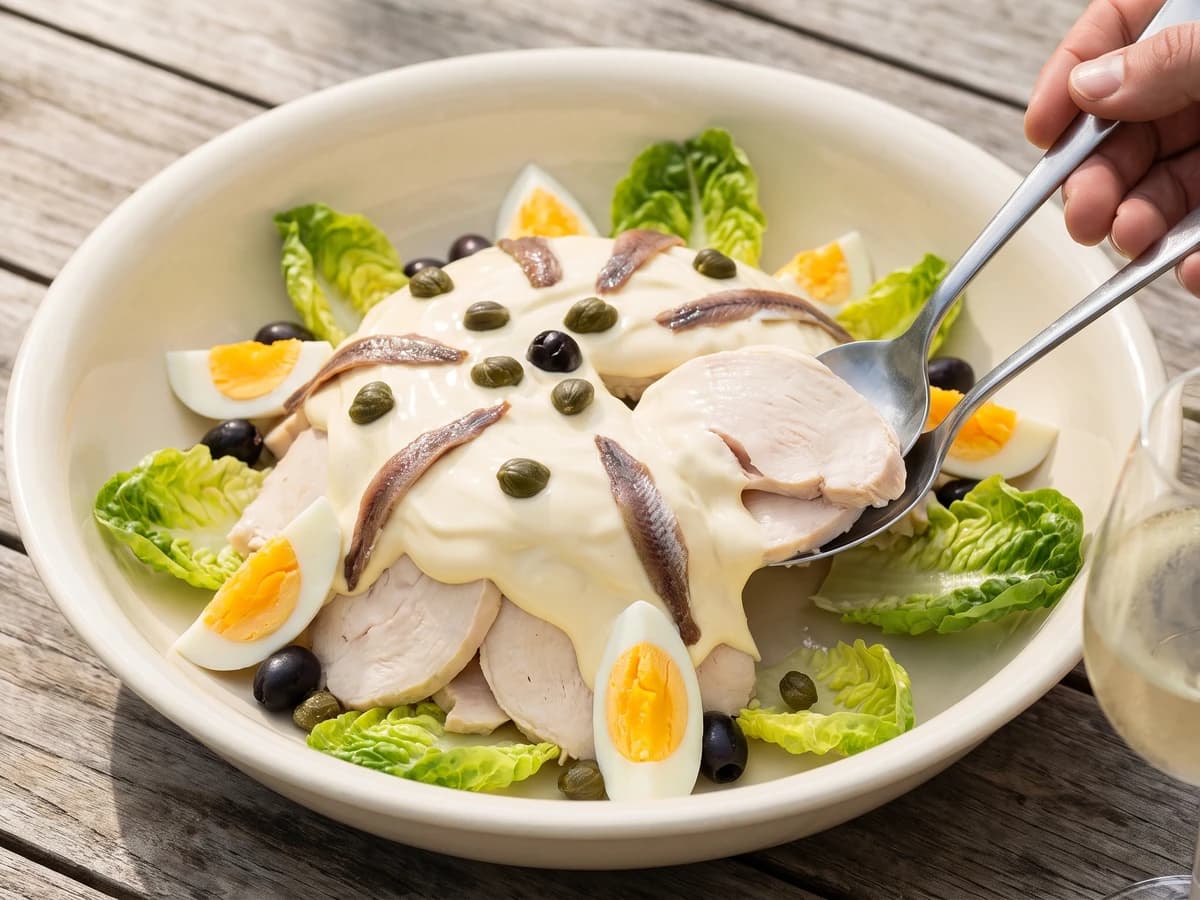
Cold roast chicken, ciseled lettuce, and a shining coat of homemade mayonnaise, arranged with capers, olives, anchovies, eggs, and lettuce hearts, then tossed at the table as the canon intends.
A cooking platform built around craft, culture, and the stories behind what we eat.
Created by Chef Juliette
Based on No. 2026, Salade Victoria, from Le Guide Culinaire (1907) by Auguste Escoffier
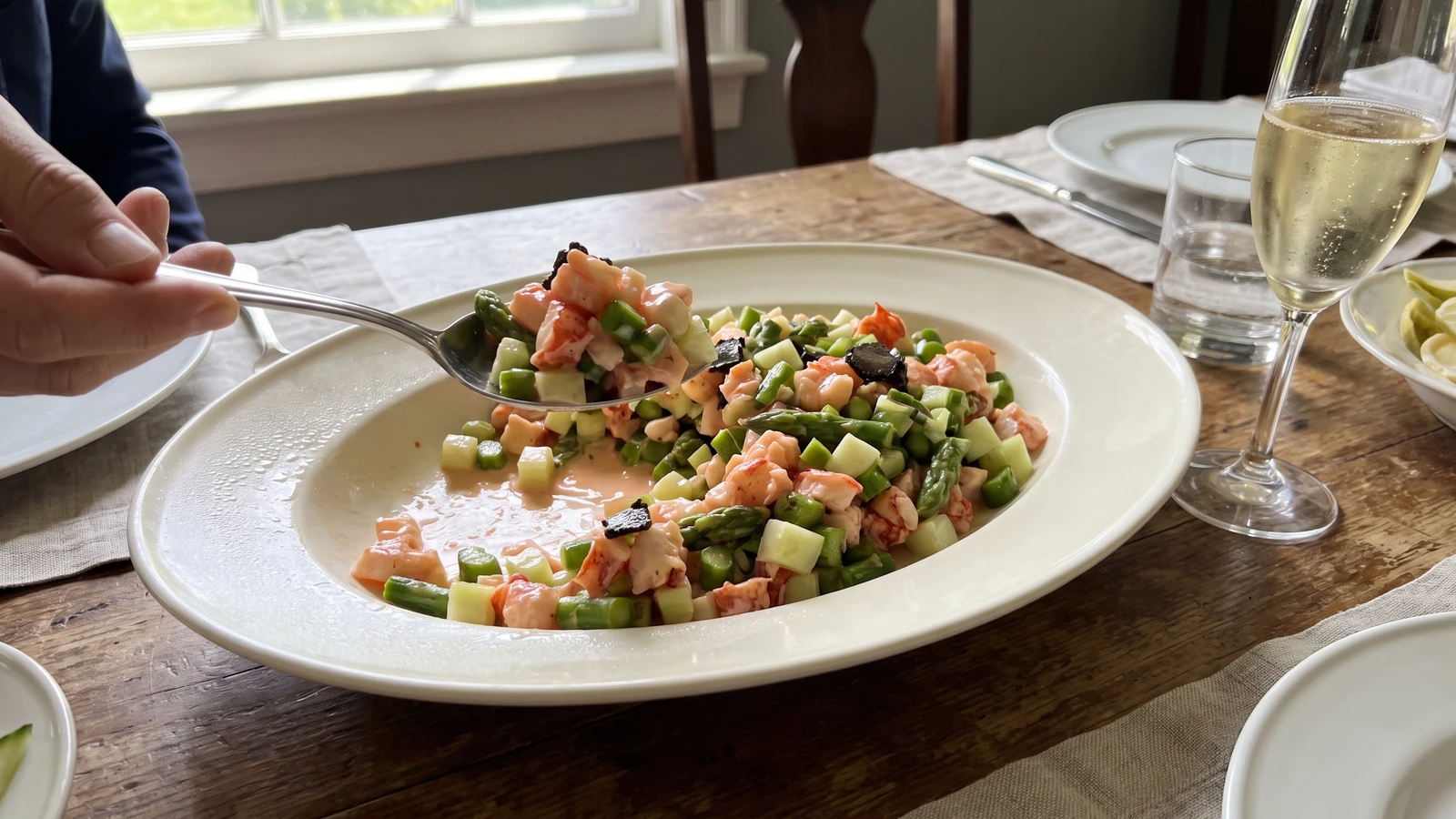
Equal dice of spiny lobster, asparagus tips, truffle, and cucumber meet a coral-tinted mayonnaise, a composed salad whose luxury depends less on display than exact proportion, dry ingredients, and a steady emulsion.
Salade Victoria (spiny-lobster salad with coral mayonnaise) teaches proportion before ornament. Four ingredients enter in equal measure, cut to one neat dice, while the coral mayonnaise binds rather than buries them. That is the one true thing to know before touching a pan: if one component is wet, warm, or oversized, the salad loses its balance.
The brigade shorthand assumed a garde-manger preparing cooked spiny-lobster trimmings, a saucier on staff with mayonnaise ready, and the creamy parts and coral carefully reserved from the shell. Your honest home equivalent is one cooked female spiny lobster from a trusted fishmonger, one small hand-whisked mayonnaise, and half a cup of each diced component. The stockpot and salamander can stay quiet. They are brigade scaffolding here; the equal proportions and coral-bound emulsion are the dish, and those remain exactly. One cook, one stove, one evening.
When it is right, every green, black, ivory, and shell-pink dice remains distinct beneath a fine coral gloss. Nothing swims and nothing clumps. Dry the blanched asparagus and cucumber completely before folding them with the mayonnaise, because that is the step that decides the dish.
Salade Victoria belongs to the Parisian grand-kitchen register of salades composées (composed salads), where luxury ingredients were cut with exact geometry and bound with sauce rather than scattered over leaves. Its royal name follows the canon's fondness for honorific dining-room titles, but the preparation is neither British nor a leafy lobster salad. Its economy is easy to miss: prized tail pieces could serve elsewhere, while the spiny-lobster trimmings, coral, and creamy parts supplied substance, colour, and seasoning here.
Quantity
½ cup, lightly packed (120 ml / 75 g)
cut into ¼-inch (6 mm) dice, with the cooked creamy parts and coral reserved separately
Quantity
½ cup, lightly packed (120 ml / 75 g)
measured after blanching and cutting into ¼-inch (6 mm) pieces
Quantity
½ cup, lightly packed (120 ml / 75 g)
fresh or whole preserved, thoroughly dried and cut into ¼-inch (6 mm) dice
Quantity
½ cup, lightly packed (120 ml / 75 g)
cut into ¼-inch (6 mm) dice
Quantity
1 tablespoon (15 ml / 15 g), or all safely available
Quantity
1 tablespoon (15 ml / 15 g)
pressed to a purée
Quantity
1
at room temperature
Quantity
2 teaspoons (10 ml / 10 g)
divided
Quantity
5 tablespoons (75 ml / 69 g)
at room temperature
Quantity
1 tablespoon plus ¼ teaspoon (16 ml / 19 g)
divided
Quantity
1/16 teaspoon (0.3 ml / 0.1 g)
| Ingredient | Quantity |
|---|---|
| cooked spiny-lobster trimmingscut into ¼-inch (6 mm) dice, with the cooked creamy parts and coral reserved separately | ½ cup, lightly packed (120 ml / 75 g) |
| tender asparagus tipsmeasured after blanching and cutting into ¼-inch (6 mm) pieces | ½ cup, lightly packed (120 ml / 75 g) |
| black trufflefresh or whole preserved, thoroughly dried and cut into ¼-inch (6 mm) dice | ½ cup, lightly packed (120 ml / 75 g) |
| peeled and seeded cucumber fleshcut into ¼-inch (6 mm) dice | ½ cup, lightly packed (120 ml / 75 g) |
| cooked creamy parts from the spiny lobster | 1 tablespoon (15 ml / 15 g), or all safely available |
| cooked spiny-lobster coralpressed to a purée | 1 tablespoon (15 ml / 15 g) |
| pasteurized large egg yolkat room temperature | 1 |
| white wine vinegardivided | 2 teaspoons (10 ml / 10 g) |
| neutral oil, such as grapeseed or sunflower oilat room temperature | 5 tablespoons (75 ml / 69 g) |
| fine sea saltdivided | 1 tablespoon plus ¼ teaspoon (16 ml / 19 g) |
| ground white pepper | 1/16 teaspoon (0.3 ml / 0.1 g) |
Chill a wide mixing bowl and the serving platter. Set a second bowl of iced water beside the stove, and spread a clean kitchen towel nearby. Every component must be cold and dry before binding, so prepare the landing place before the asparagus meets the water.
Bring a medium saucepan of water to a rolling boil and add 1 tablespoon of the salt. Drop in the asparagus tips and blanch for 60 to 90 seconds, just until brilliant green and tender enough for a knife to enter with slight resistance. Transfer them immediately to the iced water. Once cold, drain and spread them on the towel, then blot every surface dry. If they go a touch too far, chill them at once and handle them as little as possible; they cannot regain their snap, but they will keep their shape.
Toss the cucumber dice with ⅛ teaspoon of the remaining salt and leave them for 10 minutes, then blot them firmly between clean towels. Cut the lobster trimmings, dried asparagus tips, truffle, and cucumber to the same ¼-inch (6 mm) size. Measure each only after trimming and drying: ½ cup (120 ml / 75 g) of each. Equal means equal here. This proportion is not brigade scaffolding; it is the architecture of Salade Victoria.
Press the cooked coral and creamy parts through a fine-mesh sieve into a small bowl, scraping underneath to collect every smooth bit. Work in 1 teaspoon of the vinegar until the mixture becomes an even paste without lumps. The coral gives the sauce its warm shell-pink colour, while the creamy parts carry the spiny lobster's deeper savour. Use only fully cooked parts cleared for consumption by your fishmonger and local seafood guidance.
Whisk the pasteurized egg yolk with ½ teaspoon of the remaining vinegar, the final ⅛ teaspoon salt, and the white pepper until smooth. Add the oil first by drops, whisking each addition completely into the yolk; once the emulsion thickens, pour in a very thin thread while whisking steadily. If it separates, don't throw it out. Ça se rattrape: put the reserved ½ teaspoon vinegar in a clean bowl and whisk the broken mayonnaise into it one teaspoon at a time until the emulsion catches again. Whisk in the coral mixture. The finished mayonnaise should hold a soft ridge and appear evenly coral-coloured; if it is too firm, loosen it with a teaspoon of cold water.
Combine the cold lobster, asparagus, truffle, and cucumber in the chilled bowl. Reserve 2 tablespoons of coral mayonnaise, then fold the remainder through the dice with a flexible spatula, turning from the bottom so nothing is crushed. Each piece should wear a thin gloss, with no pool beneath. If liquid gathers, lift the solids out with a slotted spoon, dry the bowl, and return them with enough reserved mayonnaise to bind them again.
Cover and chill the salad for 20 minutes, enough for it to settle without muting the truffle. Taste one complete spoonful containing all four dice, then correct only with a few drops of the reserved vinegar if needed. Spoon the salad loosely onto the chilled platter rather than compressing it into a mould. Bring it to the table while cool and glossy. À table!
1 serving (about 105g)
Culinary guides, cultural storytelling, and the editorial depth that makes cooking meaningful.
Discover Culinary ExplorerChef Juliette
Cold roast chicken, ciseled lettuce, and a shining coat of homemade mayonnaise, arranged with capers, olives, anchovies, eggs, and lettuce hearts, then tossed at the table as the canon intends.

Chef Juliette
Cold roast or poached chicken with fine ribbons of lettuce, dressed at the final moment with oil and vinegar: a composed salad whose freshness depends entirely on timing.

Chef Juliette
Five leaves, one living rule: laitue, romaine, chicorée, mâche, or pissenlit must be washed, dried, and dressed only as they go to the table, while every leaf still carries its light vinaigrette.

Chef Juliette
Salade de Betteraves proves that baking, not boiling, is the whole argument: concentrated garnet sweetness, tender baked onion, sharp mustard, and herbs cut into a weeknight salad worth making ahead.