Chef Juliette
Mayonnaise de Volaille
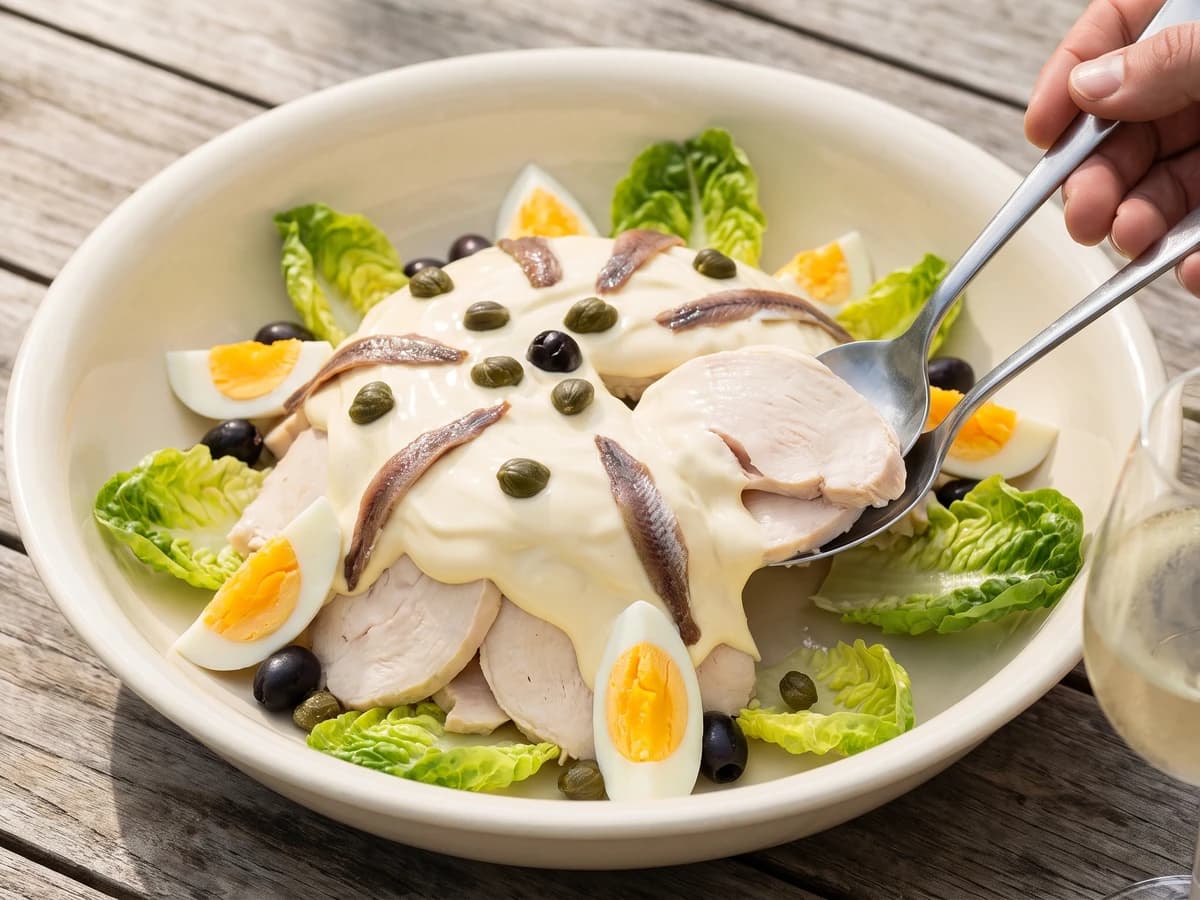
Cold roast chicken, ciseled lettuce, and a shining coat of homemade mayonnaise, arranged with capers, olives, anchovies, eggs, and lettuce hearts, then tossed at the table as the canon intends.
A cooking platform built around craft, culture, and the stories behind what we eat.

Created by Chef Juliette
Based on No. 2025, Salade de Truffes blanches, from Le Guide Culinaire (1907) by Auguste Escoffier
White Piedmont truffle, shaved at the table over a silken hard-boiled yolk sauce sharpened with Dijon and vinegar. The perfume is the dish, and timing protects every bit of it.
Salade de Truffes blanches (white truffle salad) teaches that service can be a technique. White Piedmont truffle is not cooked, steeped, or left waiting under dressing. Its perfume is most alive at the instant the blade opens the flesh, so the one true thing to know before touching a pan is this: make the yolk sauce first, seat everyone, then shave.
The old entry assumed a kitchen and dining room moving together, with truffles brushed, plates waiting, and a cook ready to cut them at the moment of service. No saucier, stockpot, or salamander is relevant here; the brigade's only advantage was its handoff. At home, an adjustable truffle shaver and four waiting plates replace it. The source gives its method but no quantities, so this version supplies a restrained three-to-one balance of oil to vinegar and scales the truffle to 60 grams for four. Nothing else enters the bowl.
The brigade handoff is scaffolding and can go. The hard-boiled yolk sauce and shaving à la minute are the dish, and both must stay. Press the yolks fine, add the oil patiently, and have every guest ready before you lift the shaver. One cook, one stove, one evening.
White truffles belong to Piedmont, especially the Langhe hills around Alba, rather than to any French region; French grand kitchens brought them into the classical repertoire because exceptional ingredients have always crossed borders. In the French salad course, salade did not necessarily mean leaves: it could be a prized ingredient served cool and seasoned with oil and vinegar, as it is here. The hard-boiled yolk gives the seasoning enough body to cling without cooking or concealing the truffle.
Quantity
2 small to medium (about 2.1 oz / 60 g total)
gently brushed clean
Quantity
2
Quantity
1 teaspoon (5 ml / 5 g)
Quantity
3 tablespoons (45 ml / 41 g)
Quantity
1 tablespoon (15 ml / 15 g)
Quantity
1/4 teaspoon (1.25 ml / 1.5 g)
Quantity
1/8 teaspoon (0.6 ml / 0.3 g)
| Ingredient | Quantity |
|---|---|
| fresh white Piedmont trufflesgently brushed clean | 2 small to medium (about 2.1 oz / 60 g total) |
| large eggs | 2 |
| Dijon mustard | 1 teaspoon (5 ml / 5 g) |
| mild olive oil | 3 tablespoons (45 ml / 41 g) |
| white wine vinegar | 1 tablespoon (15 ml / 15 g) |
| fine sea salt | 1/4 teaspoon (1.25 ml / 1.5 g) |
| freshly ground white pepper | 1/8 teaspoon (0.6 ml / 0.3 g) |
Lower the eggs into a small saucepan of gently boiling water and cook for 10 minutes, keeping the boil calm so the shells do not knock about. Transfer them immediately to cold water. Once cool enough to handle, peel them, separate the firm yellow yolks from the whites, and reserve the whites for another dish. The yolks should be fully set without a grey-green rim.
Brush the truffles gently with a soft brush, working into every hollow without scraping away the skin. If soil remains, pass them briefly under cold running water while brushing, then dry them at once and completely. Do not peel them. Keep them whole at cool room temperature while you make the sauce, because the perfume fades fastest after cutting.
Press the hard-boiled yolks through a fine sieve into a small bowl, then work in the salt, white pepper, and Dijon mustard until smooth. Reserve 1 teaspoon of this seasoned yolk paste. Beat the olive oil into the remaining paste a few drops at a time, then in a thin thread once the emulsion begins to hold. If oil gathers around the edge, stop. Ça se rattrape: loosen the reserved paste in a clean bowl with 1 teaspoon of the measured vinegar, then beat the broken sauce into it one teaspoon at a time. When the oil is fully incorporated, beat in the remaining vinegar. The sauce should be thick, satin-smooth, and spoonable, not runny.
Once the guests are seated, divide the yolk sauce among four room-temperature shallow plates, making a generous low pool rather than a decorative streak. Cold plates mute truffle perfume, and there is no advantage in chilling them. Set the plates close together so every portion can be finished quickly.
Set the truffle shaver to produce nearly translucent slices, about 0.3 to 0.5 mm thick. Shave half the truffles directly over the sauce, divide the shavings evenly, and lift them through the sauce once with the tips of two forks. Shave the remainder over the top and leave those final slices untouched. Serve immediately, while every fresh cut still carries its perfume. À table!
1 serving (about 56g)
Culinary guides, cultural storytelling, and the editorial depth that makes cooking meaningful.
Discover Culinary ExplorerChef Juliette
Cold roast chicken, ciseled lettuce, and a shining coat of homemade mayonnaise, arranged with capers, olives, anchovies, eggs, and lettuce hearts, then tossed at the table as the canon intends.

Chef Juliette
Cold roast or poached chicken with fine ribbons of lettuce, dressed at the final moment with oil and vinegar: a composed salad whose freshness depends entirely on timing.

Chef Juliette
Five leaves, one living rule: laitue, romaine, chicorée, mâche, or pissenlit must be washed, dried, and dressed only as they go to the table, while every leaf still carries its light vinaigrette.

Chef Juliette
Salade de Betteraves proves that baking, not boiling, is the whole argument: concentrated garnet sweetness, tender baked onion, sharp mustard, and herbs cut into a weeknight salad worth making ahead.