Chef Juliette
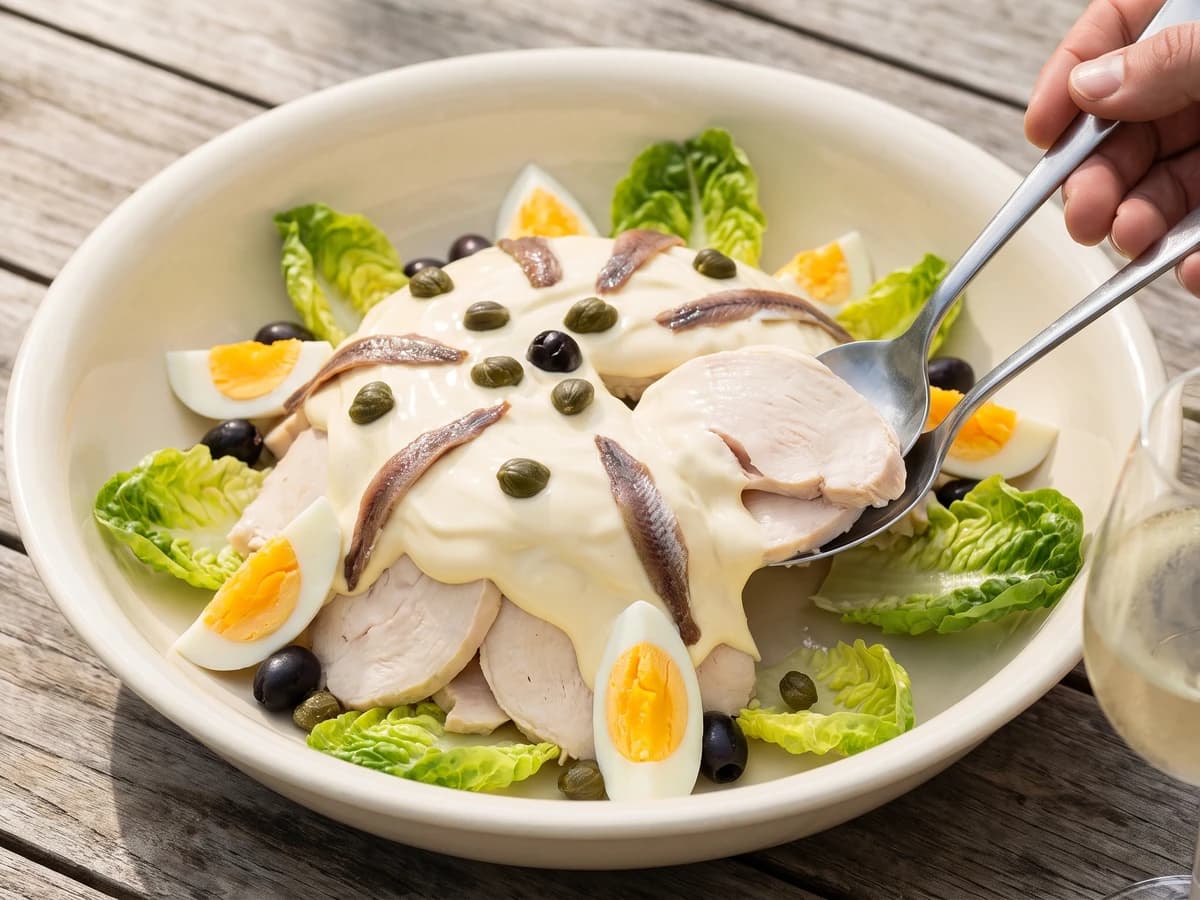
Mayonnaise de Volaille
Cold roast chicken, ciseled lettuce, and a shining coat of homemade mayonnaise, arranged with capers, olives, anchovies, eggs, and lettuce hearts, then tossed at the table as the canon intends.
A cooking platform built around craft, culture, and the stories behind what we eat.
Created by Chef Juliette
Based on No. 2023, Salade Trédern, from Le Guide Culinaire (1907) by Auguste Escoffier
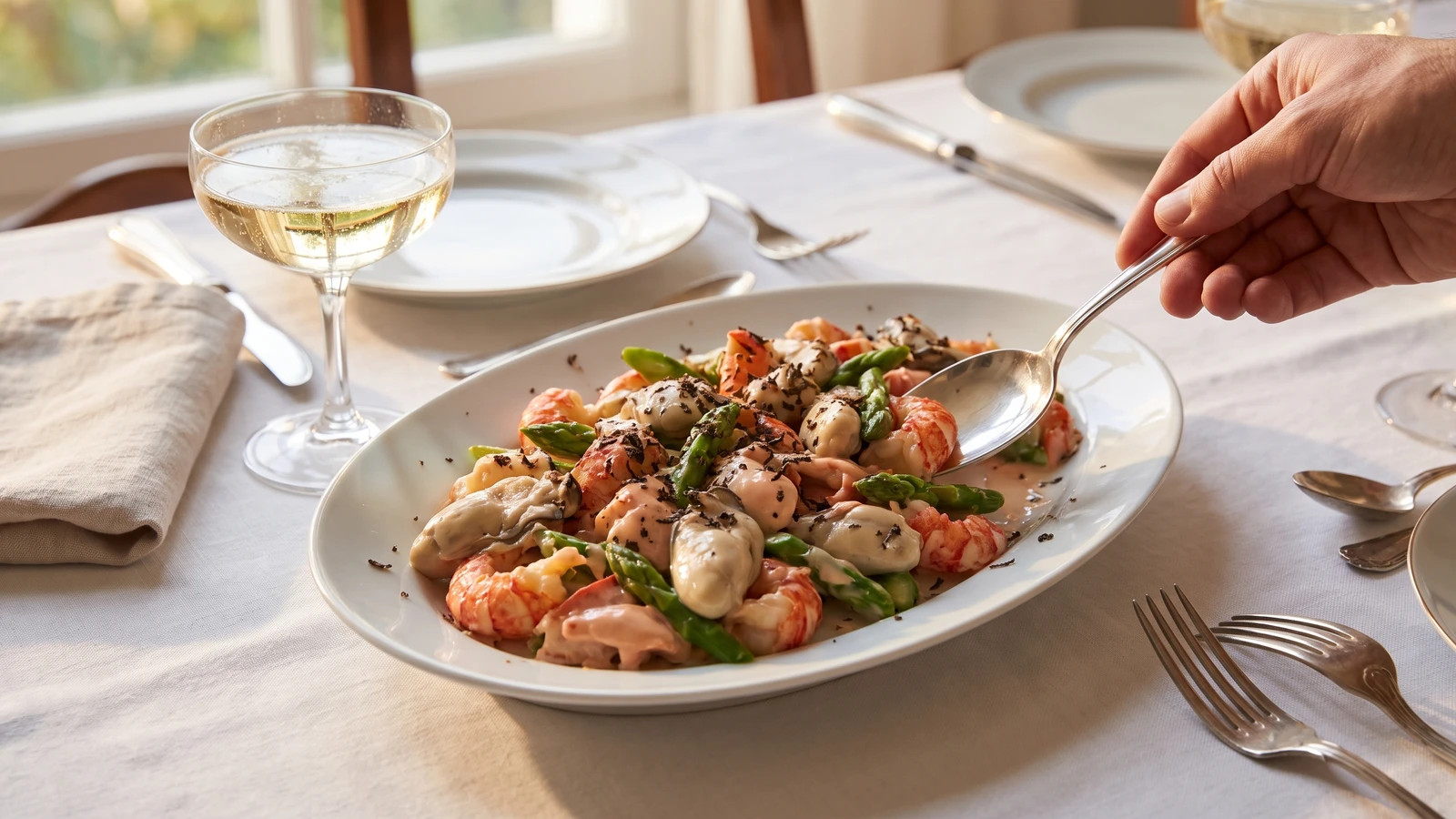
The shells are the sauce in Salade Trédern: sweet crayfish, lemon-poached oysters, asparagus tips, and raw truffle dressed while barely warm in a coral-tinted, shell-enriched mayonnaise.
Salade Trédern (barely warm crayfish, oyster, and asparagus salad) teaches one hard, useful truth: the shells are the sauce. The tails and oysters bring sweetness and salinity, the asparagus brings a green snap, but the dish becomes itself only when the crayfish carcasses are pounded with cream and worked into a condimented mayonnaise. Dress everything barely cooled. Hot shellfish loosens the emulsion, while refrigerator-cold shellfish mutes it.
The original kitchen assumed twenty-four crayfish, twenty-four oysters, a saucier with mayonnaise ready, and spare hands to pound warm shells through a tamis. For four, the honest equivalent is twelve of each, half the asparagus and cream, one small bowl of mayonnaise, a sturdy mortar, and a fine sieve. Brigade volume and extra hands are scaffolding and can go; cooking the crayfish as for bisque, poaching the oysters in lemon, using the carcasses, and assembling everything barely warm are the dish and must stay. One cook, one stove, one evening.
Make the mayonnaise first, then move in sequence so the oysters are the last thing cooked. The moment that matters is temperature: each constituent should feel barely warm against your fingertip, never hot, before it meets the mayonnaise. If the emulsion turns, don't pour it out. Ça se rattrape, and the rescue sits exactly where you'll need it.
Salade Trédern belongs to the named composed salads of the formal Parisian table, where a title signaled a fixed formula rather than a loose bowl of greens. It is not recorded as a Breton regional salad despite its name; its ceremonial larder joins crayfish, oysters, asparagus, raw truffle, and mayonnaise. Its cleverness is practical: bisque logic moves into an emulsion, so the otherwise discarded carcasses supply the coral color and deep shell flavor that define the dish.
Quantity
12 (about 1½ lb / 680 g)
fishmonger-dispatched or fully thawed
Quantity
1 tablespoon (15 ml / 14 g)
Quantity
1 (about 1 oz / 30 g)
finely sliced
Quantity
½ (about 1 oz / 30 g)
finely sliced
Quantity
1 teaspoon (5 ml / 6 g)
Quantity
2 tablespoons (30 ml / 28 g)
Quantity
⅓ cup (80 ml / 80 g)
Quantity
⅓ cup (80 ml / 80 g)
Quantity
1 small
Quantity
12
freshly shucked, beards and shell fragments removed, liquor reserved and strained
Quantity
¼ cup (60 ml / 60 g)
Quantity
1½ tablespoons (22 ml / 20 g)
trimmed
Quantity
1
Quantity
1 teaspoon (5 ml / 5 g)
Quantity
1 teaspoon (5 ml / 5 g)
Quantity
6 tablespoons (90 ml / 82 g)
Quantity
2 teaspoons (10 ml / 12 g)
divided
Quantity
⅛ teaspoon (0.6 ml / 0.3 g)
Quantity
1 pinch, less than 1/16 teaspoon (less than 0.3 ml / 0.1 g)
Quantity
1 tablespoon (15 ml / 15 g)
gently warmed
Quantity
0.35 oz (10 g)
cleaned
| Ingredient | Quantity |
|---|---|
| whole raw crayfishfishmonger-dispatched or fully thawed | 12 (about 1½ lb / 680 g) |
| unsalted butter | 1 tablespoon (15 ml / 14 g) |
| small shallotfinely sliced | 1 (about 1 oz / 30 g) |
| small carrotfinely sliced | ½ (about 1 oz / 30 g) |
| tomato paste | 1 teaspoon (5 ml / 6 g) |
| Cognac | 2 tablespoons (30 ml / 28 g) |
| dry white wine | ⅓ cup (80 ml / 80 g) |
| water | ⅓ cup (80 ml / 80 g) |
| bouquet garni of parsley stems, thyme, and bay | 1 small |
| small oystersfreshly shucked, beards and shell fragments removed, liquor reserved and strained | 12 |
| fresh lemon juice | ¼ cup (60 ml / 60 g) |
| asparagus tipstrimmed | 1½ tablespoons (22 ml / 20 g) |
| pasteurized large egg yolk | 1 |
| Dijon mustard | 1 teaspoon (5 ml / 5 g) |
| white wine vinegar | 1 teaspoon (5 ml / 5 g) |
| neutral oil | 6 tablespoons (90 ml / 82 g) |
| fine sea saltdivided | 2 teaspoons (10 ml / 12 g) |
| ground white pepper | ⅛ teaspoon (0.6 ml / 0.3 g) |
| cayenne | 1 pinch, less than 1/16 teaspoon (less than 0.3 ml / 0.1 g) |
| heavy creamgently warmed | 1 tablespoon (15 ml / 15 g) |
| fresh black trufflecleaned | 0.35 oz (10 g) |
Set a medium bowl on a folded towel. Whisk the egg yolk with the Dijon mustard, white wine vinegar, ¼ teaspoon of the salt, white pepper, and cayenne until smooth. Add the oil one drop at a time at first, whisking constantly; once the emulsion thickens and holds the trace of the whisk, pour the remaining oil in a very thin thread. The finished mayonnaise should be glossy and firm enough to nap a spoon. Cover it and keep it at cool room temperature while you cook the shellfish.
Bring a small saucepan of water to a full boil and season it with 1 teaspoon of the salt. Add the asparagus tips and blanch for 60 to 90 seconds, until brilliant green and tender at the cut end while retaining a clean bite. Lift them out, drain thoroughly, and spread them on a clean towel. Don't chill them in ice water; the original calls for barely cooled asparagus, not cold asparagus.
Melt the butter in a heavy saucepan over medium heat. Add the shallot, carrot, and ¼ teaspoon of the salt, then cook for 2 minutes without browning. Stir in the tomato paste and cook until it darkens slightly. Add the crayfish and turn them over the heat until their shells begin to redden. Remove the pan from the flame before adding the Cognac, then return it to the heat and reduce nearly dry. Add the white wine, water, and bouquet garni, cover, and hold at a lively simmer for 4 to 5 minutes, turning once, until the shells are bright red and the tail flesh is opaque. The thickest tail should reach 145°F (63°C). Lift out the crayfish, leaving the vegetables behind.
While the crayfish are still warm, twist off the tails and peel them over a bowl. Halve each tail lengthwise and remove the dark intestinal vein. Pull the stomach sacs and feathery gills from the heads and discard them, then snip the remaining shells, heads, and claws into manageable pieces with kitchen shears. Pound them firmly in a sturdy mortar until finely crushed. Add the warm cream a little at a time and continue pounding until the mixture resembles a coral-colored paste. Force it through a very fine sieve with the back of a spoon, scraping the smooth shell cream from the underside, then fold that cream into the mayonnaise.
Pour the lemon juice and strained oyster liquor into a small shallow saucepan and bring them to the barest simmer. Add the oysters in one layer and poach for 30 to 60 seconds, turning once, until they plump and their fringed edges just begin to curl. Lift them out immediately with a slotted spoon and let them drain on a plate. They should be cooked through but still tender; a hard boil tightens them before you can blink.
Touch the crayfish tails, oysters, and asparagus. They should feel barely warm, never hot, and their surfaces must be well drained so they don't water the mayonnaise. Combine the three constituents in a bowl and fold in the shell-enriched mayonnaise gently, adding enough to coat every piece without burying it. Arrange the salad loosely on a low oval platter so the crayfish, oysters, and asparagus remain distinct. Shave the raw black truffle finely over the top and serve at once. À table!
1 serving (about 140g)
Culinary guides, cultural storytelling, and the editorial depth that makes cooking meaningful.
Discover Culinary ExplorerChef Juliette
Cold roast chicken, ciseled lettuce, and a shining coat of homemade mayonnaise, arranged with capers, olives, anchovies, eggs, and lettuce hearts, then tossed at the table as the canon intends.

Chef Juliette
Cold roast or poached chicken with fine ribbons of lettuce, dressed at the final moment with oil and vinegar: a composed salad whose freshness depends entirely on timing.

Chef Juliette
Five leaves, one living rule: laitue, romaine, chicorée, mâche, or pissenlit must be washed, dried, and dressed only as they go to the table, while every leaf still carries its light vinaigrette.

Chef Juliette
Salade de Betteraves proves that baking, not boiling, is the whole argument: concentrated garnet sweetness, tender baked onion, sharp mustard, and herbs cut into a weeknight salad worth making ahead.