Chef Juliette
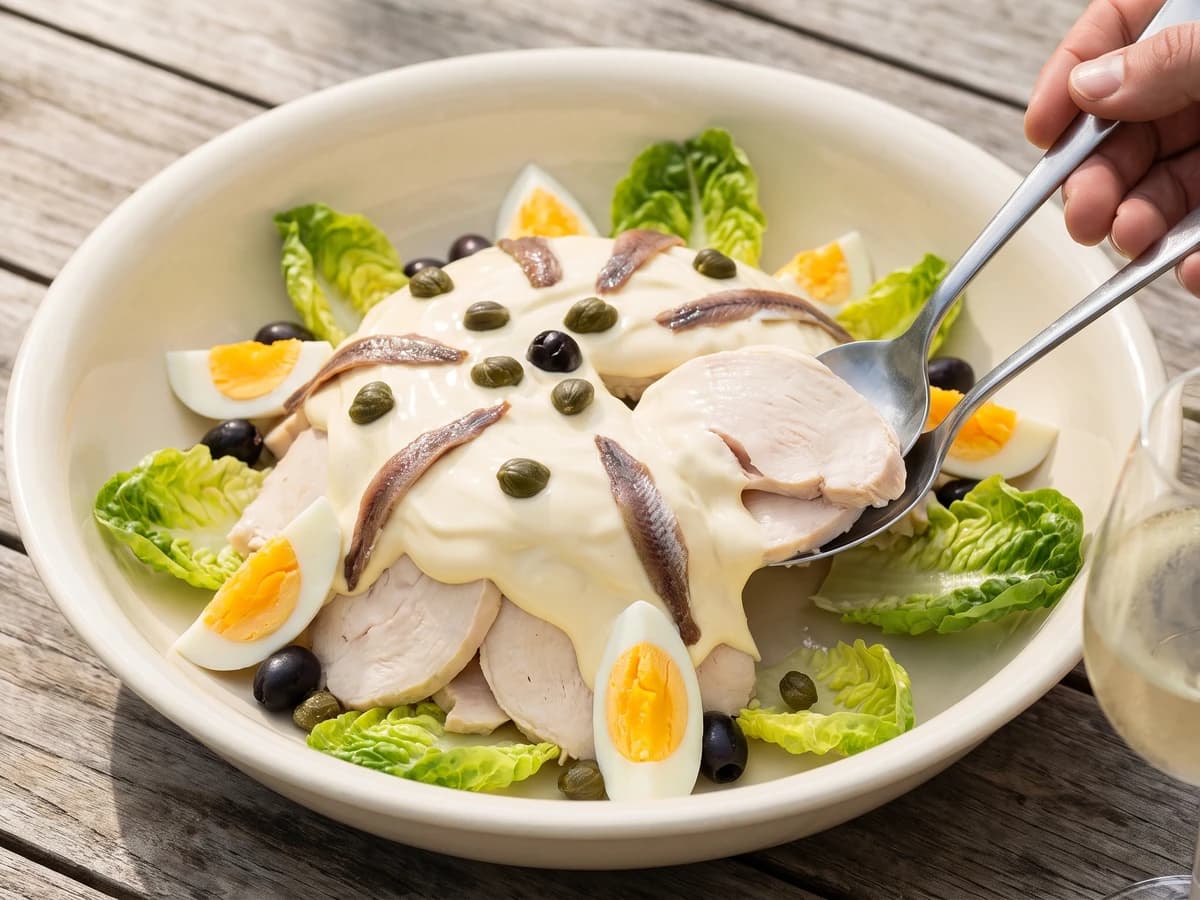
Mayonnaise de Volaille
Cold roast chicken, ciseled lettuce, and a shining coat of homemade mayonnaise, arranged with capers, olives, anchovies, eggs, and lettuce hearts, then tossed at the table as the canon intends.
A cooking platform built around craft, culture, and the stories behind what we eat.

Created by Chef Juliette
Based on No. 2021, Salade Russe, from Le Guide Culinaire (1907) by Auguste Escoffier
A lavish cold composition of exact little cuts: vegetables, lobster, ham, truffle, capers, and cornichons bound in mayonnaise, then crowned with beetroot and caviar. Dry every piece, because water is the enemy.
Salade Russe (Russian-style composed salad) teaches one severe little truth: mayonnaise can bind only what has been drained completely dry. Ten distinct ingredients become a generous, luxurious whole when every cut keeps its shape; wet vegetables loosen the emulsion, while careless beetroot turns everything pink. Before you touch a pan, clear a towel-lined tray. Dryness is the dish.
The classical entry assumed a garde-manger, the cold-larder cook, preparing each constituent separately, a saucier with mayonnaise ready, and enough hands to cut a banquet quantity julienne-fashion. At home, one saucepan used in sequence, one skillet, one tray, and a digital scale do the work. I have changed only the scale and the brigade workflow: each principal ingredient is reduced to the same finished weight of 50 grams, enough for four generous servings. One cook, one stove, one evening.
The brigade's many pans and extra hands were scaffolding, so they can go. The equal proportions, precise julienne, lobster, ham, truffle, anchovy, mayonnaise, beetroot, and caviar are the dish, so they stay. Cut everything to the same visual scale, leave only the peas and capers whole, then dry every constituent before folding. That final drying is the step that decides the salad.
Salade russe sits at the meeting point of Moscow's zakuski table and the Parisian garde-manger, or cold larder, where cooked vegetables were cut precisely, bound with mayonnaise, and arranged for grand service. In Russian homes, related salads became more potato-forward, while the French classical formula traveled toward luxury through lobster, truffle, anchovy, and caviar. The name therefore describes a French grand-kitchen branch of a wider family of Russian cold salads, not one fixed preparation preserved unchanged on both sides.
Quantity
⅓ cup (80 ml / 50 g), measured after cooking
cut julienne-fashion, cooked, cooled, and dried
Quantity
⅓ cup (80 ml / 50 g), measured after cooking
cut julienne-fashion, cooked, cooled, and dried
Quantity
½ cup (120 ml / 50 g), measured after cooking
cut into matchstick lengths, cooked, cooled, and dried
Quantity
⅓ cup (80 ml / 50 g)
cooked, cooled, and dried
Quantity
⅓ cup (80 ml / 50 g)
drained if preserved and cut julienne-fashion
Quantity
⅓ cup (80 ml / 50 g)
drained and thoroughly dried
Quantity
⅓ cup (80 ml / 50 g)
drained, dried, and cut julienne-fashion
Quantity
1½ cups raw (360 ml / 110 g), to yield ½ cup (120 ml / 50 g) cooked
thinly sliced
Quantity
1 tablespoon (15 ml / 14 g)
Quantity
⅓ cup (80 ml / 50 g)
chilled and cut into narrow strips
Quantity
⅓ cup (80 ml / 50 g)
cut julienne-fashion
Quantity
4 fillets (about 20 g)
drained, dried, and cut into fine strips
Quantity
¾ cup (180 ml / 170 g), plus 2 tablespoons (30 ml / 28 g) for rescue if needed
chilled
Quantity
1 small, about ½ cup (120 ml / 85 g)
chilled, dried, and cut julienne-fashion
Quantity
2 tablespoons (30 ml / 30 g)
Quantity
2 teaspoons (10 ml / 12 g)
for the cooking water
| Ingredient | Quantity |
|---|---|
| carrotcut julienne-fashion, cooked, cooled, and dried | ⅓ cup (80 ml / 50 g), measured after cooking |
| waxy potatocut julienne-fashion, cooked, cooled, and dried | ⅓ cup (80 ml / 50 g), measured after cooking |
| haricots verts (French beans)cut into matchstick lengths, cooked, cooled, and dried | ½ cup (120 ml / 50 g), measured after cooking |
| petits poiscooked, cooled, and dried | ⅓ cup (80 ml / 50 g) |
| black truffle, fresh in season or whole preserveddrained if preserved and cut julienne-fashion | ⅓ cup (80 ml / 50 g) |
| capersdrained and thoroughly dried | ⅓ cup (80 ml / 50 g) |
| cornichons (small gherkins)drained, dried, and cut julienne-fashion | ⅓ cup (80 ml / 50 g) |
| button mushroomsthinly sliced | 1½ cups raw (360 ml / 110 g), to yield ½ cup (120 ml / 50 g) cooked |
| unsalted butter | 1 tablespoon (15 ml / 14 g) |
| cooked lobster meatchilled and cut into narrow strips | ⅓ cup (80 ml / 50 g) |
| lean jambon de Pariscut julienne-fashion | ⅓ cup (80 ml / 50 g) |
| anchovy filletsdrained, dried, and cut into fine strips | 4 fillets (about 20 g) |
| mayonnaise saucechilled | ¾ cup (180 ml / 170 g), plus 2 tablespoons (30 ml / 28 g) for rescue if needed |
| cooked red beetrootchilled, dried, and cut julienne-fashion | 1 small, about ½ cup (120 ml / 85 g) |
| caviar | 2 tablespoons (30 ml / 30 g) |
| fine saltfor the cooking water | 2 teaspoons (10 ml / 12 g) |
Cut the carrot and waxy potato julienne-fashion, into rods about 3 mm thick and 3 cm long. Cut the haricots verts into the same length, then cut the truffle, cornichons, lobster, and ham to match. Slice the mushrooms thinly and cut the anchovies into narrow strips. Peas and capers cannot become matchsticks, of course, so leave them whole; fidelity here means matching the scale and intent of the cut, not arguing with a pea.
Bring a medium saucepan of water to a gentle boil and season it with the salt. Using the same water and a skimmer, cook the carrots for 2 to 3 minutes, the haricots verts for about 2 minutes, and the peas for 30 to 60 seconds, lifting each out separately as soon as it is tender but still holds its shape. Chill the beans and peas briefly in cold water to preserve their colour, then drain at once. Cook the potato last at a bare simmer for 3 to 4 minutes. If its edges begin to fray, lift it immediately; it will finish setting as it cools.
Melt the butter in a wide skillet over medium-high heat. Add the sliced mushrooms in one layer and cook until they release their water, take a little colour, and leave the pan nearly dry, about 5 to 7 minutes. Spread them on a plate to cool completely. Wet mushrooms would slacken the mayonnaise, so the dry pan at the finish matters more than deep browning.
Spread the cooked vegetables and mushrooms in separate sections on clean towels. Blot the capers, cornichons, truffle, lobster, ham, and anchovies as well, then chill everything uncovered for about 20 minutes. Weigh exactly 50 grams of each principal constituent: carrot, potato, haricots verts, peas, truffle, capers, cornichons, mushrooms, lobster, and ham. Different densities give different volumes, but the finished weights remain equal, exactly as the formula requires. Reserve a few handsome strips of lobster, beans, truffle, and cornichon for decoration.
Place the ten weighed constituents and the anchovy strips in a broad chilled bowl. Add about ½ cup of the mayonnaise sauce and fold with a large spoon, turning from the bottom so the julienne stays intact. Add only enough of the remaining mayonnaise to cohere the salad, coating every piece without leaving sauce pooled underneath. If the mixture slackens, stop stirring. Ça se rattrape: drain it in a fine sieve over a bowl for 5 minutes, chill it for 15 minutes, then fold in a spoonful or two of the reserved fresh mayonnaise.
Spoon the Salade Russe onto a chilled shallow oval platter and shape it into a generous low mound with the back of the spoon. Keep the surface composed rather than compressed; the separate cuts should still be visible beneath the mayonnaise. Cover without touching the surface and chill for 45 minutes, just long enough for the emulsion to settle around the ingredients.
Blot the beetroot once more, then arrange it around the edge of the salad just before serving so its colour stays distinct. Set the caviar in small spoonfuls across the top and finish with the reserved lobster, haricots verts, truffle, and cornichon. Bring the platter to the table cold, with every constituent still recognizable and the mayonnaise holding a soft gloss. À table!
1 serving (about 205g)
Culinary guides, cultural storytelling, and the editorial depth that makes cooking meaningful.
Discover Culinary ExplorerChef Juliette
Cold roast chicken, ciseled lettuce, and a shining coat of homemade mayonnaise, arranged with capers, olives, anchovies, eggs, and lettuce hearts, then tossed at the table as the canon intends.

Chef Juliette
Cold roast or poached chicken with fine ribbons of lettuce, dressed at the final moment with oil and vinegar: a composed salad whose freshness depends entirely on timing.

Chef Juliette
Five leaves, one living rule: laitue, romaine, chicorée, mâche, or pissenlit must be washed, dried, and dressed only as they go to the table, while every leaf still carries its light vinaigrette.

Chef Juliette
Salade de Betteraves proves that baking, not boiling, is the whole argument: concentrated garnet sweetness, tender baked onion, sharp mustard, and herbs cut into a weeknight salad worth making ahead.