Chef Juliette
Mayonnaise de Volaille
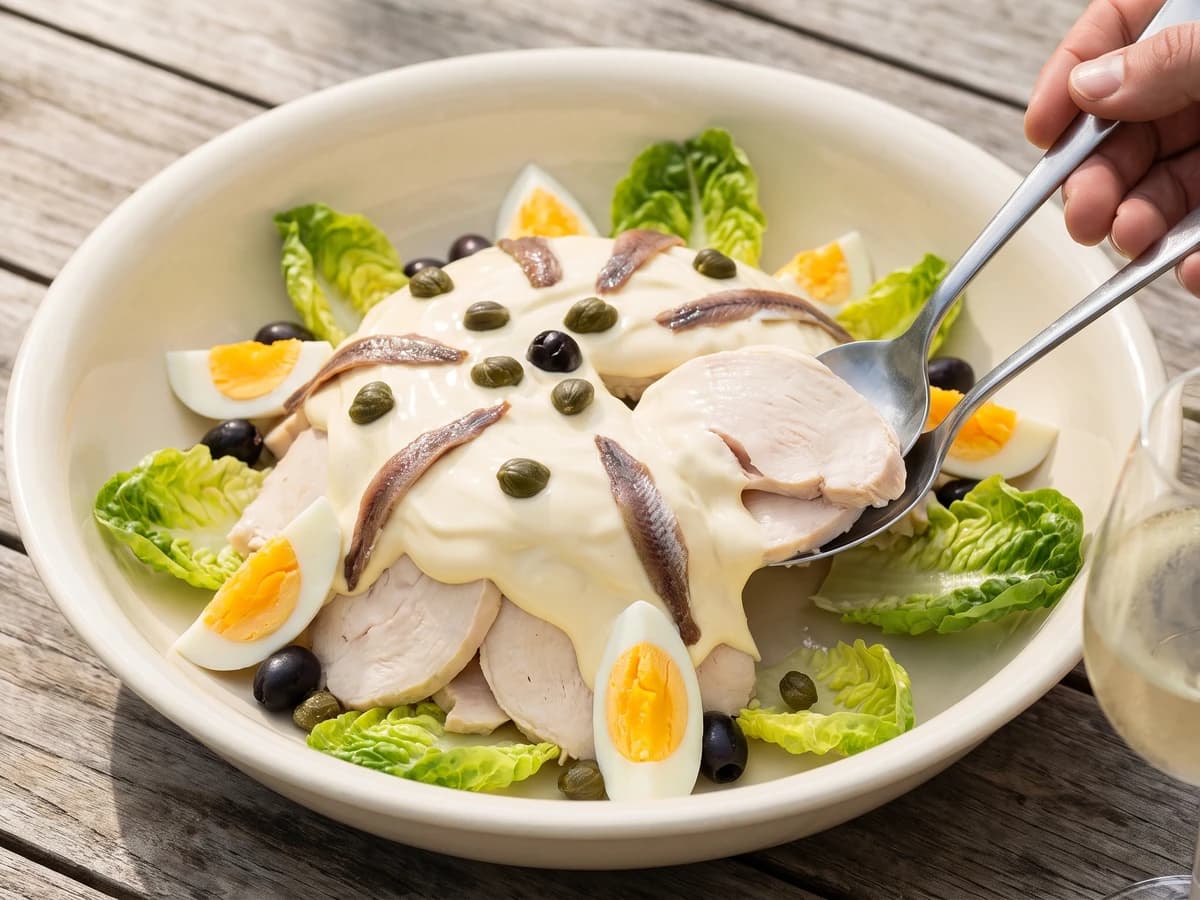
Cold roast chicken, ciseled lettuce, and a shining coat of homemade mayonnaise, arranged with capers, olives, anchovies, eggs, and lettuce hearts, then tossed at the table as the canon intends.
A cooking platform built around craft, culture, and the stories behind what we eat.

Created by Chef Juliette
Based on No. 2020, Salade Régence, from Le Guide Culinaire (1907) by Auguste Escoffier
Cocks’ kidneys, raw truffle, asparagus heads, and celery threads meet in exact proportion under a sharp lemon emulsion, a rare composed salad whose luxury depends on restraint rather than display.
Salade Régence (Regency salad) teaches that proportion is flavor. Before you touch a pan, know the one true thing: cocks’ kidneys, raw truffle, asparagus heads, and celery must meet in equal prepared weights. The result is cool, crisp, earthy, and faintly mineral, with enough lemon to keep the truffle awake.
The source entry is brigade shorthand. It needs no saucier, stockpot kept on the fire, or salamander, but it assumes a specialist poulterer delivered the kidneys cleaned, a vegetable cook had the asparagus ready, and raw truffle waited in the larder. The honest home translation uses one saucepan for the asparagus and kidneys in sequence, separate ice baths, and 50 g of each principal ingredient for four first-course portions. What changed is the scale and the written-out preparation the brigade took for granted. The equal ratio, raw truffle, celery threads, and oil-and-lemon seasoning are the dish, so none of them move. One cook, one stove, one evening.
Dress it only when the guests are ready. The decisive step is the final toss: every component must be cold, dry, and cut finely enough to share the fork, then coated at the last moment so water cannot dull the truffle or soften the celery.
Salade Régence belongs to the Parisian register of grand cuisine, where courtly titles signaled luxurious combinations rather than the cooking of a particular province: truffle, asparagus, and prized poultry offal appear here in measured equality. In classical poultry vocabulary, rognons de coq referred to the cock’s pale reproductive glands, often translated euphemistically as cocks’ kidneys, rather than the dark renal tissue fixed along the backbone. The salad settled into the canon as a composed first course, and its spare oil-and-lemon seasoning is deliberate, exposing costly ingredients instead of concealing them beneath a heavy sauce.
Quantity
about ⅓ cup (80 ml / 50 g)
membranes and attached tissue removed
Quantity
about ½ cup loosely packed (120 ml / 50 g)
brushed clean
Quantity
about 12 tips, ½ cup (120 ml / 50 g)
trimmed to 2-inch lengths
Quantity
1 stalk, about 1 cup loosely packed (240 ml / 50 g)
cut lengthwise into extremely fine threads
Quantity
3 tablespoons (45 ml / 41 g)
Quantity
2½ tablespoons (37 ml / 37 g)
Quantity
1 tablespoon plus ¾ teaspoon (19 ml / 22 g)
divided
Quantity
½ teaspoon (2.5 ml / 1 g)
Quantity
6 cups (1.5 L / 1.5 kg)
for blanching
Quantity
4 cups (950 ml / 900 g)
divided between two ice baths
| Ingredient | Quantity |
|---|---|
| cleaned cocks’ kidneys (rognons de coq)membranes and attached tissue removed | about ⅓ cup (80 ml / 50 g) |
| fresh raw black trufflebrushed clean | about ½ cup loosely packed (120 ml / 50 g) |
| large asparagus tipstrimmed to 2-inch lengths | about 12 tips, ½ cup (120 ml / 50 g) |
| large inner celery stalkcut lengthwise into extremely fine threads | 1 stalk, about 1 cup loosely packed (240 ml / 50 g) |
| mild olive oil | 3 tablespoons (45 ml / 41 g) |
| freshly squeezed lemon juice | 2½ tablespoons (37 ml / 37 g) |
| fine sea saltdivided | 1 tablespoon plus ¾ teaspoon (19 ml / 22 g) |
| finely ground white pepper | ½ teaspoon (2.5 ml / 1 g) |
| waterfor blanching | 6 cups (1.5 L / 1.5 kg) |
| icedivided between two ice baths | 4 cups (950 ml / 900 g) |
Fill two medium bowls with equal portions of the ice and enough cold water to make separate ice baths. Bring the measured blanching water and 1 tablespoon of the salt to a boil in a 2-quart saucepan. Keep the trimmed asparagus and cleaned cocks’ kidneys separate and cold while the water heats.
Lower the asparagus tips into the boiling water and cook for 1½ to 2 minutes, until brilliant green and tender enough for a knife tip to enter with slight resistance. Transfer them immediately to the first ice bath, chill for 3 minutes, then drain and dry thoroughly. Lower the water to a bare simmer, add the cocks’ kidneys, and poach gently for 5 to 7 minutes, until opaque throughout and 165°F (74°C) at the thickest point. Chill them in the second ice bath, drain, and pat dry. If they tightened in water that boiled too hard, ça se rattrape: chill them completely, slice them nearly translucent, and moisten them with a teaspoonful of the finished dressing for 5 minutes.
Slice the chilled cocks’ kidneys into thin, neat rounds. Cut the celery lengthwise with a very sharp knife into threads no thicker than a matchstick, then weigh out exactly 50 g. Weigh 50 g each of the cooked asparagus tips and kidneys. Shave 50 g of raw truffle directly onto a cool plate. Equal prepared weights are the grammar of Salade Régence; the ingredients pack differently by volume, so the scale keeps the book’s one-to-one-to-one-to-one proportion honestly.
Make an émulsion temporaire, a temporary emulsion: whisk the lemon juice with the remaining ¾ teaspoon salt and the white pepper until the salt dissolves, then pour in the olive oil slowly while whisking. Taste it. The lemon and seasoning should feel unusually bright on their own because the four cool ingredients will soften them. If the oil separates, whisk again just before dressing; this emulsion is meant to be immediate, not stabilized with mustard.
Put the completely dry kidneys, asparagus tips, celery threads, and truffle shavings in a wide chilled bowl. Pour over two-thirds of the émulsion and fold gently with a large spoon and fork, lifting from beneath so the truffle stays in broad shavings. Add only enough of the remaining dressing to make every surface glisten. If dressing pools at the bottom, lift the salad into a clean chilled bowl and leave the excess behind; adding more solids would spoil the equal proportion.
Arrange the Salade Régence loosely on a chilled oval platter, interlacing the celery through the kidneys and asparagus rather than separating the ingredients into little territories. Turn a few broad truffle shavings toward the surface, spoon over any dressing clinging to the mixing bowl, and serve at once. The celery should still snap, the asparagus should hold its shape, and the lemon should lift the truffle without covering it. À table!
1 serving (about 70g)
Culinary guides, cultural storytelling, and the editorial depth that makes cooking meaningful.
Discover Culinary ExplorerChef Juliette
Cold roast chicken, ciseled lettuce, and a shining coat of homemade mayonnaise, arranged with capers, olives, anchovies, eggs, and lettuce hearts, then tossed at the table as the canon intends.

Chef Juliette
Cold roast or poached chicken with fine ribbons of lettuce, dressed at the final moment with oil and vinegar: a composed salad whose freshness depends entirely on timing.

Chef Juliette
Five leaves, one living rule: laitue, romaine, chicorée, mâche, or pissenlit must be washed, dried, and dressed only as they go to the table, while every leaf still carries its light vinaigrette.

Chef Juliette
Salade de Betteraves proves that baking, not boiling, is the whole argument: concentrated garnet sweetness, tender baked onion, sharp mustard, and herbs cut into a weeknight salad worth making ahead.