Culinary Explorer

A cooking platform built around craft, culture, and the stories behind what we eat.
Discover Culinary Explorer
Salade Rachel

Salade Rachel

Created by Chef Juliette

Based on No. 2019, Salade Rachel, from Le Guide Culinaire (1907) by Auguste Escoffier

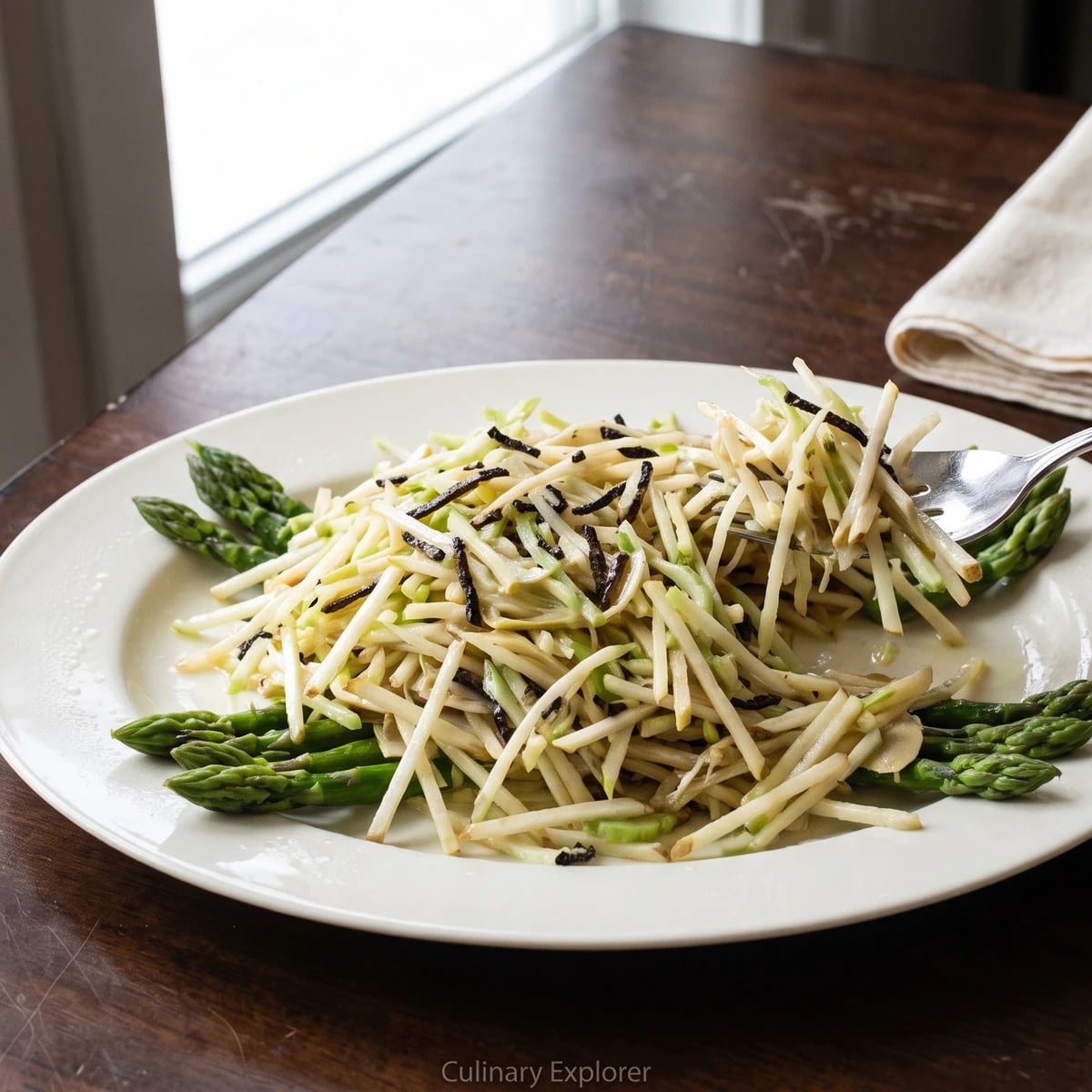
Celery, raw artichoke, truffle, and potato cut to fine julienne, asparagus tips left whole, and just enough mayonnaise to make them cohere: Salade Rachel is restraint dressed for company.

Salads
French
Dinner Party
Special Occasion
Celebration
50 min
Active Time
25 min cook1 hr 30 min total
Yield4 servings

Salade Rachel (a composed salad of matchstick-cut vegetables, truffle, and whole asparagus tips) teaches restraint before it teaches knife work. Know this before touching a pan: the mayonnaise is a thread, never a coat. Celery must snap, raw artichoke must stay pale and faintly nutty, truffle must remain visible, potato must hold its edges, and the asparagus heads must sit among them whole.

The original assumed a garde-manger with every element already trimmed, chilled, and weighed, plus mayonnaise sauce ready for service. At home, one saucepan cooks the potato and blanches the asparagus, one ice bath chills both, and a small scale protects the book's equal proportions at 75 g of each element, enough for four. The brigade's ranks of trays were scaffolding and can go. Equal weights, julienne-fashion for the first four ingredients, whole asparagus heads, and scant mayonnaise are the dish; they stay. One cook, one stove, one evening.

Dry and chill every element completely before binding. This is the step that decides the salad. Water loosens the emulsion and turns delicacy into a slippery heap, so don't hurry past the towels. Once everything is cold and dry, fold with the lightest hand you own.

Salade Rachel belongs to the Parisian grand-kitchen repertory, not to a regional farmhouse table, and its name is generally associated with the celebrated tragedienne known simply as Rachel. In that repertory, a named salad was a fixed composition rather than a loose inspiration: equal quantities of celery, raw artichoke bottom, truffle, potato, and asparagus heads, with only the first four cut julienne-fashion. It passed from the professional garde-manger to formal home tables through cookery manuals, carrying the same discipline with it, mayonnaise used to make the pieces cohere, never to hide them.

The technique, the tradition, and the story behind every dish.

Discover Culinary Explorer

Ingredients

tender inner celery stalks

Quantity

2 large, yielding about ¾ cup (180 ml / 75 g) after trimming

strings removed

young globe artichokes

Quantity

2 medium, yielding about ½ cup (120 ml / 75 g) trimmed raw bottoms

leaves and chokes removed

fresh black truffle

Quantity

1 large or several smaller, about ⅓ cup (80 ml / 75 g) after trimming

brushed clean

waxy potato

Quantity

1 small, yielding about ½ cup (120 ml / 75 g) after cooking and peeling

medium asparagus heads

Quantity

14 to 18, each about 2 inches (5 cm) long, about 1 cup (240 ml / 75 g) after trimming

mayonnaise sauce

Quantity

2 to 3 tablespoons (30 to 45 ml / 30 to 45 g)

cold

fresh lemon juice

Quantity

2 tablespoons (30 ml / 30 g)

cold water

Quantity

4¼ cups (1 L / 1,000 g)

for the artichokes

fine sea salt

Quantity

1 tablespoon (15 ml / 18 g)

for the cooking water

ice and additional cold water

Quantity

as needed

for cooling

Equipment Needed

  • Digital scale accurate to 1 g
  • Sharp 20 cm (8-inch) chef's knife
  • 2-litre saucepan
  • Two medium mixing bowls
  • Fine-mesh sieve
  • Flexible spatula
  • Clean kitchen towels

Instructions

  1. 1

    Build the cold station

    Combine the lemon juice and 4¼ cups (1 L) cold water in a bowl for the raw artichoke bottoms. Set a second bowl of ice water beside it, then spread two clean kitchen towels on a tray. The acidulated water slows browning; it isn't a dressing, so the artichoke will be drained and dried thoroughly before the salad is bound.

    Prepare the acidulated water before cutting the artichokes. A raw bottom browns while you admire it, and the bowl should already be waiting.
  2. 2

    Cook the potato gently

    Put the unpeeled potato in a 2-litre saucepan, cover generously with cold water, and add the salt. Bring it slowly to a simmer and cook for 15 to 20 minutes, until a thin knife enters with slight resistance at the centre. Tender is right; soft is too far. Drain the potato, let it cool just enough to peel, then chill it completely. If it smears beneath the knife later, stop and chill it for another 15 minutes rather than forcing the cut.

    Choose a waxy potato such as Charlotte, fingerling, or a small yellow potato. Floury potatoes fracture into crumbs, and this salad depends on clean rods.
  3. 3

    Blanch the asparagus heads

    Bring the same cooking water to a full boil. Lower in the whole asparagus heads and blanch for 1½ to 3 minutes, depending on thickness, until vivid green and tender enough for a knife point to enter while a little resistance remains. Transfer them straight to the ice water. Once cold, drain and lay them on a towel without pressing. The heads stay whole, exactly as the source directs.

  4. 4

    Cut julienne-fashion

    Trim the celery and remove every tough string. Prepare the artichokes by cutting away the leaves and dark green outer flesh, then scoop out each fuzzy choke until only the pale raw bottom remains; hold the bottoms in the acidulated water. Peel the cold potato and brush the truffle clean without soaking it. Cut the celery, artichoke bottoms, truffle, and potato julienne-fashion, meaning even match-shaped rods about 1⁄16 inch (2 mm) thick and 1½ inches (4 cm) long. Slice first, stack only a few slices at a time, then cut the rods. Work gently with the potato and truffle, and leave every asparagus head whole.

    Uniformity matters more than speed. Equal rods share the mayonnaise evenly and meet the teeth together; thick celery beside fine truffle makes two separate salads in one bowl.
  5. 5

    Dry and equalize

    Drain the artichoke julienne and spread it between clean towels. Dry the celery and asparagus just as carefully, then check that the potato and truffle surfaces are dry. Weigh 75 g of each prepared element separately. Equal quantity here means ready weight, not equal cup measures, because whole asparagus heads occupy more space than dense truffle. If one component falls short, reduce all five to the smallest shared weight and reserve the extras for another dish. Chill everything uncovered for 10 minutes.

  6. 6

    Bind with restraint

    Place the four juliennes in a wide chilled bowl and scatter in the whole asparagus heads. Add 2 tablespoons (30 ml / 30 g) mayonnaise sauce, the cold egg-and-oil emulsion, and fold from underneath with a flexible spatula. Stop when the pieces hold together in a loose forkful and carry only a faint gloss; the bowl itself should not look white. Add the remaining mayonnaise one teaspoon at a time only if the salad still falls apart. If moisture makes the dressing puddle, stop. Ça se rattrape: lift the solids into a fine sieve for 2 minutes, dry and chill the bowl, then return the salad with one teaspoon of fresh mayonnaise. If you simply added too much, lift the salad into a clean bowl with two forks, leaving the excess behind.

    The mayonnaise is a binding thread, not a sauce blanket. You should still see the pale artichoke, green celery, ivory potato, black truffle, and every asparagus head clearly.
  7. 7

    Settle and serve

    Let the salad stand in the cold for 10 minutes, then divide it among four chilled shallow plates or spoon it into a loose, low oval on a small serving platter. Turn a few asparagus heads toward the surface without arranging them into a fussy crown. Add no herbs, extra lemon, or truffle oil; the original composition is complete. Serve cool, not numbed by the cold. À table!

Chef Tips

  • The scale isn't fuss here; it protects the dish. Weigh each element after trimming and cooking, because a whole artichoke, an unpeeled potato, and an asparagus spear carry very different amounts of waste.
  • Raw artichoke means raw. Choose young, tight, heavy globes whose bottoms are crisp and pale. Jarred, canned, and frozen hearts are already cooked and cannot supply the nutty crunch this composition requires; this is one salad that must wait for a sound fresh artichoke.
  • Fresh black truffle gives the clearest aroma. Outside its season, a whole preserved black truffle is the honest classical-pantry answer: use 75 g drained weight and dry it carefully. Truffle oil is not an equivalent; it replaces the ingredient's quiet earthiness with perfume.
  • Use a firm, neutral mayonnaise sauce made with egg yolk and neutral oil. Garlic, herbs, or a strong mustard turn it into another sauce and bury the truffle. If serving anyone especially vulnerable to raw egg, choose a pasteurized-egg mayonnaise.
  • For a celebration, pour a dry Champagne. Its acidity clears the mayonnaise, while the bubbles leave the raw artichoke and truffle distinct.

Advance Preparation

  • Cook the potato and blanch the asparagus up to one day ahead. Chill them separately in covered containers lined with dry towels, then bring them out only when you are ready to cut and weigh the salad.
  • The mayonnaise sauce can be prepared one day ahead and kept covered in the cold. Stir it gently before measuring, but don't thin it.
  • Cut the celery, raw artichoke, and truffle close to serving time. The completed salad may wait in the cold for about 30 minutes, but a long rest softens the celery and mutes the truffle.

Frequently Asked Questions

Nutrition Information

1 serving (about 103g)

Calories
105 calories
Total Fat
7 g
Saturated Fat
1 g
Trans Fat
0 g
Unsaturated Fat
6 g
Cholesterol
4 mg
Sodium
150 mg
Total Carbohydrates
9 g
Dietary Fiber
3 g
Sugars
1 g
Protein
3 g

Note: Chef personas and recipes are created with AI assistance. Cook with care: follow safe food-handling practices, check doneness with a thermometer when needed, and adapt for allergies and your kitchen.

Where cooking meets culture.

Culinary guides, cultural storytelling, and the editorial depth that makes cooking meaningful.

Discover Culinary Explorer

More from Roasts and Salads - Salads

Browse the full collection