Chef Juliette
Mayonnaise de Volaille
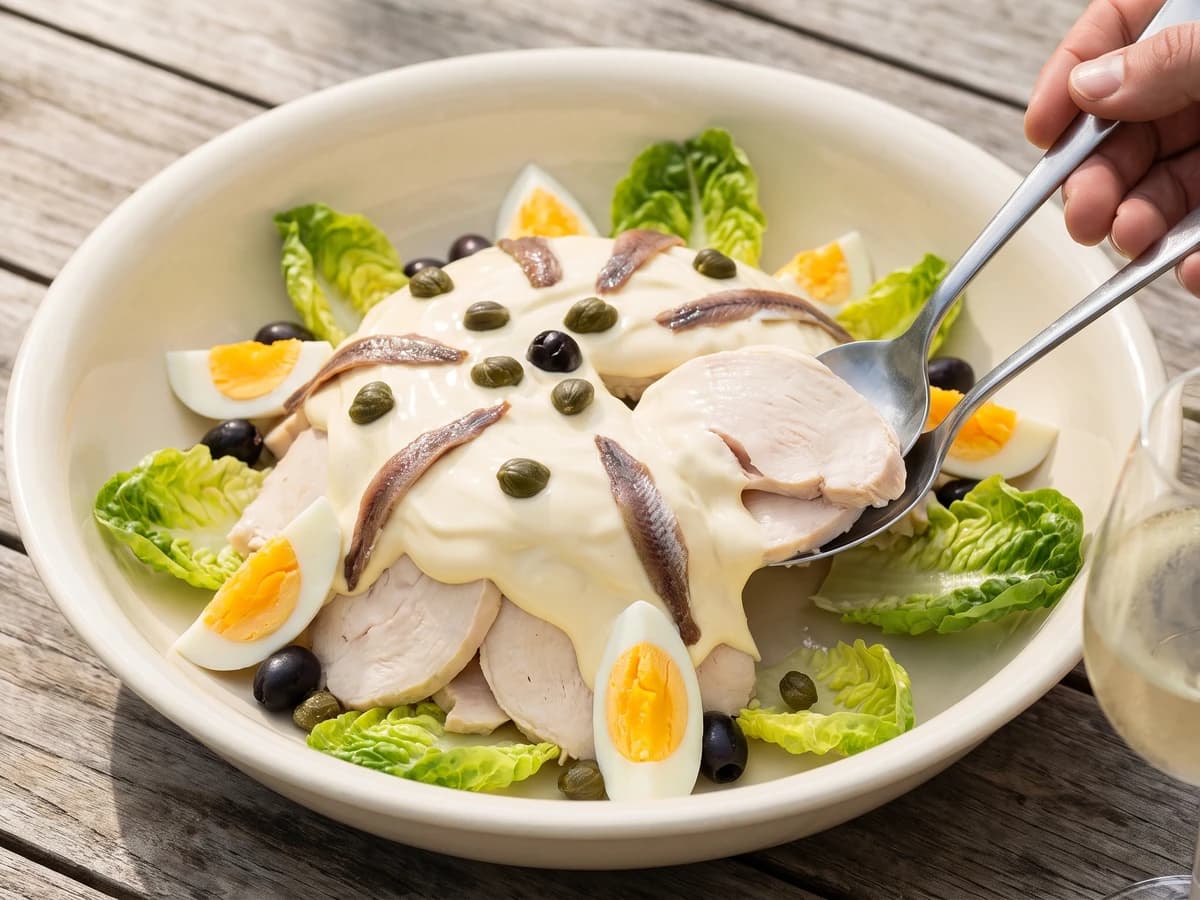
Cold roast chicken, ciseled lettuce, and a shining coat of homemade mayonnaise, arranged with capers, olives, anchovies, eggs, and lettuce hearts, then tossed at the table as the canon intends.
A cooking platform built around craft, culture, and the stories behind what we eat.
Created by Chef Juliette
Based on No. 2018, Salade Mascotte, from Le Guide Culinaire (1907) by Auguste Escoffier
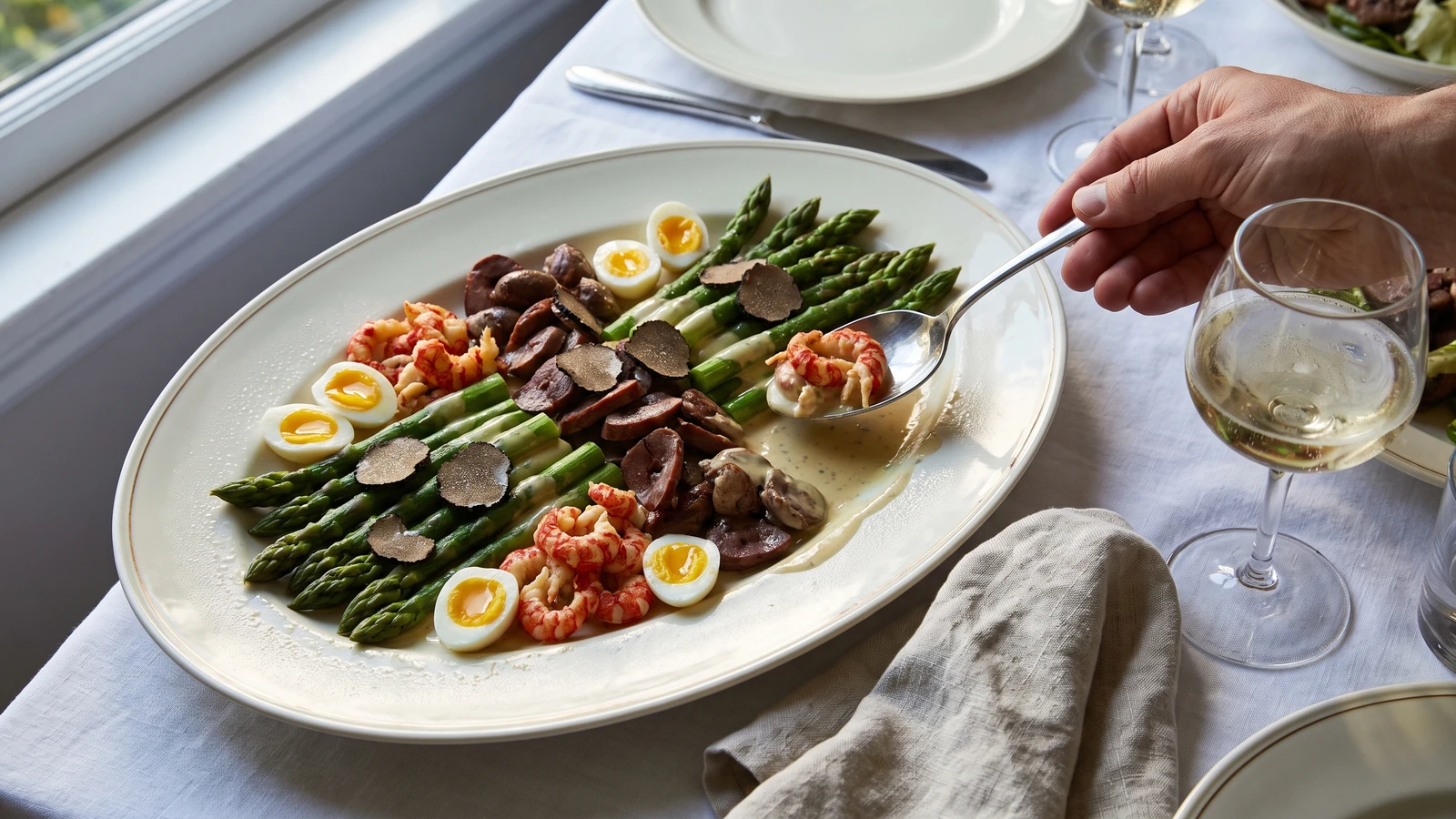
Salade Mascotte gathers green asparagus, quail eggs, truffle, crayfish, and tender poultry offal beneath mustard cream: a composed salad whose arrangement is part of its flavour.
Salade Mascotte (Mascotte composed salad) teaches one discipline above all: each constituent must be cooked on its own terms, then cooled and dried before it meets the dressing. Moisture is the enemy here. Warm eggs or wet asparagus loosen the mustard cream, the careful pattern slumps, and five distinct flavours become one muddle.
The original entry assumed a garde-manger stocked with cooked crayfish, rare birds' eggs, cocks' kidneys, asparagus heads, and truffle, all ready for a cold-larder cook to arrange by eye. It supplied no brigade quantities. This version balances the five constituents for four diners, uses cooked peeled crayfish, and prepares everything serially for one cook, one stove, one evening. That stocked larder was scaffolding and can go; the separately cooked garnishes, real cream, mustard emulsion, and decoration made from the salad itself are the dish and must stay.
Lapwing eggs are protected and absent from legal commerce in most places, so small, rich-yolked quail eggs take their place. Cocks' kidneys are no longer routinely collected for market, and chicken hearts provide an honest compact slice with the necessary poultry-offal depth, though they are not identical. Dry every constituent completely before dressing it. That is the step that decides the Salade Mascotte.
Salade Mascotte belongs to the cosmopolitan Parisian grand-kitchen repertoire rather than to a regional farmhouse table: named salades composées were assembled in the garde-manger from individually prepared luxury garnishes. Lapwing eggs, cocks' kidneys, crayfish, and truffle displayed the reach of that professional larder, while mustard sauce with cream kept the richness sharp rather than heavy. Grand-kitchen manuals carried the composition to private celebration tables, but its defining practice stayed intact: decorate the salad only with its own constituents.
Quantity
18 spears (about 1 pound / 454 g)
woody ends removed and 3-inch tips reserved
Quantity
12
Quantity
8 hearts (about 4 ounces / 115 g)
vessels and surface fat trimmed
Quantity
1 cup (240 ml / 150 g)
drained and dried
Quantity
1 small truffle (about 3/4 ounce / 20 g)
cleaned or drained
Quantity
2 tablespoons plus 1 teaspoon (35 ml / 35 g)
divided, with 1 teaspoon reserved for rescuing the sauce if needed
Quantity
1 tablespoon (15 ml / 15 g)
Quantity
1/4 cup (60 ml / 55 g)
Quantity
1/2 cup (120 ml / 120 g)
Quantity
1 teaspoon (5 ml / 6 g), plus more for the asparagus water
Quantity
1/4 teaspoon (1.25 ml / 0.6 g)
| Ingredient | Quantity |
|---|---|
| thick green asparagus spearswoody ends removed and 3-inch tips reserved | 18 spears (about 1 pound / 454 g) |
| quail eggs | 12 |
| cleaned chicken heartsvessels and surface fat trimmed | 8 hearts (about 4 ounces / 115 g) |
| cooked peeled crayfish tailsdrained and dried | 1 cup (240 ml / 150 g) |
| fresh black truffle or whole preserved black trufflecleaned or drained | 1 small truffle (about 3/4 ounce / 20 g) |
| Dijon mustarddivided, with 1 teaspoon reserved for rescuing the sauce if needed | 2 tablespoons plus 1 teaspoon (35 ml / 35 g) |
| white wine vinegar | 1 tablespoon (15 ml / 15 g) |
| grapeseed or sunflower oil | 1/4 cup (60 ml / 55 g) |
| cold heavy cream | 1/2 cup (120 ml / 120 g) |
| fine sea salt | 1 teaspoon (5 ml / 6 g), plus more for the asparagus water |
| freshly ground white pepper | 1/4 teaspoon (1.25 ml / 0.6 g) |
Bring a small saucepan of water seasoned with half the measured salt to the barest simmer. Add the chicken hearts and cook gently for 20 to 25 minutes, never allowing the water to boil hard, until a paring knife enters with slight resistance and the centres reach at least 165°F (74°C). If they remain tough, continue at the same gentle simmer in 5-minute intervals. Ça se rattrape: time at gentle heat tenderizes them, while furious boiling only tightens them. Drain, spread them on a small tray, and chill until completely cold.
Lower the quail eggs carefully into gently boiling water and cook for 4 minutes. Transfer them immediately to ice water and leave them for 5 minutes, then crack each shell all over, roll it gently beneath your palm, and peel under a thin stream of water. Halve the eggs lengthwise once cold. If an egg tears, keep it for the centre of the salad and reserve the clean halves for decoration.
Return the saucepan to a full boil with fresh water and salt it generously. Add the asparagus tips and blanch for 2 to 4 minutes, according to thickness, until vividly green and tender enough for a knife point to enter while retaining a slight bite. Move them straight into fresh ice water, then drain and spread them between clean towels. Dry them thoroughly. Wet asparagus thins the dressing and makes the arrangement slide; if one tip has softened too far, place it inside the salad and save the firmest tips for the top.
Make the sauce moutarde à la crème (mustard sauce with cream) as an émulsion froide, a cold emulsion. Whisk 2 tablespoons of Dijon mustard with the vinegar, remaining measured salt, and white pepper. Add the oil in a slender stream while whisking until the sauce is thick and glossy, then whisk in the cold cream a tablespoon at a time. It should coat a spoon but still fall in a broad ribbon. If it separates, don't pour it out. Ça se rattrape: put the reserved teaspoon of mustard in a clean bowl and whisk in the broken sauce one teaspoon at a time until the emulsion gathers again. If it becomes too thick, loosen it with a teaspoon of cold water.
Slice the cold chicken hearts thinly across their width. Dry the crayfish tails once more, because packing liquid has no place in the sauce. Slice the truffle into fine rounds with a sharp knife or truffle slicer, keeping every fragment. Reserve 8 handsome asparagus tips, 8 egg halves, 8 crayfish tails, several heart slices, and the finest truffle rounds for the final arrangement.
Turn the remaining asparagus tips, egg halves, heart slices, and crayfish tails very gently with about 1/2 cup (120 ml) of the mustard cream. Arrange them in a low, generous oval on a chilled serving platter, layering in the smaller truffle pieces as you go. Spoon about 1/4 cup (60 ml) more sauce into a natural pool around the base. Decorate the top with the reserved constituents, repeating each ingredient so diners can see the entire salad before the first spoonful is taken. Keep it abundant, not architectural.
Chill the composed salad for 20 minutes, then bring it out 10 minutes before serving so the truffle and mustard can speak. Pass any remaining sauce at the table. The salad should be cool, glossy, and distinct, with every constituent tasting of itself beneath the cream. À table!
1 serving (about 250g)
Culinary guides, cultural storytelling, and the editorial depth that makes cooking meaningful.
Discover Culinary ExplorerChef Juliette
Cold roast chicken, ciseled lettuce, and a shining coat of homemade mayonnaise, arranged with capers, olives, anchovies, eggs, and lettuce hearts, then tossed at the table as the canon intends.

Chef Juliette
Cold roast or poached chicken with fine ribbons of lettuce, dressed at the final moment with oil and vinegar: a composed salad whose freshness depends entirely on timing.

Chef Juliette
Five leaves, one living rule: laitue, romaine, chicorée, mâche, or pissenlit must be washed, dried, and dressed only as they go to the table, while every leaf still carries its light vinaigrette.

Chef Juliette
Salade de Betteraves proves that baking, not boiling, is the whole argument: concentrated garnet sweetness, tender baked onion, sharp mustard, and herbs cut into a weeknight salad worth making ahead.