Chef Juliette
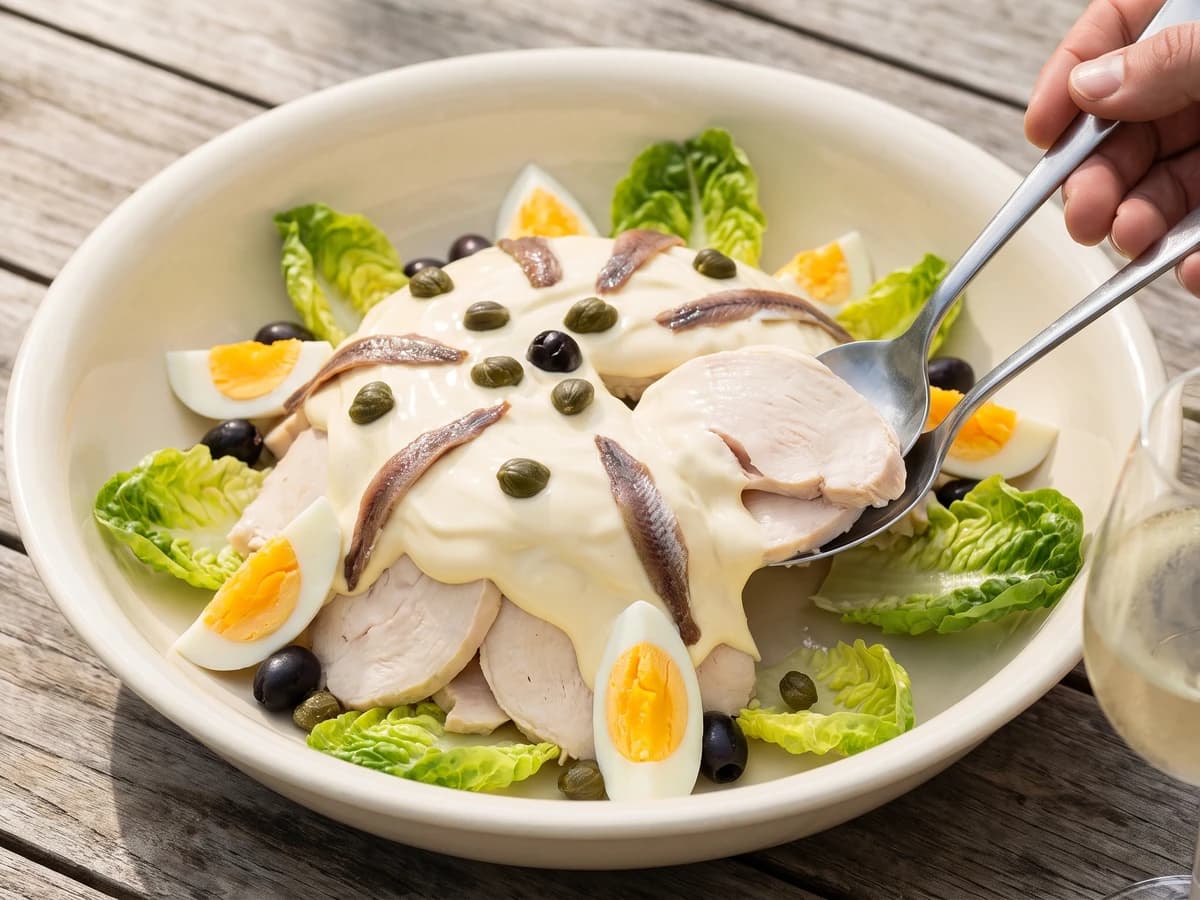
Mayonnaise de Volaille
Cold roast chicken, ciseled lettuce, and a shining coat of homemade mayonnaise, arranged with capers, olives, anchovies, eggs, and lettuce hearts, then tossed at the table as the canon intends.
A cooking platform built around craft, culture, and the stories behind what we eat.

Created by Chef Juliette
Based on No. 2015, Salade Niçoise, from Le Guide Culinaire (1907) by Auguste Escoffier
Salade Niçoise in its grand-kitchen form: equal measures of French beans, potato, and tomato, composed with capers, olives, and anchovy, then glossed with oil and vinegar for a generous cold supper.
Salade Niçoise (Nice-style composed salad) teaches proportion before embellishment. Know one thing before you touch the pan: in this particular grand-kitchen reading, French beans, potato dice, and quartered tomato stand in equal quantity, and none should dissolve into another. It is a salade composée, a composed salad, not a bowl to toss until its edges blur.
The entry assumed a garde-manger with cooked vegetables waiting in brigade trays and enough hands to arrange each plate to order. What changes at home is scale and station work, not formula: weigh 350 grams of each principal vegetable after trimming, cook them with one saucepan, and arrange everything on one family platter. The ready trays were scaffolding and can go. The equal proportion, pitted olives, capers, anchovy, and final oil-and-vinegar seasoning are the dish, so they stay. One cook, one stove, one evening.
Done properly, the beans remain green and crisp-tender, the potato dice keep their corners, and the tomatoes give their juice only when bitten. Capers and little black olives scatter through the vegetables, anchovy fillets lie proudly across the top, and vinaigrette gives everything a light gloss. The step that matters most is separate cooking: beans must retain their snap, while potatoes must become tender without losing their shape.
Salade Niçoise belongs to Nice and the Comté de Nice, whose Mediterranean larder gives the dish tomatoes, small dark olives, anchovies, and olive oil. Many Niçois cooks defend a raw-vegetable reading and reject boiled beans and potatoes entirely, which is why arguments over the salad remain unusually fierce. The grand-kitchen branch recorded here traveled through hotel and bistro kitchens, fixing equal quantities of French beans, potato, and tomato into a composed salad with capers, olives, and anchovy.
Quantity
3½ cups (350 g)
trimmed
Quantity
2⅓ cups (350 g)
peeled and cut into ½-inch (1.5 cm) dice
Quantity
2 cups (350 g)
cored and quartered
Quantity
2 tablespoons (30 ml / 20 g)
drained
Quantity
½ cup (120 ml / 75 g)
pitted
Quantity
8 fillets (about ¼ cup / 30 g)
drained
Quantity
6 tablespoons (90 ml / 82 g)
Quantity
2 tablespoons (30 ml / 30 g)
Quantity
1½ tablespoons (22 ml / 27 g)
divided, mostly for the cooking water
| Ingredient | Quantity |
|---|---|
| haricots verts (French beans)trimmed | 3½ cups (350 g) |
| waxy potatopeeled and cut into ½-inch (1.5 cm) dice | 2⅓ cups (350 g) |
| ripe tomatoescored and quartered | 2 cups (350 g) |
| capersdrained | 2 tablespoons (30 ml / 20 g) |
| small black olivespitted | ½ cup (120 ml / 75 g) |
| oil-packed anchovy filletsdrained | 8 fillets (about ¼ cup / 30 g) |
| extra-virgin olive oil | 6 tablespoons (90 ml / 82 g) |
| red wine vinegar | 2 tablespoons (30 ml / 30 g) |
| fine sea saltdivided, mostly for the cooking water | 1½ tablespoons (22 ml / 27 g) |
Bring a 4-quart saucepan of water to a full boil and season it with 2 teaspoons of the measured salt. Add the haricots verts and cook for 4 to 6 minutes, until bright green and crisp-tender, with no raw squeak when you bite one. Lift them into a bowl of very cold water to stop the cooking, then drain. If they have softened further than intended, cool them immediately and handle them only once during assembly; you cannot restore the snap, but you can prevent them from breaking.
Discard the bean water and cool the saucepan briefly. Add the potato dice, cover them by 1 inch with fresh cold water, and season with another 2 teaspoons of salt. Bring the water slowly to a bare simmer and cook for 7 to 10 minutes, until a small knife enters with slight resistance and the corners remain clean. Drain at once and spread the dice on a tray without stirring. If their edges begin to crumble, stop cooking immediately, cool them untouched, and place the broken pieces beneath the intact dice when composing the platter. Ça se rattrape.
Spread the beans on a clean towel and pat them thoroughly dry. Let the potatoes cool until barely warm, then blot away any surface moisture without crushing them. Set the quartered tomatoes cut-side down on another towel for 5 minutes. Water left on any of the three vegetables dilutes the vinaigrette, so this quiet drying step earns its place.
Whisk the red wine vinegar with ¼ teaspoon of the measured salt until the grains dissolve. Pour in the olive oil in a thin stream while whisking until the vinaigrette, an emulsion of vinegar and oil, becomes glossy and lightly thickened. There is no mustard, garlic, or herb in this entry. If the vinaigrette separates while it waits, whisk it again just before pouring.
Arrange the beans, cooled potato dice, and quartered tomatoes on a broad, shallow platter in loose neighboring bands, allowing the colors to overlap without tossing them together. Scatter the capers and pitted olives evenly across the vegetables, then lay the anchovy fillets over the top. This composition is the source's decoration, and it lets every ingredient remain recognizable.
Whisk the vinaigrette once more and spoon it slowly over the whole platter, paying particular attention to the potatoes. Rest the salad for 5 minutes, then spoon any dressing gathered at the bottom back over the vegetables. Taste a bean, a potato dice, and a piece of tomato together before adding any remaining salt, because the anchovies, capers, and olives already carry plenty. Serve cool rather than refrigerator-cold. À table!
1 serving (about 320g)
Culinary guides, cultural storytelling, and the editorial depth that makes cooking meaningful.
Discover Culinary ExplorerChef Juliette
Cold roast chicken, ciseled lettuce, and a shining coat of homemade mayonnaise, arranged with capers, olives, anchovies, eggs, and lettuce hearts, then tossed at the table as the canon intends.

Chef Juliette
Cold roast or poached chicken with fine ribbons of lettuce, dressed at the final moment with oil and vinegar: a composed salad whose freshness depends entirely on timing.

Chef Juliette
Five leaves, one living rule: laitue, romaine, chicorée, mâche, or pissenlit must be washed, dried, and dressed only as they go to the table, while every leaf still carries its light vinaigrette.

Chef Juliette
Salade de Betteraves proves that baking, not boiling, is the whole argument: concentrated garnet sweetness, tender baked onion, sharp mustard, and herbs cut into a weeknight salad worth making ahead.