
Chef Juliette
The Seasoning of Salads
Five dressings, one governing lesson: match fat and acid to the salad itself, from tender lettuce under fresh cream to bitter dandelion leaves glossed with hot bacon fat.
A cooking platform built around craft, culture, and the stories behind what we eat.
Created by Chef Juliette
Based on No. 2014, Salade Monte-Cristo, from Le Guide Culinaire (1907) by Auguste Escoffier
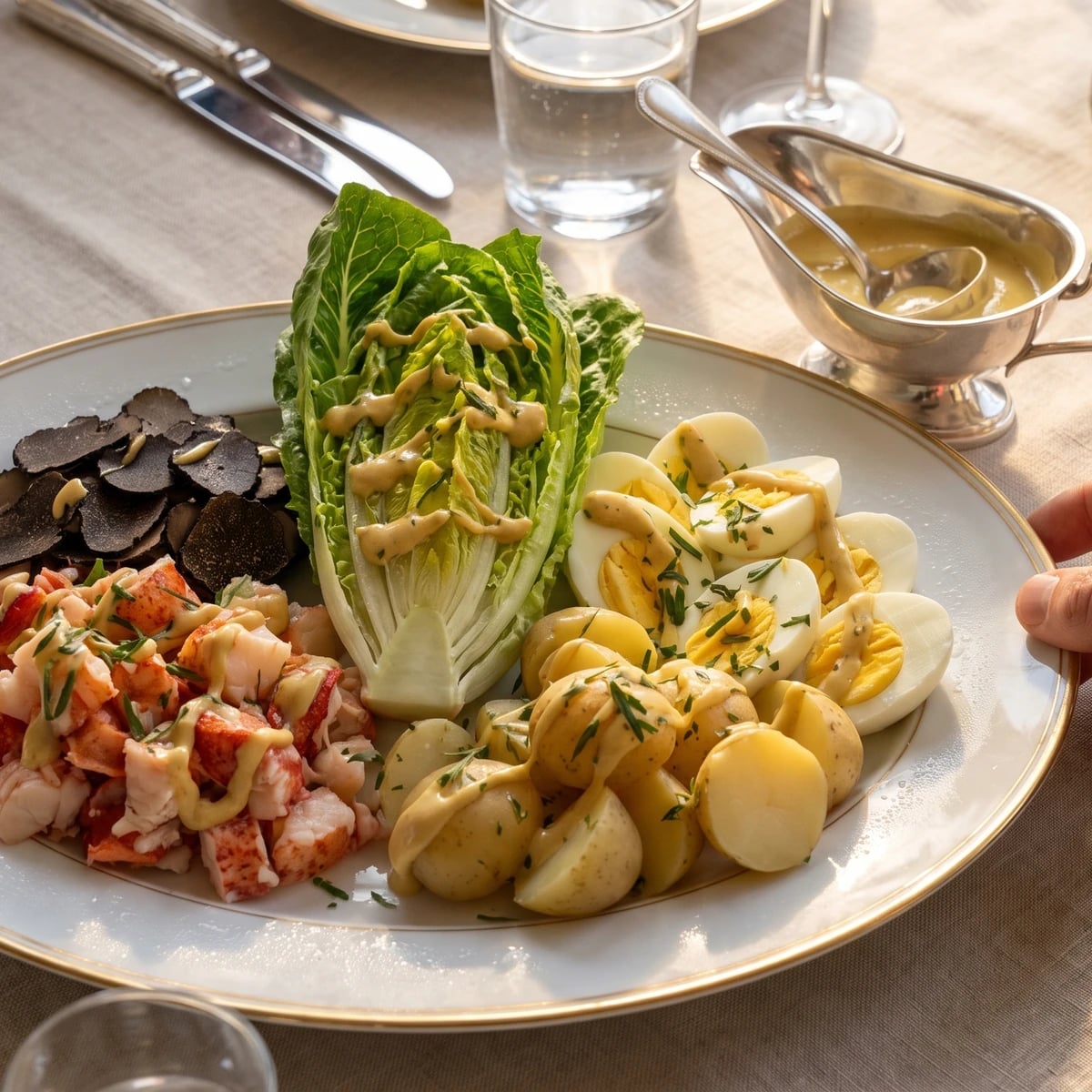
Four equal heaps, lobster, truffle, potato, and egg, stand around a whole white lettuce heart under mustard mayonnaise and tarragon. Salade Monte-Cristo proves that exact arrangement can be as decisive as cooking.
Salade Monte-Cristo (a composed lobster and truffle salad) teaches that separation can be a technique. Lobster, cooked truffle, potato, and hard-boiled egg appear in equal quantities, but each keeps its own taste, texture, and distinct heap. Do not toss them together. The very white lettuce heart stands whole in the middle, never cut, because the architecture is part of the dish.
The original entry assumed a garde-manger, the cold-pantry cook, with boiled potatoes, hard-boiled eggs, cooked lobster, cooked truffles, and mayonnaise already waiting. At home, buy the lobster cooked, use whole black truffles preserved after cooking, boil the potatoes and eggs in one saucepan, and whisk only the cup of mustard mayonnaise you need. The brigade's advance preparation is scaffolding and can go. The equal proportions, separate heaps, whole lettuce heart, mustard emulsion, and tarragon are the dish and stay. One cook, one stove, one evening.
When it reaches the table, the plate should read clearly: coral lobster, black truffle, ivory potato, yellow and white egg, then the pale crisp heart rising through mustard-colored mayonnaise and green tarragon. Weigh the prepared components after draining, peeling, and cooling them, not before; that is the step that matters most.
Salade Monte-Cristo belongs to the Parisian grand-kitchen family of salades composées, cold preparations arranged component by component for formal service rather than tossed in a bowl. Its title is literary and ornamental, not regional: lobster and black truffle declare a celebration dish, while potato and egg give those rich ingredients substance. From formal dining rooms it passed to hotel and private celebration tables, keeping the whole white lettuce heart as its architecture; despite the shared name, it has no culinary kinship with the fried Monte Cristo sandwich known in America.
Quantity
about 1 1/2 cups (355 ml / 200 g)
well chilled, patted dry, and cut into 8 mm dice
Quantity
about 1 1/4 cups (300 ml / 200 g)
drained, patted dry, and cut into 8 mm dice
Quantity
about 2 cups (475 ml / 260 g), yielding 200 g cooked and peeled
scrubbed
Quantity
4 (about 200 g once hard-boiled and peeled)
Quantity
1
Quantity
1
at room temperature
Quantity
1 1/2 tablespoons (22 ml / 22 g)
Quantity
1 tablespoon (15 ml / 15 g)
Quantity
3/4 cup (180 ml / 165 g)
at room temperature
Quantity
2 teaspoons (10 ml / 10 g)
Quantity
2 tablespoons (30 ml / 6 g)
finely chopped
Quantity
2 1/2 teaspoons (12 ml / 15 g)
divided
Quantity
1/4 teaspoon (1 ml / 0.5 g)
| Ingredient | Quantity |
|---|---|
| cooked lobster meatwell chilled, patted dry, and cut into 8 mm dice | about 1 1/2 cups (355 ml / 200 g) |
| whole cooked black trufflesdrained, patted dry, and cut into 8 mm dice | about 1 1/4 cups (300 ml / 200 g) |
| small waxy potatoesscrubbed | about 2 cups (475 ml / 260 g), yielding 200 g cooked and peeled |
| large eggs | 4 (about 200 g once hard-boiled and peeled) |
| small butter lettuce | 1 |
| pasteurized large egg yolkat room temperature | 1 |
| Dijon mustard | 1 1/2 tablespoons (22 ml / 22 g) |
| white wine vinegar | 1 tablespoon (15 ml / 15 g) |
| neutral sunflower or grapeseed oilat room temperature | 3/4 cup (180 ml / 165 g) |
| cold water (optional) | 2 teaspoons (10 ml / 10 g) |
| fresh tarragon leavesfinely chopped | 2 tablespoons (30 ml / 6 g) |
| fine sea saltdivided | 2 1/2 teaspoons (12 ml / 15 g) |
| finely ground white pepper | 1/4 teaspoon (1 ml / 0.5 g) |
Put the scrubbed potatoes and eggs in a medium saucepan, cover them by 2.5 cm with cold water, and add 2 teaspoons of the salt. Bring the water just to a boil, lower it to a steady simmer, and begin timing. Lift the eggs into ice water after 10 minutes. Continue cooking the potatoes until a thin knife enters their centers without resistance, usually 18 to 25 minutes depending on size. Drain them immediately, let their surfaces dry, then peel while just warm and chill completely. Warm potato crumbles under the knife and drinks the mayonnaise; cold waxy potato gives a clean dice.
Whisk the egg yolk, Dijon mustard, vinegar, remaining salt, and white pepper in a stable bowl until smooth. Add the oil one drop at a time at first, whisking constantly; once a thick emulsion forms, pour the rest in a thin, steady thread. Loosen with cold water, a teaspoon at a time, until the mayonnaise falls from the spoon in a broad ribbon rather than standing like mortar. If it splits, don't discard it. Ça se rattrape: whisk 1 teaspoon cold water in a clean bowl, then add the broken mayonnaise a teaspoon at a time until the emulsion becomes smooth again. Cover and chill.
Peel the eggs and cut them into even 8 mm dice. Cut the cold potatoes, lobster, and drained truffles to the same size, working with each ingredient separately. Weigh exactly 200 g of each prepared component and return the four portions to separate bowls. If the potato edges begin to crumble, stop and chill them for 15 minutes before continuing; ça se rattrape. Pat any surface moisture from the lobster and truffles so it cannot thin the mayonnaise.
Remove the dark outer lettuce leaves one at a time until only the compact, very pale heart remains. Reserve those outer leaves for another salad. Rinse the heart gently in cold water without pulling it apart, invert it to drain, and dry it thoroughly between clean towels. Pare only the brown end of the root so the heart can stand upright while its base still holds every leaf together. Do not quarter it and do not core it. The heart goes in whole, never cut.
Set the whole lettuce heart upright in the center of a chilled oval platter. Arrange the lobster, truffle, potato, and egg around it in four generous, distinct heaps, keeping clear borders between them. Spoon about 2 tablespoons of mustard mayonnaise over each heap, allowing the ingredients to remain recognizable, then place another spoonful around the foot of the lettuce. Scatter the chopped tarragon over the mayonnaise and pass any remaining sauce separately. The dish must look composed, not mixed.
Return the completed platter to the refrigerator for no more than 20 minutes, just long enough to settle the arrangement without dulling the lettuce. Bring it to the table while the heart is crisp and the four heaps are clearly defined. Each guest takes a leaf from the center and a little of every heap, joining the contrasts on the plate rather than in the serving dish. À table!
1 serving (about 300g)
Culinary guides, cultural storytelling, and the editorial depth that makes cooking meaningful.
Discover Culinary Explorer
Chef Juliette
Five dressings, one governing lesson: match fat and acid to the salad itself, from tender lettuce under fresh cream to bitter dandelion leaves glossed with hot bacon fat.

Chef Juliette
Five leaves, one living rule: laitue, romaine, chicorée, mâche, or pissenlit must be washed, dried, and dressed only as they go to the table, while every leaf still carries its light vinaigrette.

Chef Juliette
Salade de Betteraves proves that baking, not boiling, is the whole argument: concentrated garnet sweetness, tender baked onion, sharp mustard, and herbs cut into a weeknight salad worth making ahead.

Chef Juliette
Salade de Céleri turns pale stalks into crisp curling fringes, then coats them with mustard and cream. The lesson is absolute: drain the celery hard, because water steals the sauce.