Chef Juliette
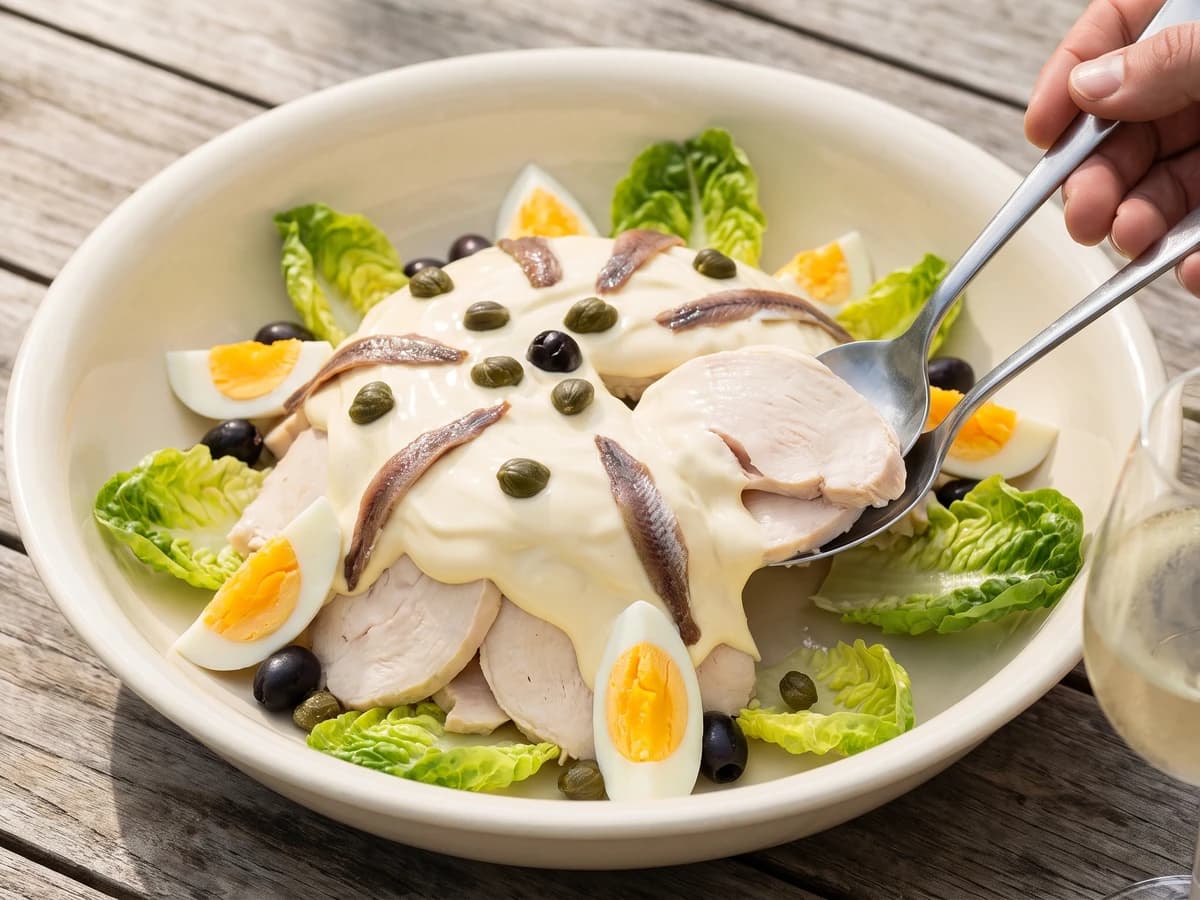
Mayonnaise de Volaille
Cold roast chicken, ciseled lettuce, and a shining coat of homemade mayonnaise, arranged with capers, olives, anchovies, eggs, and lettuce hearts, then tossed at the table as the canon intends.
A cooking platform built around craft, culture, and the stories behind what we eat.

Created by Chef Juliette
Based on No. 2012, Salade Lorette, from Le Guide Culinaire (1907) by Auguste Escoffier
Salade Lorette is a study in clean contrasts: tender mâche, earthy beetroot, and crisp celeriac in equal measure, dressed simply and joined only when the bowl is ready for the table.
Salade Lorette (lamb's lettuce with beetroot and celeriac) teaches one clean principle: ingredients that stain must remain separate until the final fold. The bowl should show deep green mâche, ivory celeriac, and garnet beetroot as three distinct voices, not one weary pink mixture. Before you touch a pan, know that you don't need one. This salad is decided by the knife and the final thirty seconds.
The old entry assumed a garde-manger with cooked beetroot, washed mâche, and a practiced hand cutting trays of julienne. The honest home equivalent is plain ready-cooked beetroot, a sharp knife, and 100 grams of each principal ingredient for four people. Cooking and cooling a single beet is brigade scaffolding, so it may go; equal proportions, the julienne cut, and the spare seasoning of oil and vinegar are the dish, so they stay.
The vinaigrette simple, an oil-and-vinegar emulsion, needs no mustard, herbs, or other embroidery. Dress the celeriac and mâche first, then fold in the beetroot only once or twice. That last restraint is the step that matters most.
Salade Lorette belongs to the Parisian classical repertoire of named composed salads, concise formulas intended for the garde-manger rather than a particular regional farmhouse table. Its name points toward the quarter surrounding Notre-Dame-de-Lorette and the Parisian social vocabulary attached to it, although the exact dedication was never securely recorded. The dish traveled easily into bourgeois dining rooms because its identity required no rare ingredient, only a fixed composition of equal parts and disciplined handling.
Quantity
4 loosely packed cups (950 ml / 100 g prepared weight)
roots trimmed, washed and thoroughly dried
Quantity
¾ cup (180 ml / 100 g prepared weight)
peeled and cut julienne-fashion
Quantity
1 cup (240 ml / 100 g prepared weight)
peeled and cut julienne-fashion
Quantity
3 tablespoons (45 ml / 41 g)
Quantity
1 tablespoon (15 ml / 15 g)
| Ingredient | Quantity |
|---|---|
| mâche, also called corn salad or lamb's lettuceroots trimmed, washed and thoroughly dried | 4 loosely packed cups (950 ml / 100 g prepared weight) |
| plain cooked beetrootpeeled and cut julienne-fashion | ¾ cup (180 ml / 100 g prepared weight) |
| celeriac, also called celery rootpeeled and cut julienne-fashion | 1 cup (240 ml / 100 g prepared weight) |
| neutral oil, such as sunflower or grapeseed oil | 3 tablespoons (45 ml / 41 g) |
| wine vinegar | 1 tablespoon (15 ml / 15 g) |
Separate the mâche into small clusters, trimming away any root ends or bruised leaves. Wash it in a large bowl of cold water, lifting the leaves out so grit remains on the bottom, then spin or pat them completely dry. Water clinging to the leaves thins the vinegar and prevents the oil from coating them; the mâche must feel cool and dry, not damp.
Whisk the wine vinegar in a large shallow bowl, then pour in the oil gradually while whisking until the vinaigrette looks lightly clouded and cohesive. With no mustard to hold it, this is deliberately a fleeting emulsion. If it separates while you finish cutting, whisk it again for a few seconds. Nothing has failed.
Cut the celeriac first into julienne-fashion rods, match-shaped pieces about 4 cm long and 2 mm thick. Weigh 100 grams after peeling, add it to the vinaigrette, and turn it gently so the vinegar arrests browning. On a separate board, cut the cooked beetroot to the same dimensions and hold it in its own bowl. Blot any wet cut surfaces with a clean towel, because loose beet juice is what turns the salad muddy.
Add the dry mâche to the dressed celeriac and turn gently until the leaves take a fine sheen. Add the beetroot at the very last moment and fold only once or twice, just enough to distribute it without painting the leaves. If pink streaks begin to spread, stop mixing and arrange the beetroot over the top instead. Ça se rattrape: a marbled salad is still handsome, but another ten turns will make it dull. Serve immediately. À table!
1 serving (about 90g)
Culinary guides, cultural storytelling, and the editorial depth that makes cooking meaningful.
Discover Culinary ExplorerChef Juliette
Cold roast chicken, ciseled lettuce, and a shining coat of homemade mayonnaise, arranged with capers, olives, anchovies, eggs, and lettuce hearts, then tossed at the table as the canon intends.

Chef Juliette
Cold roast or poached chicken with fine ribbons of lettuce, dressed at the final moment with oil and vinegar: a composed salad whose freshness depends entirely on timing.

Chef Juliette
Five leaves, one living rule: laitue, romaine, chicorée, mâche, or pissenlit must be washed, dried, and dressed only as they go to the table, while every leaf still carries its light vinaigrette.

Chef Juliette
Salade de Betteraves proves that baking, not boiling, is the whole argument: concentrated garnet sweetness, tender baked onion, sharp mustard, and herbs cut into a weeknight salad worth making ahead.