Chef Juliette
Mayonnaise de Volaille
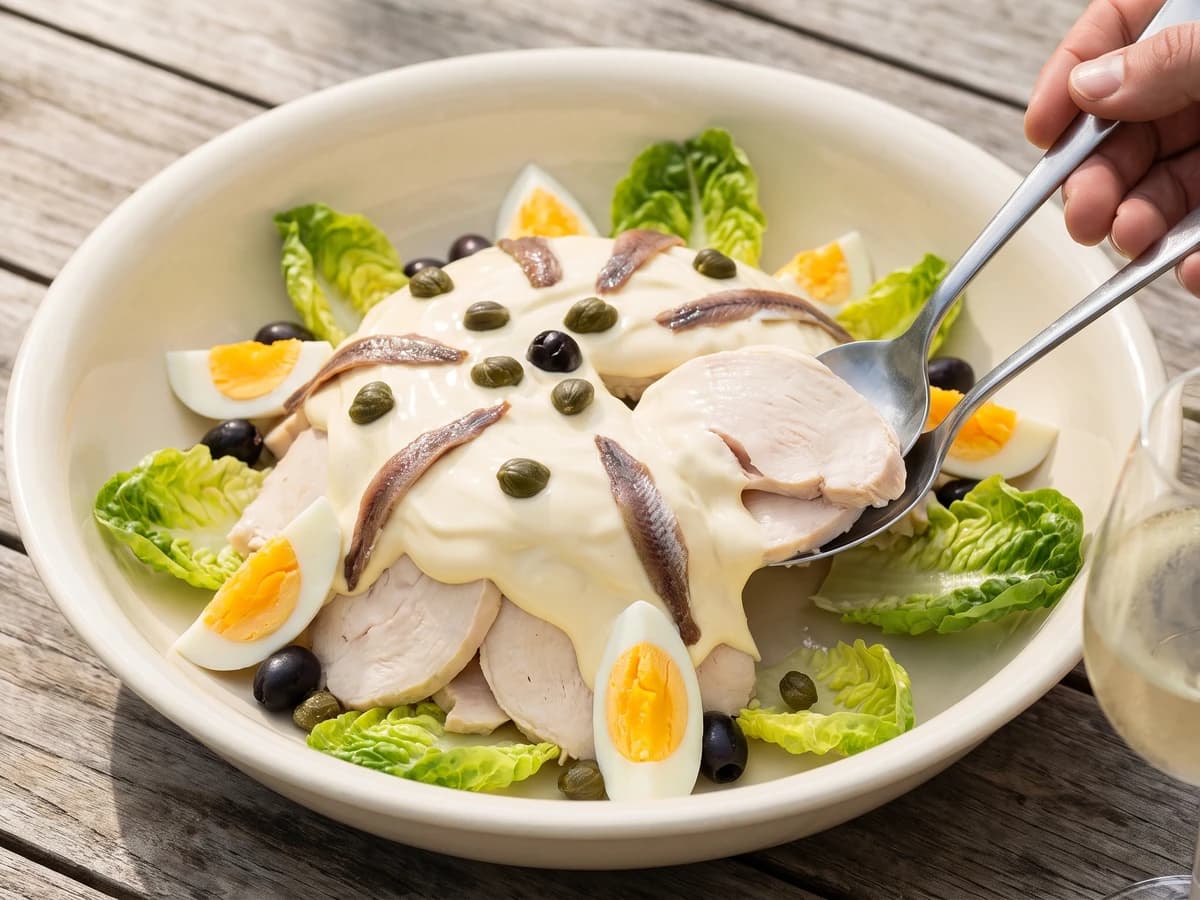
Cold roast chicken, ciseled lettuce, and a shining coat of homemade mayonnaise, arranged with capers, olives, anchovies, eggs, and lettuce hearts, then tossed at the table as the canon intends.
A cooking platform built around craft, culture, and the stories behind what we eat.
Created by Chef Juliette
Based on No. 2008, Salade Italienne, from Le Guide Culinaire (1907) by Auguste Escoffier
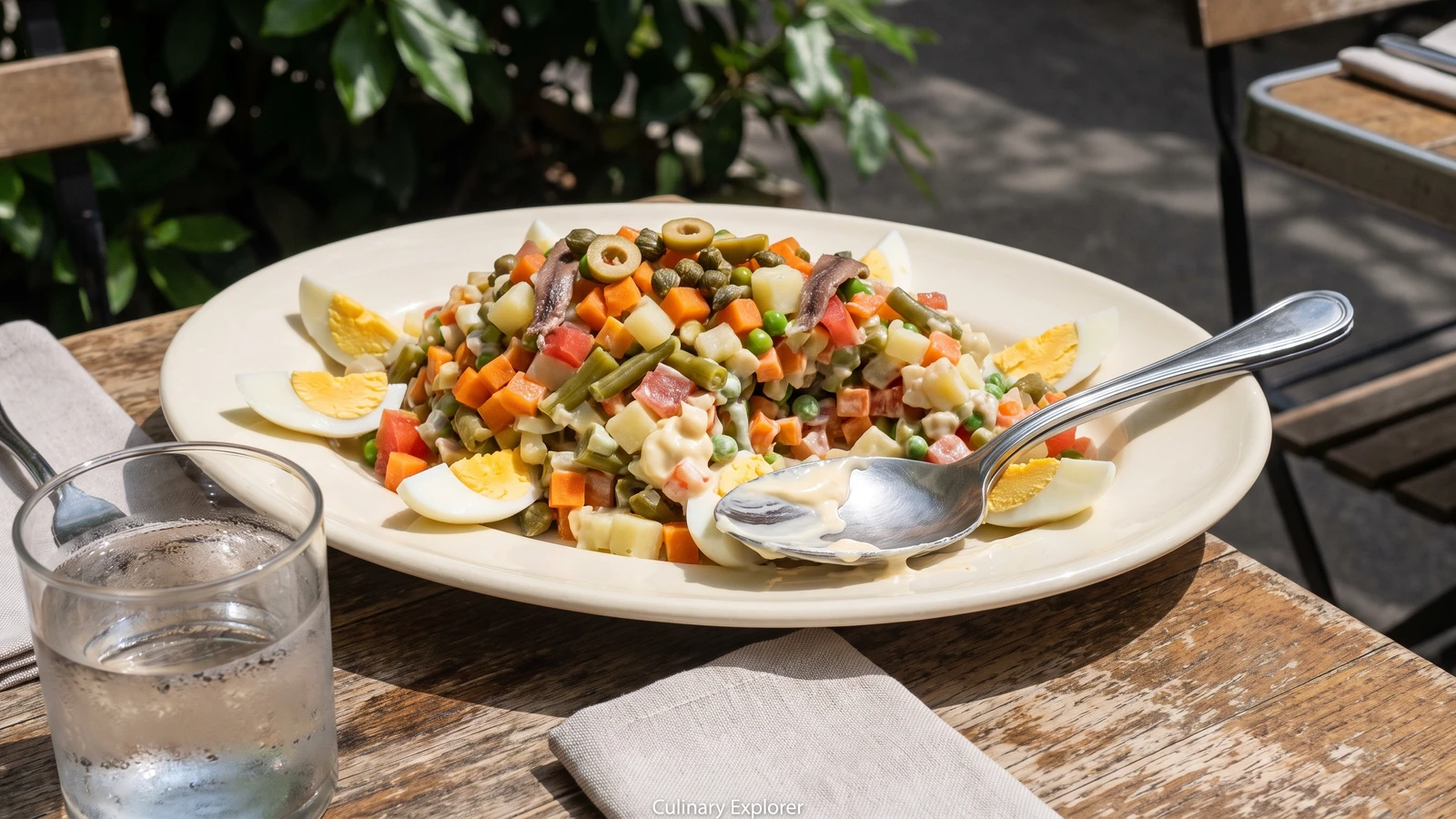
Equal dice, distinct vegetables, and a firm anchovy mayonnaise make Salade Italienne a cool composed salad whose elegance comes from the knife, not from ornament.
Salade Italienne (a French composed vegetable salad) teaches the discipline of the macédoine, a regular small dice in which every carrot, turnip, potato, tomato, and bean arrives together on the fork. The one true thing to know before touching a pan is this: the knife work isn't preparation for the dish. It is the dish.
The original assumed brigade quantities, a garde-manger with several pans at the boil, and sauce mayonnaise waiting from the saucier. At home, one saucepan used in succession, one cooling tray, and a small hand-whisked mayonnaise do the work honestly. The extra pans were service scaffolding and can go; cooking each vegetable separately until precisely tender must stay. The quantity is reduced to four servings, while the five principal vegetables remain equal by volume, preserving the source's balance. One cook, one stove, one evening.
When it is right, the salad holds distinct jewel-like dice under a light ivory coating, sharpened by capers and anchovy, with black olives tucked through and hard-boiled egg around the edge. Cool every cooked vegetable completely and dry it well before binding. That, after the knife, is the step that decides the dish.
Salade Italienne belongs to the classical garde-manger of Parisian grand kitchens and bourgeois cold tables, not to the repertoire of any single Italian region. In this French naming tradition, italienne described a garnish palette of tomato, olives, capers, and anchovy rather than a claim of Italian origin. From formal cold buffets it traveled easily to home lunches and picnic baskets, where its careful dice and make-ahead nature remain thoroughly practical.
Quantity
3/4 cup (180 ml / 100 g)
peeled and cut into regular 8 mm dice
Quantity
3/4 cup (180 ml / 100 g)
peeled and cut into regular 8 mm dice
Quantity
3/4 cup (180 ml / 120 g)
peeled and cut into regular 8 mm dice
Quantity
3/4 cup (180 ml / 120 g)
seeded, cut into regular 8 mm dice, and drained
Quantity
3/4 cup (180 ml / 90 g)
trimmed and cut crosswise into 8 mm pieces
Quantity
1/2 cup (120 ml / 75 g)
Quantity
1/3 cup (80 ml / 50 g)
drained
Quantity
2 tablespoons (30 ml / 18 g)
rinsed and drained
Quantity
6 fillets (about 30 g)
drained and cut into small dice
Quantity
1/4 cup (60 ml / 10 g)
finely chopped
Quantity
2
Quantity
1
Quantity
1
Quantity
2 teaspoons (10 ml / 10 g)
divided
Quantity
1 tablespoon (15 ml / 15 g)
Quantity
2/3 cup (160 ml / 145 g)
Quantity
2 teaspoons (10 ml / 10 g)
Quantity
1 tablespoon plus 1/2 teaspoon (17.5 ml / 21 g), plus more to taste
divided
Quantity
1/8 teaspoon (0.6 ml / 0.3 g)
Quantity
1 tablespoon (15 ml / 15 g)
| Ingredient | Quantity |
|---|---|
| carrotspeeled and cut into regular 8 mm dice | 3/4 cup (180 ml / 100 g) |
| turnipspeeled and cut into regular 8 mm dice | 3/4 cup (180 ml / 100 g) |
| waxy potatoespeeled and cut into regular 8 mm dice | 3/4 cup (180 ml / 120 g) |
| ripe tomato fleshseeded, cut into regular 8 mm dice, and drained | 3/4 cup (180 ml / 120 g) |
| slender green beanstrimmed and cut crosswise into 8 mm pieces | 3/4 cup (180 ml / 90 g) |
| fresh or frozen peas | 1/2 cup (120 ml / 75 g) |
| small pitted black olivesdrained | 1/3 cup (80 ml / 50 g) |
| capersrinsed and drained | 2 tablespoons (30 ml / 18 g) |
| small oil-packed anchovy filletsdrained and cut into small dice | 6 fillets (about 30 g) |
| mixed flat-leaf parsley, chervil, and tarragonfinely chopped | 1/4 cup (60 ml / 10 g) |
| large eggs | 2 |
| pasteurized egg yolk | 1 |
| additional pasteurized egg yolk for rescuing the sauce mayonnaise (optional) | 1 |
| Dijon mustarddivided | 2 teaspoons (10 ml / 10 g) |
| white wine vinegar | 1 tablespoon (15 ml / 15 g) |
| neutral oil, such as sunflower or grapeseed | 2/3 cup (160 ml / 145 g) |
| fresh lemon juice | 2 teaspoons (10 ml / 10 g) |
| fine sea saltdivided | 1 tablespoon plus 1/2 teaspoon (17.5 ml / 21 g), plus more to taste |
| ground white pepper | 1/8 teaspoon (0.6 ml / 0.3 g) |
| cold water (optional) | 1 tablespoon (15 ml / 15 g) |
Choose an 8 mm cube and keep it beside the board as your measure. Trim the carrots, turnips, and potatoes into flat-sided blocks, cut even 8 mm slabs, then batons, then dice. Cut the beans into matching lengths. Seed the tomatoes, dice the firm flesh, and leave it in a sieve to drain for at least 15 minutes. If the first dice wander in size, sort out the larger pieces and recut them now. Ça se rattrape. Don't chase the smallest pieces with the knife or the whole bowl will become mince.
Lower the 2 eggs into a saucepan of gently boiling water and cook for 10 minutes. Transfer them immediately to iced water and let them cool completely, then drain. Empty and rinse the saucepan before cooking the vegetables. The eggs should have firm yolks for clean decoration, not the soft centres wanted at breakfast.
Fill the saucepan with about 2 litres of water, add 1 tablespoon of the salt, and bring it to a strong boil. Cook each vegetable separately, lifting it out with a wire skimmer before adding the next: carrots for 4 to 5 minutes, turnips for 3 to 4 minutes, green beans for 2 to 3 minutes, peas for 45 to 60 seconds, and potatoes last for 5 to 7 minutes. Judge each by texture, not only the clock; the pieces should be tender through but still hold sharp edges. Chill the beans and peas briefly in iced water to fix their colour, then drain. Spread every cooked vegetable in a separate band on a towel-lined tray until completely cold and dry. Separate pans were brigade scaffolding. Separate judgment is the dish and cannot be skipped.
Put 1 pasteurized yolk, 1 teaspoon of the Dijon mustard, the vinegar, the remaining 1/2 teaspoon salt, and the white pepper in a stable bowl. Whisk until smooth, then add the oil drop by drop until the emulsion catches and thickens. Continue in a thin steady thread, whisking constantly. Finish with the lemon juice and, if needed, enough cold water to make a supple mayonnaise that falls heavily from the whisk. If it splits, stop pouring. In a clean bowl, whisk the optional second yolk with the reserved teaspoon of mustard and 1 teaspoon cold water, then whisk in the broken mayonnaise a teaspoon at a time until smooth. Ça se rattrape.
Put the cold carrots, turnips, potatoes, beans, and peas in a wide bowl. Add the olives, capers, diced anchovy, and chopped herbs, then fold in about 1/2 cup of the sauce mayonnaise with a broad spoon. Add the drained tomato last so its edges remain distinct. Fold gently and add only enough of the remaining mayonnaise to bind every piece with a light ivory coating. Taste before adding salt, because the anchovy, capers, and olives have already brought plenty. If damp vegetables loosen the dressing, lift the solids into a clean bowl with a slotted spoon and rebind them with a spoonful of reserved mayonnaise.
Mound the salad loosely on a low oval platter, keeping the individual dice visible rather than pressing them into a smooth dome. Peel the hard-boiled eggs, cut each into four neat wedges, and arrange them around the salad as the source directs. Cover and chill for at least 1 hour so the seasoning settles. Bring it out 10 minutes before serving, still cool but no longer numb from the refrigerator. For a picnic or potluck, carry it in a well-chilled container and keep it over ice until the table is ready. À table!
1 serving (about 250g)
Culinary guides, cultural storytelling, and the editorial depth that makes cooking meaningful.
Discover Culinary ExplorerChef Juliette
Cold roast chicken, ciseled lettuce, and a shining coat of homemade mayonnaise, arranged with capers, olives, anchovies, eggs, and lettuce hearts, then tossed at the table as the canon intends.

Chef Juliette
Cold roast or poached chicken with fine ribbons of lettuce, dressed at the final moment with oil and vinegar: a composed salad whose freshness depends entirely on timing.

Chef Juliette
Five leaves, one living rule: laitue, romaine, chicorée, mâche, or pissenlit must be washed, dried, and dressed only as they go to the table, while every leaf still carries its light vinaigrette.

Chef Juliette
Salade de Betteraves proves that baking, not boiling, is the whole argument: concentrated garnet sweetness, tender baked onion, sharp mustard, and herbs cut into a weeknight salad worth making ahead.