Chef Juliette
Mayonnaise de Volaille
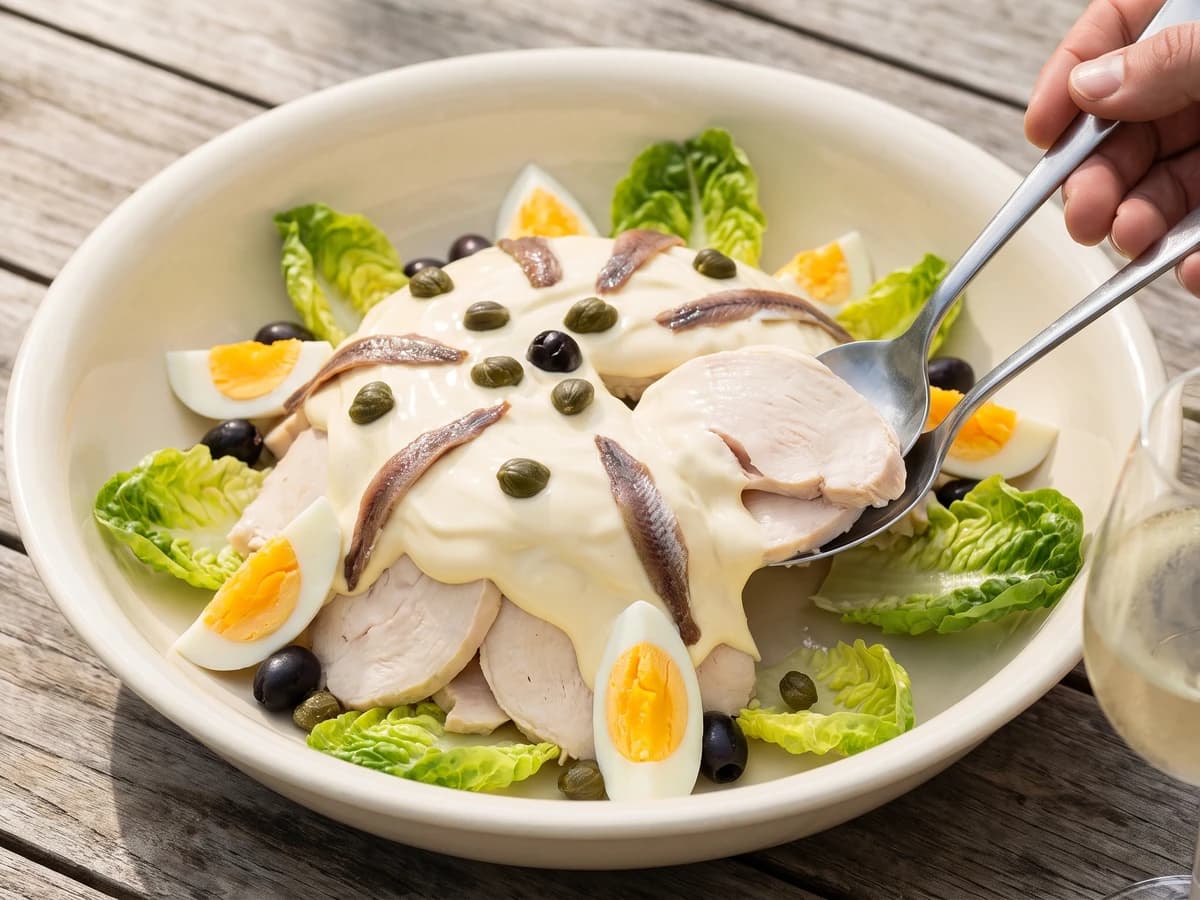
Cold roast chicken, ciseled lettuce, and a shining coat of homemade mayonnaise, arranged with capers, olives, anchovies, eggs, and lettuce hearts, then tossed at the table as the canon intends.
A cooking platform built around craft, culture, and the stories behind what we eat.
Created by Chef Juliette
Based on No. 2005, Salade d’Estrées, from Le Guide Culinaire (1907) by Auguste Escoffier
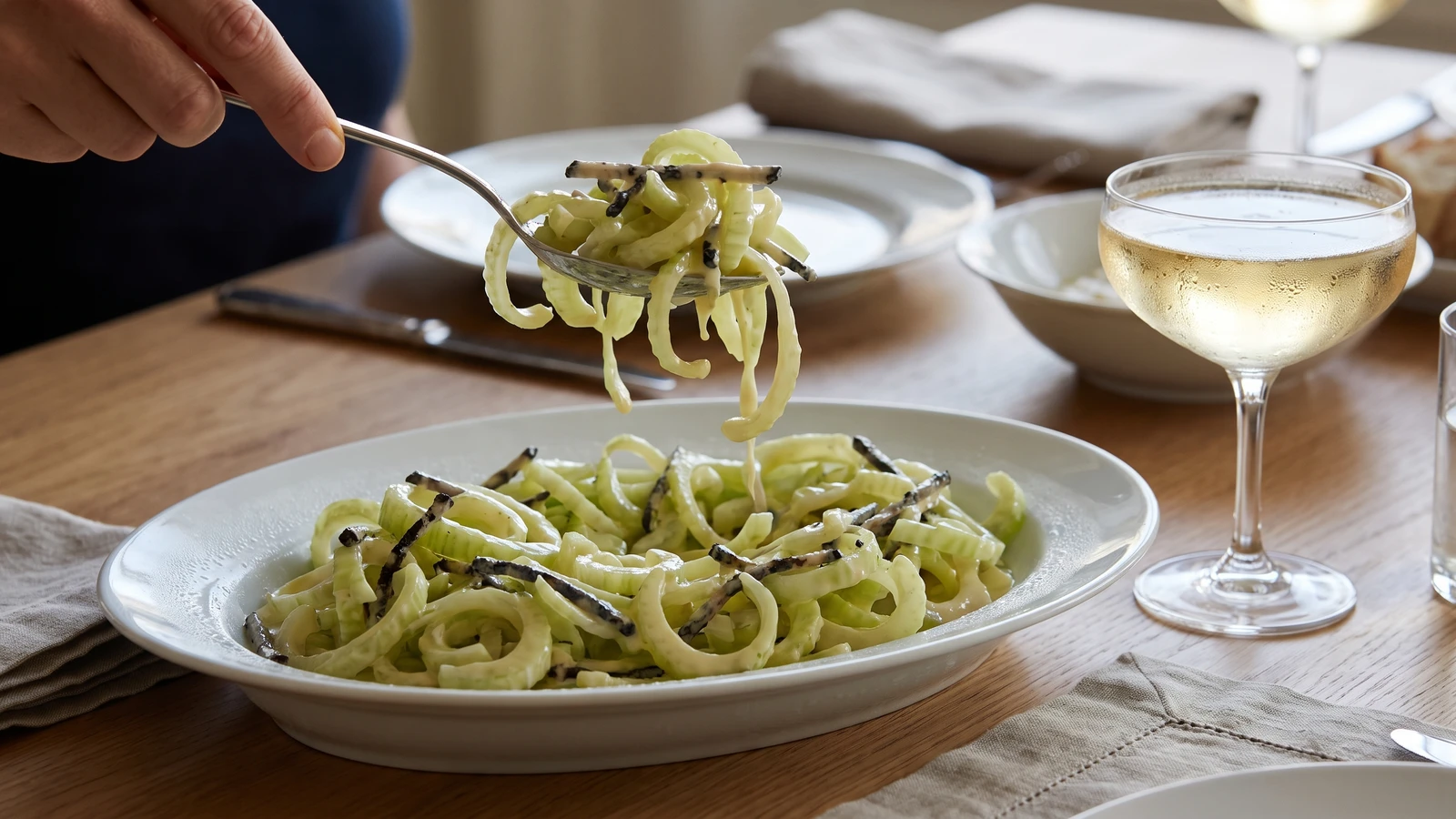
Salade d’Estrées sets crisp celery curls against a true julienne of raw black truffle, then binds them at the last instant with mustard mayonnaise and cayenne. Its luxury is precision, not ornament.
Salade d’Estrées (curled celery and raw-truffle salad) teaches the discipline of the last minute. Crisp pale celery and fragrant black truffle meet in equal measure, but the mustard mayonnaise touches them only when the plates are waiting. Dress the salad early and the celery sheds water, the truffle softens, and its perfume retreats into the sauce.
The old entry assumed a garde-manger, the cold-kitchen cook, with mayonnaise already mounted, celery curled, and truffles cut for each order. At home, make one small yolk emulsion and weigh 80 grams of each principal ingredient. The brigade’s bowls of prepared garnish are scaffolding and can go. Equal measure, a true julienne, and last-instant dressing are the dish and must stay. One cook, one stove left cold, one evening.
When it is right, the mayonnaise barely glosses the pale green curls and black matchsticks; nothing slumps, and every forkful smells unmistakably of truffle before it reaches the mouth. Dry the curled celery until it leaves no moisture on the towel, then keep the dressing away until serving. That final fold decides everything.
Salade d’Estrées belongs to the Parisian classical repertory of named composed salads, where a courtly title signaled luxury and an exact service gesture rather than a farmhouse origin. The d’Estrées name follows the grand-kitchen custom of dedicating preparations to noble houses and public figures, while raw black truffle marks the dish as formal table food. It is not a Périgord regional salad simply because it contains truffle; its true home is the classical dining room, and its identity rests on equal proportions and immediate service.
Quantity
¾ cup, lightly packed (180 ml / 80 g)
trimmed
Quantity
¾ cup, loosely packed (180 ml / 80 g)
well scrubbed and dried
Quantity
1
Quantity
2 teaspoons (10 ml / 10 g)
Quantity
1½ teaspoons (7.5 ml / 7.5 g)
Quantity
⅓ cup (80 ml / 74 g)
Quantity
¼ teaspoon (1.25 ml / 1.5 g)
Quantity
1 small pinch, about 1/32 teaspoon (0.15 ml / 0.05 g)
Quantity
4 cups (960 ml / 960 g)
for curling the celery
Quantity
1 tablespoon (15 ml / 15 g)
as needed to loosen or rescue the mayonnaise
Quantity
1
only if needed to rescue the mayonnaise
| Ingredient | Quantity |
|---|---|
| pale inner celery stalkstrimmed | ¾ cup, lightly packed (180 ml / 80 g) |
| fresh black winter trufflewell scrubbed and dried | ¾ cup, loosely packed (180 ml / 80 g) |
| large egg yolk | 1 |
| Dijon mustard | 2 teaspoons (10 ml / 10 g) |
| white wine vinegar | 1½ teaspoons (7.5 ml / 7.5 g) |
| neutral oil, such as grapeseed or sunflower oil | ⅓ cup (80 ml / 74 g) |
| fine sea salt | ¼ teaspoon (1.25 ml / 1.5 g) |
| cayenne | 1 small pinch, about 1/32 teaspoon (0.15 ml / 0.05 g) |
| ice waterfor curling the celery | 4 cups (960 ml / 960 g) |
| cold water (optional)as needed to loosen or rescue the mayonnaise | 1 tablespoon (15 ml / 15 g) |
| additional large egg yolk (optional)only if needed to rescue the mayonnaise | 1 |
Whisk the egg yolk with the Dijon mustard, vinegar, salt, and cayenne until completely smooth. Add the oil a few drops at a time until the émulsion, the suspension of oil in yolk, takes hold; then pour in a very fine thread while whisking steadily. Stop when the mayonnaise is thick, glossy, and falls from the whisk in a heavy ribbon. Whisk in 1 teaspoon (5 ml / 5 g) cold water if it needs loosening. If oil beads on the surface or the sauce splits, stop pouring. Place 1 teaspoon (5 ml / 5 g) cold water in a clean bowl and whisk in the broken mayonnaise a teaspoon at a time. If it still refuses, begin with the optional fresh yolk and feed the broken sauce into it slowly. Ça se rattrape. Cover and refrigerate at once.
Cut the trimmed celery across into 1½-inch (4 cm) lengths, then slice each piece along the grain into strips about 1/16 inch (1.5 mm) wide. Drop the strips into the ice water and leave them for 15 to 20 minutes, until they tighten into hooks and loose curls. This is céleri frisé, curled celery, not chopped stalks. Drain thoroughly, spin gently if you have a salad spinner, then roll the curls in a clean towel and leave them uncovered for 5 minutes. Wet celery thins the mayonnaise and prevents it from clinging.
Wait until the table is nearly ready before cutting the truffle. Slice it into wafers about 1/16 inch (2 mm) thick, stack no more than three wafers at once, then cut them into match-shaped rods about 1/16 inch (2 mm) wide and 1½ inches (4 cm) long. This moderately small julienne keeps enough body to meet the celery under the teeth; paper-thin shavings would wilt at once and abandon the source preparation.
Weigh 80 g of the dried celery curls and 80 g of the truffle julienne into a wide chilled bowl. Equal quantities are the backbone of Salade d’Estrées. Do not bulk the bowl with extra celery because the truffle is costly; that changes the dish rather than scaling it.
When the serving plates are waiting, add about ⅓ cup (80 ml / 75 g) of the mustard mayonnaise and fold with two large spoons, lifting rather than pressing. Add another spoonful only if dry patches remain. The celery and truffle should gleam, not disappear under a heavy coating. If a little water gathers immediately, lift the salad into a sieve for 30 seconds, wipe the bowl dry, and fold it back with a teaspoon of reserved mayonnaise. A salad left dressed until the truffle wilts cannot be restored, so proceed directly to the table.
Divide the salad among four chilled plates in loose, generous nests, keeping the black julienne visible among the celery curls. Do not compress it and add no decorative garnish; the truffle is already the occasion. Serve immediately. À table!
1 serving (about 70g)
Culinary guides, cultural storytelling, and the editorial depth that makes cooking meaningful.
Discover Culinary ExplorerChef Juliette
Cold roast chicken, ciseled lettuce, and a shining coat of homemade mayonnaise, arranged with capers, olives, anchovies, eggs, and lettuce hearts, then tossed at the table as the canon intends.

Chef Juliette
Cold roast or poached chicken with fine ribbons of lettuce, dressed at the final moment with oil and vinegar: a composed salad whose freshness depends entirely on timing.

Chef Juliette
Five leaves, one living rule: laitue, romaine, chicorée, mâche, or pissenlit must be washed, dried, and dressed only as they go to the table, while every leaf still carries its light vinaigrette.

Chef Juliette
Salade de Betteraves proves that baking, not boiling, is the whole argument: concentrated garnet sweetness, tender baked onion, sharp mustard, and herbs cut into a weeknight salad worth making ahead.