Chef Juliette
Mayonnaise de Volaille
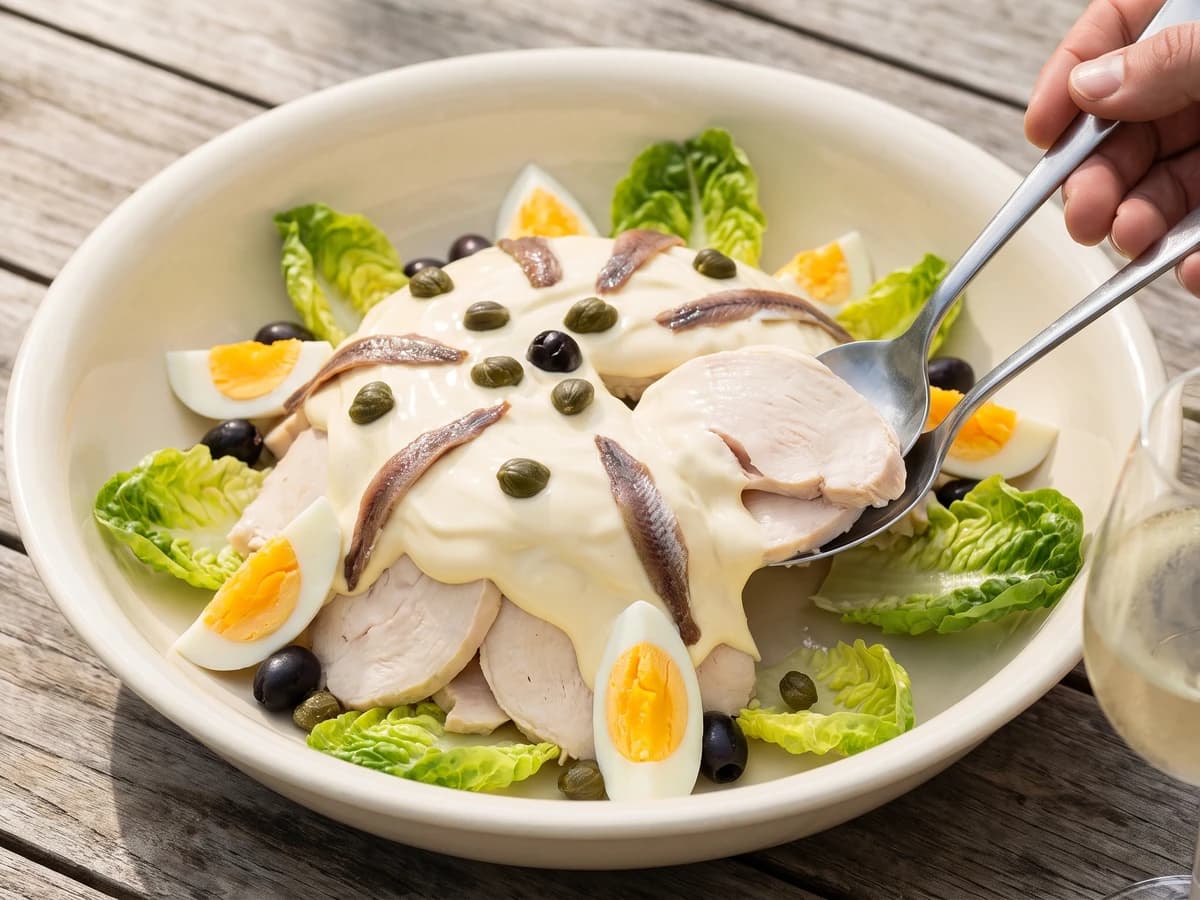
Cold roast chicken, ciseled lettuce, and a shining coat of homemade mayonnaise, arranged with capers, olives, anchovies, eggs, and lettuce hearts, then tossed at the table as the canon intends.
A cooking platform built around craft, culture, and the stories behind what we eat.

Created by Chef Juliette
Based on No. 2004, Salade Demi-Deuil, from Le Guide Culinaire (1907) by Auguste Escoffier
Equal juliennes of pale potato and black truffle, bordered with inverse rings and barely veiled in mustard cream: Lyon's demi-deuil pattern brought to the table, exact, aromatic, and generous enough for four.
Salade demi-deuil (half-mourning salad) teaches proportion before ornament. Before you touch a pan, know the one true thing: potato and black truffle are equal partners in the julienne. The potato gives pale tenderness and quiet; the truffle gives blackness, perfume, and earth. Reduce it to a shaving on top and you've made another salad.
The classical entry assumed a garde-manger with cold cooked potatoes, matched tube cutters, and enough whole truffle that its scraps could be treated as ordinary mise en place. It needed neither saucier, permanent stockpot, nor salamander; its brigade scaffolding was spare hands and truffle abundance. At home, two nested piping tips make the inverse rings, a small scale protects the equal ratio, and every dark offcut returns to the julienne. Four servings, one cook, one stove, one evening.
The sauce moutarde à la crème (mustard sauce with cream) should cling in a thin ivory veil, never burying the cut work. No herbs, lettuce, or truffle oil belong here. The step that decides the dish is weighing the finished juliennes after the decorative rings are cut; get that balance right, and the black-and-white dress carries both flavor and meaning.
Salade demi-deuil belongs to Lyon's formal composed-salad repertoire, where demi-deuil, half-mourning, names the black-and-white contrast of truffle against pale poultry, eggs, or potato. The city's better-known poularde demi-deuil places truffle beneath white chicken skin; this salad transfers the same visual language to the garde-manger, with inverse rings making the name literal on the platter. It is not potato salad enriched with a little truffle: equal juliennes and an unmuddied mustard-cream seasoning are its identity.
Quantity
2 medium, about 8 ounces (225 g) raw, yielding at least ½ cup julienne (120 ml / 80 g) plus ornament slices
Quantity
3 to 5 whole, about ¾ cup once cut (180 ml / 100 g)
fresh and ripe, or whole preserved, drained and dried
Quantity
4 cups (960 ml / 960 g), plus more if needed
Quantity
1 tablespoon (15 ml / 18 g)
Quantity
⅓ cup (80 ml / 80 g)
Quantity
1 tablespoon (15 ml / 15 g)
Quantity
2 teaspoons (10 ml / 10 g)
Quantity
¼ teaspoon (1.25 ml / 1.5 g)
Quantity
⅛ teaspoon (0.6 ml / 0.3 g)
Quantity
1 tablespoon (15 ml / 15 g)
| Ingredient | Quantity |
|---|---|
| waxy potatoes, such as Charlotte or Yukon Gold | 2 medium, about 8 ounces (225 g) raw, yielding at least ½ cup julienne (120 ml / 80 g) plus ornament slices |
| whole very black winter trufflesfresh and ripe, or whole preserved, drained and dried | 3 to 5 whole, about ¾ cup once cut (180 ml / 100 g) |
| cold water | 4 cups (960 ml / 960 g), plus more if needed |
| fine sea salt for the potato water | 1 tablespoon (15 ml / 18 g) |
| heavy cream, 35 to 40 percent fat | ⅓ cup (80 ml / 80 g) |
| Dijon mustard | 1 tablespoon (15 ml / 15 g) |
| white wine vinegar | 2 teaspoons (10 ml / 10 g) |
| fine sea salt for the sauce | ¼ teaspoon (1.25 ml / 1.5 g) |
| finely ground white pepper | ⅛ teaspoon (0.6 ml / 0.3 g) |
| chilled water (optional) | 1 tablespoon (15 ml / 15 g) |
Put the unpeeled potatoes in a small saucepan with the cold water and the tablespoon of salt. Bring them slowly to a bare simmer, then cook for 18 to 22 minutes, until a fine skewer enters the center with only faint resistance. A rolling boil knocks them about and bursts their skins; gentle water keeps the flesh dense enough to cut. Drain at once, peel while warm, and chill for 30 minutes. If one potato splits, chill it immediately and use its firm center. If it has turned fluffy throughout, cook another, because the rings require sound flesh.
Reserve 1 tablespoon of the measured cream for rescue. Whisk the Dijon mustard, vinegar, sauce salt, and white pepper until perfectly smooth, then add the remaining cream in a thin stream while whisking steadily. The sauce should lightly coat a spoon and still run from it. If it turns grainy or separates, don't pour it out. Ça se rattrape: put the reserved cream in a clean bowl and whisk in the broken sauce one teaspoon at a time. If no rescue is needed, whisk in the reserved cream at the end. Loosen an overly thick sauce with chilled water by the teaspoon, then refrigerate it.
Brush fresh truffles clean and dry them thoroughly; blot preserved truffles until their surfaces are no longer wet. Cut four potato coins and four truffle coins of equal thickness, about ⅛ inch (3 mm). Stamp each coin first with the larger cutter, then with the smaller cutter centered inside it. Fit the potato centers into the truffle rings, and the truffle centers into the potato rings, making four of each form. Keep every sound offcut. If a ring cracks, send it to the julienne and cut another. C'est la même grammaire: matched thickness, matched cutters, opposite colors.
Cut all remaining truffle and its offcuts julienne-fashion into match-shaped rods about 1½ mm square and 1¼ inches (3 cm) long. Weigh the finished truffle julienne; it should give about 80 to 90 g. Cut the chilled potato to the same dimensions, then weigh out exactly the same amount as the truffle. The scale decides the equality, not the apparent size of the handfuls. This equal proportion is the dish and must stay; the matched cutters were brigade scaffolding, and the piping tips have already replaced them honestly.
Place the equal juliennes in a chilled bowl and lift them together gently with two forks. Add the mustard cream one tablespoon at a time, folding after each addition, until every matchstick carries a fine sheen but no sauce collects underneath. If too much sauce goes in, lift the solids into a clean bowl with a slotted spoon and leave the excess behind. Ça se rattrape. Never correct overdressing with potato alone, because that would break the equal ratio that defines the salad.
Arrange the dressed julienne in a low oval on a chilled serving platter. Around it, alternate the eight ornaments: one black truffle ring with a pale potato center, then one pale potato ring with a black truffle center. Repeat until the border closes. Serve cool rather than numb from the refrigerator, ideally within an hour of cutting the truffle. Add nothing else. The sharp ivory sauce and the black-and-white dress have finished the work. À table!
1 serving (about 110g)
Culinary guides, cultural storytelling, and the editorial depth that makes cooking meaningful.
Discover Culinary ExplorerChef Juliette
Cold roast chicken, ciseled lettuce, and a shining coat of homemade mayonnaise, arranged with capers, olives, anchovies, eggs, and lettuce hearts, then tossed at the table as the canon intends.

Chef Juliette
Cold roast or poached chicken with fine ribbons of lettuce, dressed at the final moment with oil and vinegar: a composed salad whose freshness depends entirely on timing.

Chef Juliette
Five leaves, one living rule: laitue, romaine, chicorée, mâche, or pissenlit must be washed, dried, and dressed only as they go to the table, while every leaf still carries its light vinaigrette.

Chef Juliette
Salade de Betteraves proves that baking, not boiling, is the whole argument: concentrated garnet sweetness, tender baked onion, sharp mustard, and herbs cut into a weeknight salad worth making ahead.