Chef Juliette
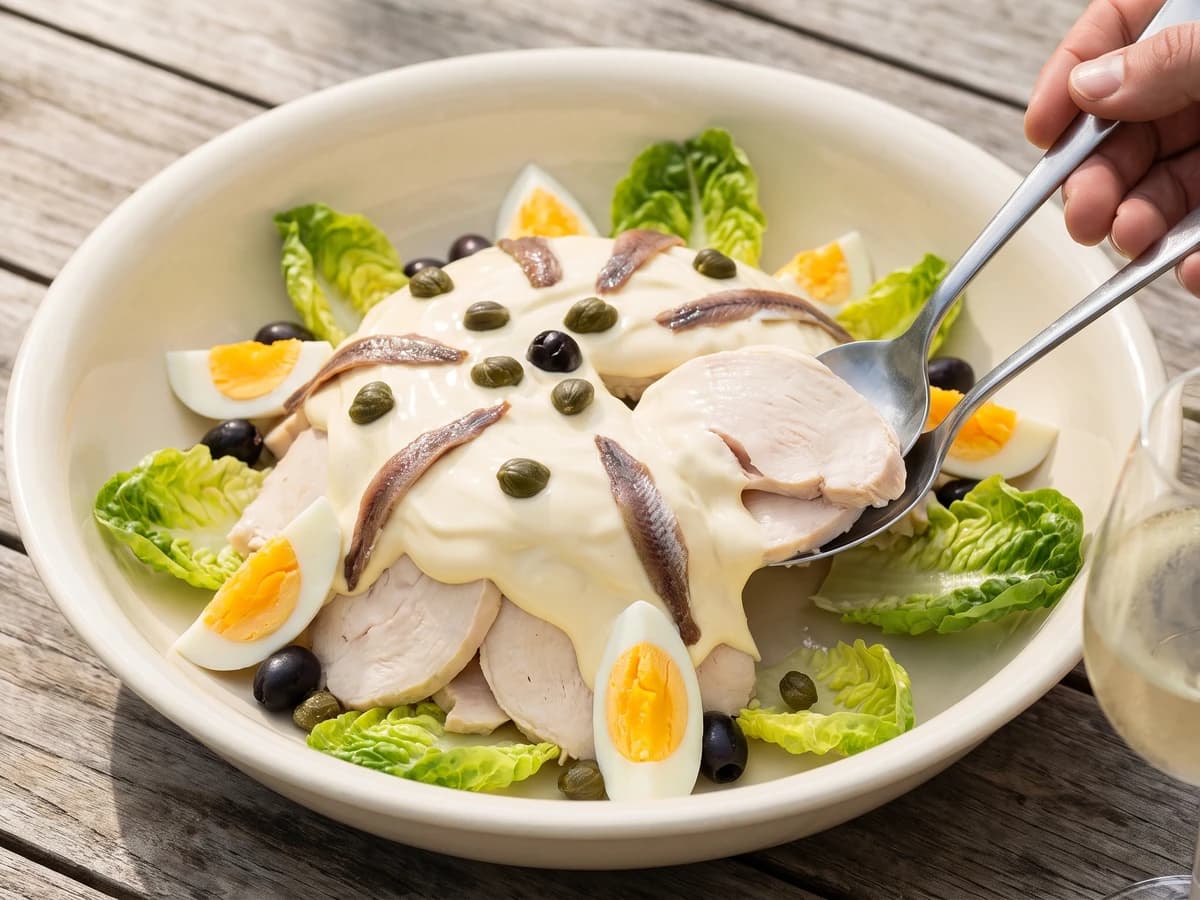
Mayonnaise de Volaille
Cold roast chicken, ciseled lettuce, and a shining coat of homemade mayonnaise, arranged with capers, olives, anchovies, eggs, and lettuce hearts, then tossed at the table as the canon intends.
A cooking platform built around craft, culture, and the stories behind what we eat.
Created by Chef Juliette
Based on No. 2002, Salade Isabelle, from Le Guide Culinaire (1907) by Auguste Escoffier
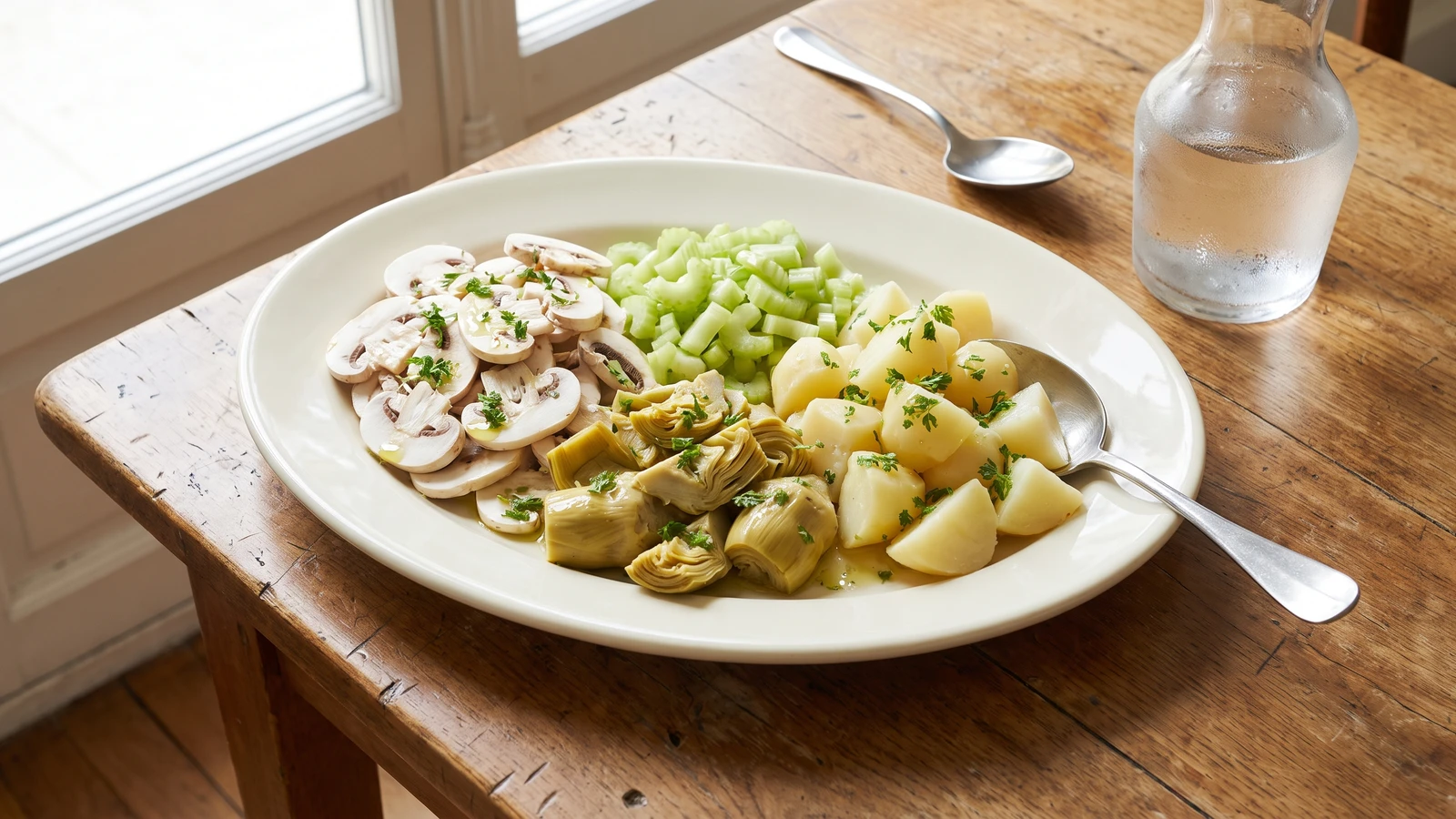
Four equal heaps of raw mushrooms, crisp celery, tender potato, and artichoke bottoms meet a sharp oil-and-vinegar dressing and fresh chervil in a composed salad whose whole discipline is timing.
Salade Isabelle teaches the discipline of a salade composée, a composed salad whose ingredients remain distinct on the platter. Four equal quantities, four different textures, one clean seasoning. The one true thing is timing: raw mushrooms must be sliced only when the platter and dressing are ready, or their pale surfaces darken before the vinegar can protect them.
No saucier, stock kept on the fire, or salamander was needed here. The professional advantage was quieter: a garde-manger with cooked potatoes and artichoke bottoms waiting in the larder, plus another pair of hands to slice mushrooms at the last second. At home, simmer one waxy potato and use plain jarred or canned artichoke bottoms, rinsed of their brine. Those prepared vegetables were brigade scaffolding and may go. The equal proportions, separate heaps, and last-minute mushrooms are the dish and must stay. One cook, one stove, one evening.
Everything is scaled to four people, with each principal ingredient measured at 150 grams after trimming or cooking. Whisking the oil and vinegar into a brief emulsion merely gives one cook even seasoning; it changes neither the flavor nor the order of service. The step that decides the salad is the last one: don't cut a mushroom until every other ingredient is on the platter.
Salade Isabelle belongs to the named composed salads of the French classical dining room, where ingredients were arranged in separate groups so their equality and contrasts remained visible at service. Its namesake is not securely documented, and the dish has no honest claim to Lyon, Burgundy, Normandy, Alsace, or Provence; its true home is the classical garde-manger, with cooked vegetables prepared ahead and delicate raw mushrooms cut to order. It passed easily to the home table because its distinction comes from order rather than rarity: four equal quantities, oil and vinegar, and fresh chervil.
Quantity
2 cups (475 ml / 150 g)
wiped clean and stems trimmed, left whole until serving
Quantity
1¼ cups (300 ml / 150 g)
strings removed and thinly sliced
Quantity
1 medium (about 6½ oz / 185 g), to yield 1 cup (240 ml / 150 g) cooked and peeled
Quantity
4 to 5, yielding 1 cup (240 ml / 150 g) drained
rinsed and patted dry
Quantity
4 tablespoons (60 ml / 55 g)
Quantity
1 tablespoon plus 1 teaspoon (20 ml / 20 g)
Quantity
2 tablespoons (30 ml / 4 g)
chopped just before serving
Quantity
¾ teaspoon (3.75 ml / 4.5 g)
Quantity
⅛ teaspoon (0.6 ml / 0.3 g)
| Ingredient | Quantity |
|---|---|
| small white button mushroomswiped clean and stems trimmed, left whole until serving | 2 cups (475 ml / 150 g) |
| celery heartsstrings removed and thinly sliced | 1¼ cups (300 ml / 150 g) |
| waxy potato | 1 medium (about 6½ oz / 185 g), to yield 1 cup (240 ml / 150 g) cooked and peeled |
| plain cooked artichoke bottoms, jarred or canned and not marinatedrinsed and patted dry | 4 to 5, yielding 1 cup (240 ml / 150 g) drained |
| neutral salad oil, such as sunflower oil | 4 tablespoons (60 ml / 55 g) |
| white wine vinegar | 1 tablespoon plus 1 teaspoon (20 ml / 20 g) |
| fresh chervil leaveschopped just before serving | 2 tablespoons (30 ml / 4 g) |
| fine sea salt | ¾ teaspoon (3.75 ml / 4.5 g) |
| finely ground white pepper | ⅛ teaspoon (0.6 ml / 0.3 g) |
Put the unpeeled potato in a small saucepan, cover it with cold water, and bring it slowly to a simmer. Cook gently for 15 to 20 minutes, until a narrow knife enters with only slight resistance; a hard boil splits the skin and waterlogs the flesh. Drain, peel while warm enough to handle, and cool completely. Measure 1 cup (240 ml / 150 g), then cut it into slices about ⅛ inch (3 mm) thick. If the warm potato crumbles, stop and chill it before continuing. Ça se rattrape: hide any broken slices beneath the intact ones when you build the heap.
Slice the celery hearts thinly on a slight diagonal, keeping their pale leaves if they are tender. Cut the well-dried artichoke bottoms into slices about ⅛ inch (3 mm) thick. Arrange the celery, potato, and artichoke in three separate, generous heaps on a shallow platter, leaving a fourth space for the mushrooms. Keep the borders loose and natural, but do not mingle them; the distinct arrangement is part of Salade Isabelle, not plating theater.
Put the vinegar, salt, and white pepper in a small bowl and whisk until the salt dissolves. Add the oil in a thin stream while whisking to make a light vinaigrette, a temporary oil-and-vinegar emulsion. It need not become thick. If it separates while you work, whisk it again just before dressing. C'est la même grammaire: seasoning dissolves in vinegar, while oil carries it over every cut surface.
Only now slice the raw mushrooms about 1⁄16 inch (2 mm) thick and place them directly into the empty space on the platter. Work with a sharp knife so the slices stay clean rather than bruised. If the first slices begin turning grey before the last are cut, stop and spoon a teaspoon of vinaigrette over them. Ça se rattrape: the acid cannot bleach color already lost, but it will slow further darkening while you finish.
Whisk the vinaigrette once more, then spoon it evenly over all four heaps. Use two spoons to lift each heap gently within its own space, coating the slices without mixing the vegetables together. Scatter the freshly chopped chervil over the whole platter and let the salad stand for 5 minutes at cool room temperature, just long enough for the potato and artichoke to take the seasoning. Serve at once. À table!
1 serving (about 170g)
Culinary guides, cultural storytelling, and the editorial depth that makes cooking meaningful.
Discover Culinary ExplorerChef Juliette
Cold roast chicken, ciseled lettuce, and a shining coat of homemade mayonnaise, arranged with capers, olives, anchovies, eggs, and lettuce hearts, then tossed at the table as the canon intends.

Chef Juliette
Cold roast or poached chicken with fine ribbons of lettuce, dressed at the final moment with oil and vinegar: a composed salad whose freshness depends entirely on timing.

Chef Juliette
Five leaves, one living rule: laitue, romaine, chicorée, mâche, or pissenlit must be washed, dried, and dressed only as they go to the table, while every leaf still carries its light vinaigrette.

Chef Juliette
Salade de Betteraves proves that baking, not boiling, is the whole argument: concentrated garnet sweetness, tender baked onion, sharp mustard, and herbs cut into a weeknight salad worth making ahead.