Chef Juliette
Mayonnaise de Volaille
Cold roast chicken, ciseled lettuce, and a shining coat of homemade mayonnaise, arranged with capers, olives, anchovies, eggs, and lettuce hearts, then tossed at the table as the canon intends.
A cooking platform built around craft, culture, and the stories behind what we eat.
Created by Chef Juliette
Based on No. 2000, Salade Belle-Fermière, from Le Guide Culinaire (1907) by Auguste Escoffier
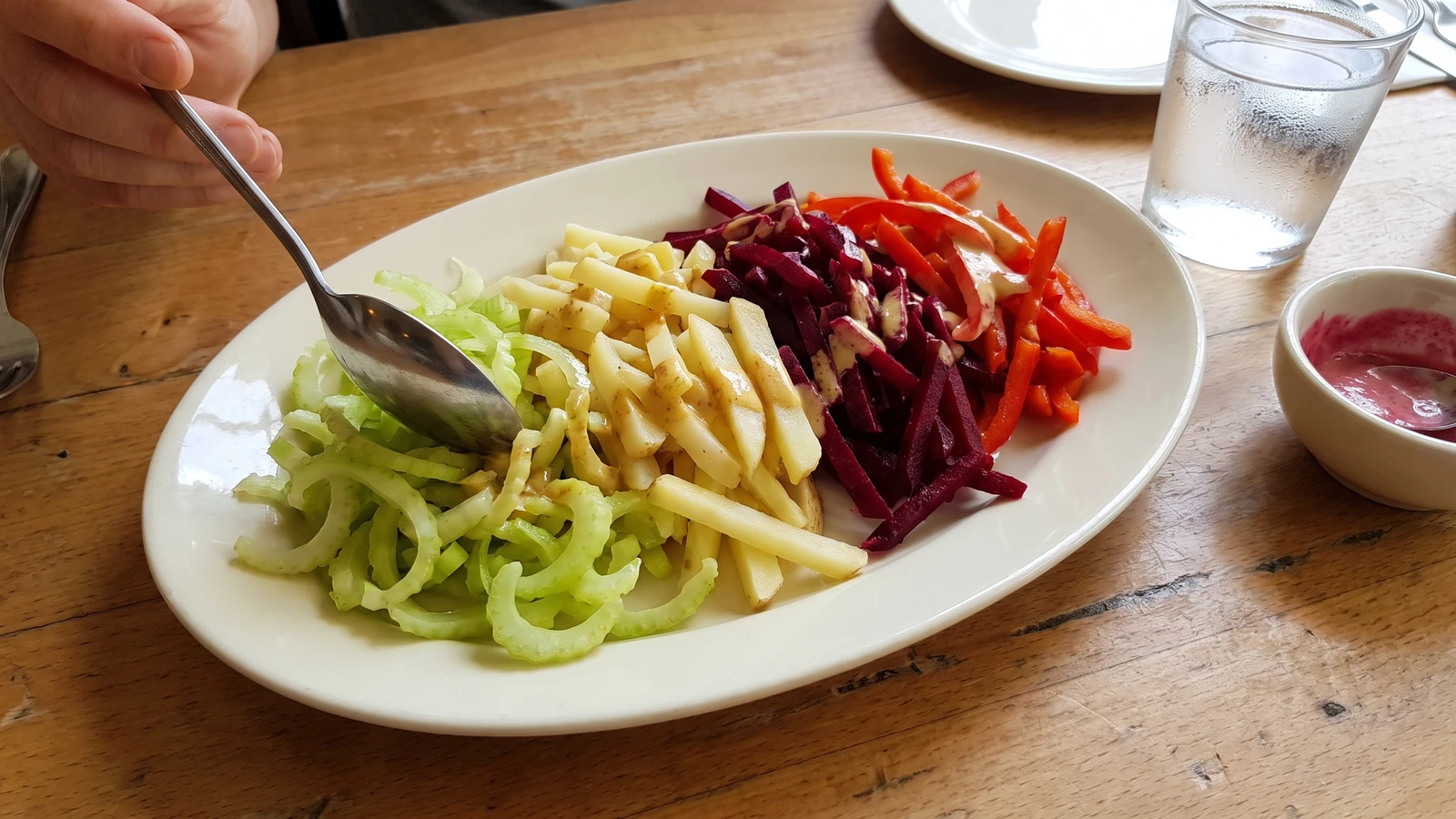
Curled celery meets neat julienne of potato, beetroot, and capsicum beneath a mustard-cream dressing, a composed salad whose quiet discipline lies in keeping every color, texture, and flavor distinct.
Salade Belle-Fermière (the farmwife's salad) teaches that a salade composée (composed salad) is governed by proportion, not decoration. Celery makes exactly one-third; equal quantities of potato, beetroot, and capsicum make the remaining two-thirds. The one true thing to know before touching a pan is this: dress the beetroot apart and add it last, or one careless turn of the spoon paints the whole bowl pink.
The old entry assumed a garde-manger, the cold-pantry cook, with plain-boiled vegetables waiting cold, a practiced hand for cutting julienne-fashion, and mustard sauce with cream already made. It needed neither a saucier, a perpetual stockpot, nor a salamander. At home, two saucepans, an ice bath, a small whisk, and a kitchen scale do the work. The brigade's trays and extra hands are scaffolding and can go; the exact ratio, clean cut, curled celery, and cream-softened mustard seasoning are the dish and must stay. One cook, one stove, one evening.
When it is right, pale-green celery curls remain crisp, the potato stays ivory, the capsicum flashes red, and beetroot keeps its dark garnet edge beneath a cool ochre-cream gloss. Dry every vegetable thoroughly, then dress the beetroot alone. That final separation decides whether Salade Belle-Fermière arrives bright and composed or merely pink.
Salade Belle-Fermière belongs to the Parisian classical cold pantry, not to a single farming region; its pastoral title signals a garden-led composition rather than a documented village specialty. Its fixed architecture, one-third curled celery and the remaining two-thirds divided equally among potato, beetroot, and sweet pepper, shows how the garde-manger organized vegetables by proportion, color, and cut. Cream-enriched mustard seasoning and separate handling of the beetroot carried readily from grand service to the bourgeois table.
Quantity
2¼ cups (530 ml / 225 g)
trimmed, with leaves removed
Quantity
2 small, yielding 1 cup (240 ml / 150 g) prepared
boiled whole, peeled, and trimmed
Quantity
1 medium, yielding 1 cup (240 ml / 150 g) prepared
boiled whole, peeled, and trimmed
Quantity
1 large, yielding 1¼ cups (300 ml / 150 g) prepared
seeded, trimmed, and blanched
Quantity
4 cups (950 ml / 950 g)
divided between two bowls
Quantity
6 tablespoons (90 ml / 90 g)
Quantity
2 tablespoons (30 ml / 30 g)
Quantity
1 tablespoon (15 ml / 15 g)
Quantity
1 tablespoon plus ½ teaspoon (17.5 ml / 21 g)
divided
Quantity
¼ teaspoon (1.25 ml / 0.6 g)
| Ingredient | Quantity |
|---|---|
| pale inner celery stalkstrimmed, with leaves removed | 2¼ cups (530 ml / 225 g) |
| small waxy potatoesboiled whole, peeled, and trimmed | 2 small, yielding 1 cup (240 ml / 150 g) prepared |
| medium beetrootboiled whole, peeled, and trimmed | 1 medium, yielding 1 cup (240 ml / 150 g) prepared |
| red capsicum (bell pepper)seeded, trimmed, and blanched | 1 large, yielding 1¼ cups (300 ml / 150 g) prepared |
| ice waterdivided between two bowls | 4 cups (950 ml / 950 g) |
| cold heavy cream | 6 tablespoons (90 ml / 90 g) |
| Dijon mustard | 2 tablespoons (30 ml / 30 g) |
| white wine vinegar | 1 tablespoon (15 ml / 15 g) |
| fine sea saltdivided | 1 tablespoon plus ½ teaspoon (17.5 ml / 21 g) |
| finely ground white pepper | ¼ teaspoon (1.25 ml / 0.6 g) |
Place the unpeeled beetroot in one saucepan, cover it with cold water by 1 inch (2.5 cm), and bring it to a gentle boil. Simmer until a small knife enters the center without force, 35 to 45 minutes. In a second saucepan, cover the unpeeled potatoes with cold water, add 1 tablespoon (15 ml / 18 g) of the salt, and simmer gently for 15 to 20 minutes, until a knife enters with only slight resistance. Lift the potatoes out and keep their cooking water hot for the capsicum. Drain the beetroot, then spread the roots separately to cool. If a potato begins to split, lift it immediately and chill it whole; once cold, the starch firms enough to cut, and the sound center remains usable. Ça se rattrape.
While the roots cook, cut the celery lengthwise into rods about 2 inches (5 cm) long and ⅛ inch (3 mm) thick. Drop them into one bowl of ice water and leave them for 20 to 30 minutes, until the rods stiffen and their ends begin to curl. Seed the capsicum, flatten its panels, and cut them to the same dimensions. Return the potato water to a boil, blanch the capsicum for 60 to 90 seconds, just until supple but still crisp under the teeth, then transfer it to the second bowl of ice water. Drain both vegetables separately.
Peel the cooled potatoes and beetroot. Square them lightly into slabs, then cut them julienne-fashion, meaning match-shaped rods, about 2 inches (5 cm) long and ⅛ inch (3 mm) thick. Cut the beetroot last and wash the knife and board afterward. Dry every vegetable thoroughly, then weigh the prepared portions: 225 g celery and 150 g each of potato, beetroot, and capsicum. This keeps the book's exact one-third to two-thirds architecture. If one cooked vegetable comes up short, reduce the others to match it rather than filling the gap with something else.
Whisk the Dijon mustard with the white wine vinegar, the reserved ½ teaspoon (2.5 ml / 3 g) salt, and the white pepper. Add the cold cream gradually, whisking only until the sauce is smooth, pale ochre, and thick enough to cling lightly to a potato strip. Do not whip air into it. If the sauce tightens or looks grainy, stop and whisk in 1 teaspoon of the ice water; ça se rattrape. If it seems loose, chill it for 10 minutes before dressing.
Work in one clean bowl for the pale vegetables and keep a second bowl for the beetroot. Toss the celery with 3 tablespoons of mustard cream, the potato with 2 tablespoons, and the capsicum with 2 tablespoons, wiping the bowl between vegetables if necessary. Dress the beetroot separately with the final 2 tablespoons. Turn each component only enough to coat it. If beetroot reaches the pale vegetables and begins to bleed, stop stirring, lift it out, wipe the bowl, and compose the colors in separate loose sections. The salad will be marbled rather than pristine, but it will still taste exactly right.
Mound the curled celery loosely along one broad third of an oval platter. Bring the potato and capsicum beside it, then tuck the dressed beetroot through the remaining vegetables at the last moment, keeping the colors distinct rather than arranging rigid stripes. Serve cool within 30 minutes, before salt draws water from the celery and loosens the sauce. Cooking well is not cooking fancy. À table!
1 serving (about 200g)
Culinary guides, cultural storytelling, and the editorial depth that makes cooking meaningful.
Discover Culinary ExplorerChef Juliette
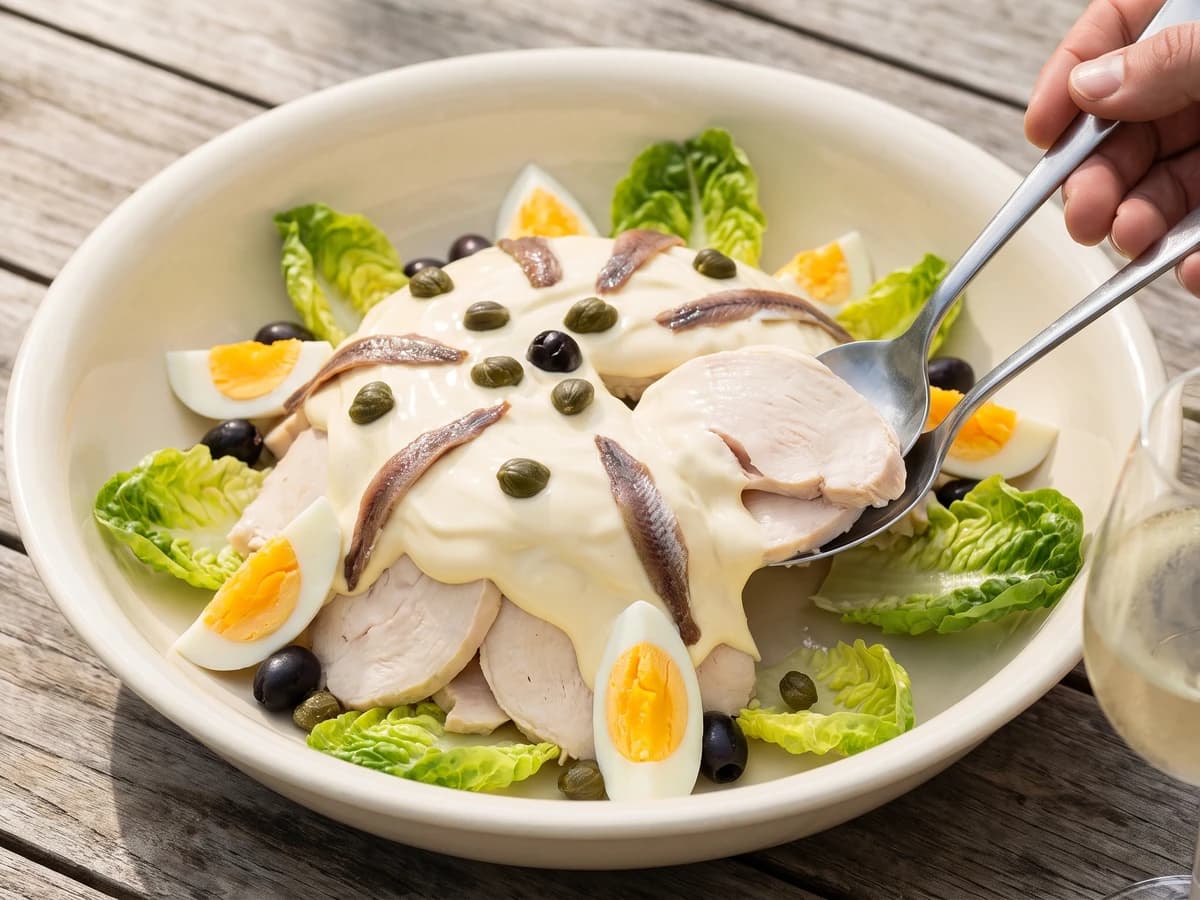
Cold roast chicken, ciseled lettuce, and a shining coat of homemade mayonnaise, arranged with capers, olives, anchovies, eggs, and lettuce hearts, then tossed at the table as the canon intends.

Chef Juliette
Cold roast or poached chicken with fine ribbons of lettuce, dressed at the final moment with oil and vinegar: a composed salad whose freshness depends entirely on timing.

Chef Juliette
Five leaves, one living rule: laitue, romaine, chicorée, mâche, or pissenlit must be washed, dried, and dressed only as they go to the table, while every leaf still carries its light vinaigrette.

Chef Juliette
Salade de Betteraves proves that baking, not boiling, is the whole argument: concentrated garnet sweetness, tender baked onion, sharp mustard, and herbs cut into a weeknight salad worth making ahead.