Chef Juliette
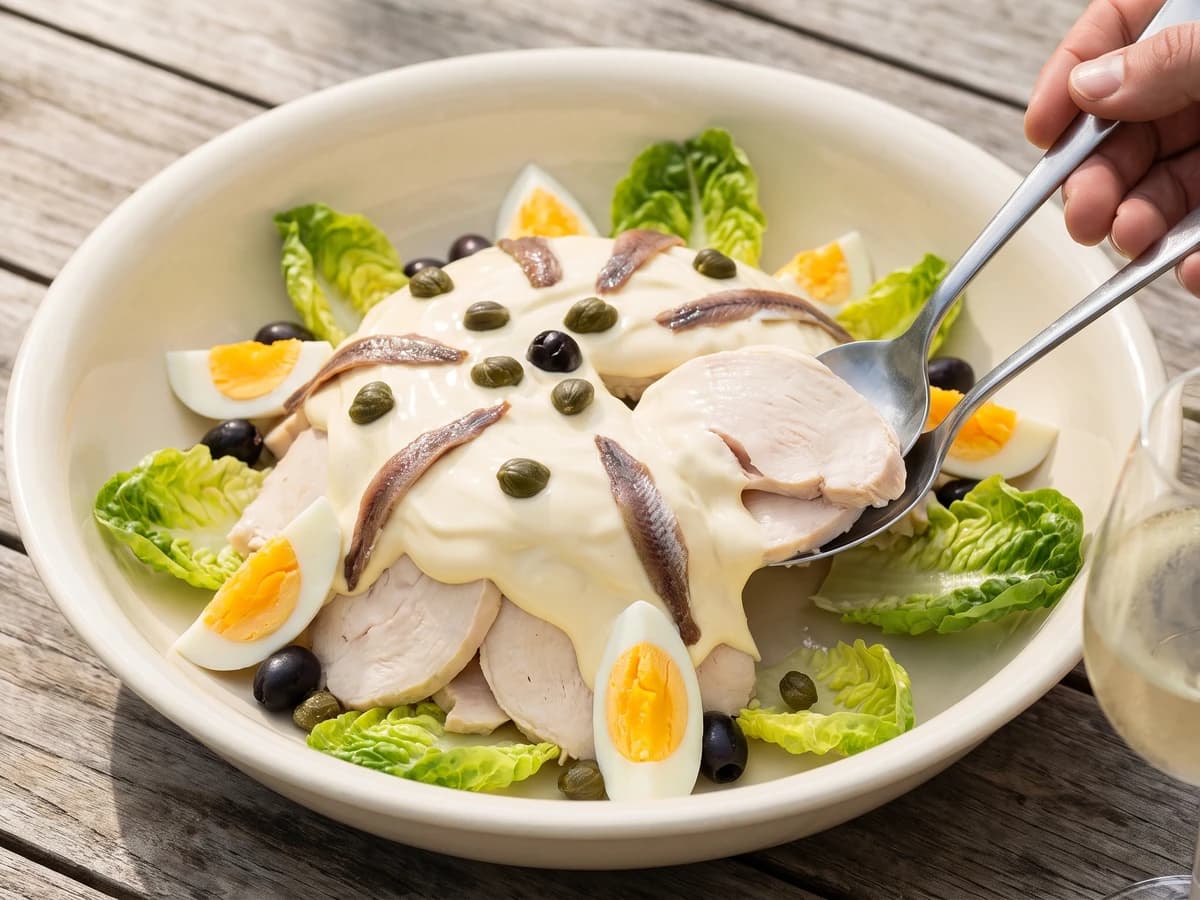
Mayonnaise de Volaille
Cold roast chicken, ciseled lettuce, and a shining coat of homemade mayonnaise, arranged with capers, olives, anchovies, eggs, and lettuce hearts, then tossed at the table as the canon intends.
A cooking platform built around craft, culture, and the stories behind what we eat.

Created by Chef Juliette
Based on No. 1998, Salade Américaine, from Le Guide Culinaire (1907) by Auguste Escoffier
Pressed tomato slices and tender potato roundels meet crisp celery julienne, egg, and onion under a clean oil-and-vinegar dressing, a composed salad whose success depends on controlling water before the plate is built.
Salade Américaine (American-style composed salad) teaches the quiet discipline of the garde-manger (cold station): water is an ingredient even when you don't want it. Peel the tomatoes, halve and press out their seed water, then let them drain before slicing, or the vinaigrette (oil-and-vinegar dressing) loses its clean edge in a pink puddle. That is the one true thing to know before you touch a pan.
The original entry assumed a garde-manger with boiled potatoes, hard-boiled eggs, and pressed tomatoes waiting in orderly trays. It needed no saucier, stockpot, or salamander. At home, one saucepan handles the blanching, eggs, and potatoes, a clean towel handles the draining, and the brigade quantity becomes four generous servings. The ready mise en place was service scaffolding and can go; the pressing, thin roundels, short julienne, and composed arrangement are the dish and must stay. One cook, one stove, one evening.
Once the components are cool, the work is careful rather than difficult: red tomato, pale potato, green celery, egg, and translucent onion, each kept distinct beneath a light gleam of dressing. Give the tomatoes their full twenty minutes to drain after pressing. Everything else is assembly.
Salade Américaine belongs to the French classical garde-manger and, more precisely, to the composed hors-d'oeuvre table of grand dining rooms, not to any single American regional tradition. On French menus, à l'américaine changed meaning with the preparation; here it names a tidy arrangement of tomato, potato, celery, egg, and onion, with no connection to the lobster-based sauce bearing the same adjective elsewhere in the canon. The name traveled through dining-room menus, while the method remained cold-station discipline: distinct cuts, controlled tomato water, and oil and vinegar added only at service.
Quantity
4 medium (about 3 cups / 600 g)
cored, peeled, pressed, and thinly sliced
Quantity
3 medium (about 3 cups / 450 g)
scrubbed, cooked whole, cooled, peeled, and cut into roundels
Quantity
2 large (about 1 cup / 100 g)
trimmed and cut into a short julienne
Quantity
3
hard-boiled, peeled, and cut into roundels
Quantity
½ small (about ⅓ cup / 40 g)
cut into paper-thin rings
Quantity
¼ cup (60 ml / 55 g)
Quantity
1 tablespoon plus 1 teaspoon (20 ml / 20 g)
Quantity
¾ teaspoon (3.75 ml / 4 g)
| Ingredient | Quantity |
|---|---|
| ripe but firm tomatoescored, peeled, pressed, and thinly sliced | 4 medium (about 3 cups / 600 g) |
| waxy potatoesscrubbed, cooked whole, cooled, peeled, and cut into roundels | 3 medium (about 3 cups / 450 g) |
| celery stalkstrimmed and cut into a short julienne | 2 large (about 1 cup / 100 g) |
| large eggshard-boiled, peeled, and cut into roundels | 3 |
| white onioncut into paper-thin rings | ½ small (about ⅓ cup / 40 g) |
| neutral salad oil, preferably sunflower or grapeseed | ¼ cup (60 ml / 55 g) |
| white wine vinegar | 1 tablespoon plus 1 teaspoon (20 ml / 20 g) |
| fine sea salt | ¾ teaspoon (3.75 ml / 4 g) |
Bring a medium saucepan of water to a boil and ready a bowl of cold water. Score a shallow cross in the base of each tomato, lower them into the water for 15 to 20 seconds, then transfer them to the cold water and slip off the skins. Core the tomatoes and halve them through the equator. Hold each half cut side down over a bowl and press gently until the loose seeds and clear juice fall away; don't wring the flesh. Set the halves cut side down between two clean absorbent towels, press once with the flat of your hand, and leave them for 20 minutes. If the towels become saturated, replace them and wait another 5 minutes. Slice the drained halves crosswise into thin ¼-inch / 6 mm half-rounds.
Place the scrubbed potatoes in the saucepan, cover them with cold water by 1 inch / 2.5 cm, and bring the water to a bare simmer. Lower in the eggs carefully and cook them for 9 minutes, then lift them into cold water. Continue simmering the potatoes until a small knife enters the centre cleanly, usually 10 to 15 minutes longer. Keep the water calm; a hard boil breaks their skins and softens the edges. Drain the potatoes, peel them while barely warm, and let them cool completely. Peel the cooled eggs.
Slice the cooled potatoes and eggs crosswise into roundels about ¼ inch / 6 mm thick. Cut the celery en julienne (into match-shaped rods), then shorten the rods to about 1½ inches / 4 cm. Slice the onion paper-thin and separate it into rings. Keep every component apart until the platter is built; this is a composed salad, not a tossed one.
Put the white wine vinegar and ½ teaspoon of the salt in a small bowl, then whisk until the salt dissolves. Add the oil gradually, whisking until the vinaigrette forms a light temporary emulsion. Keep it to oil and vinegar, with no mustard, mayonnaise, or herbs; that clean seasoning is part of the dish. The vinaigrette will separate as it waits, so whisk it again immediately before dressing.
Arrange overlapping bands of tomato half-rounds and potato roundels on a cool 12-inch / 30 cm platter. Lay the short celery julienne in a loose narrow band through the centre, then deck the salad with egg roundels and onion rings, keeping each shape visible. Taste one potato with a tomato and add the remaining salt only if needed. Whisk the vinaigrette and spoon about two-thirds over the salad, giving the potatoes a little more than the tomatoes. Wait one minute, then add only enough of the remainder to leave the surfaces lightly gleaming. If liquid gathers around the platter, lift it away with a spoon, blot the rim, and dress again sparingly. Ça se rattrape. Serve promptly, cool but not numb from the refrigerator. À table!
1 serving (about 350g)
Culinary guides, cultural storytelling, and the editorial depth that makes cooking meaningful.
Discover Culinary ExplorerChef Juliette
Cold roast chicken, ciseled lettuce, and a shining coat of homemade mayonnaise, arranged with capers, olives, anchovies, eggs, and lettuce hearts, then tossed at the table as the canon intends.

Chef Juliette
Cold roast or poached chicken with fine ribbons of lettuce, dressed at the final moment with oil and vinegar: a composed salad whose freshness depends entirely on timing.

Chef Juliette
Five leaves, one living rule: laitue, romaine, chicorée, mâche, or pissenlit must be washed, dried, and dressed only as they go to the table, while every leaf still carries its light vinaigrette.

Chef Juliette
Salade de Betteraves proves that baking, not boiling, is the whole argument: concentrated garnet sweetness, tender baked onion, sharp mustard, and herbs cut into a weeknight salad worth making ahead.