Chef Juliette
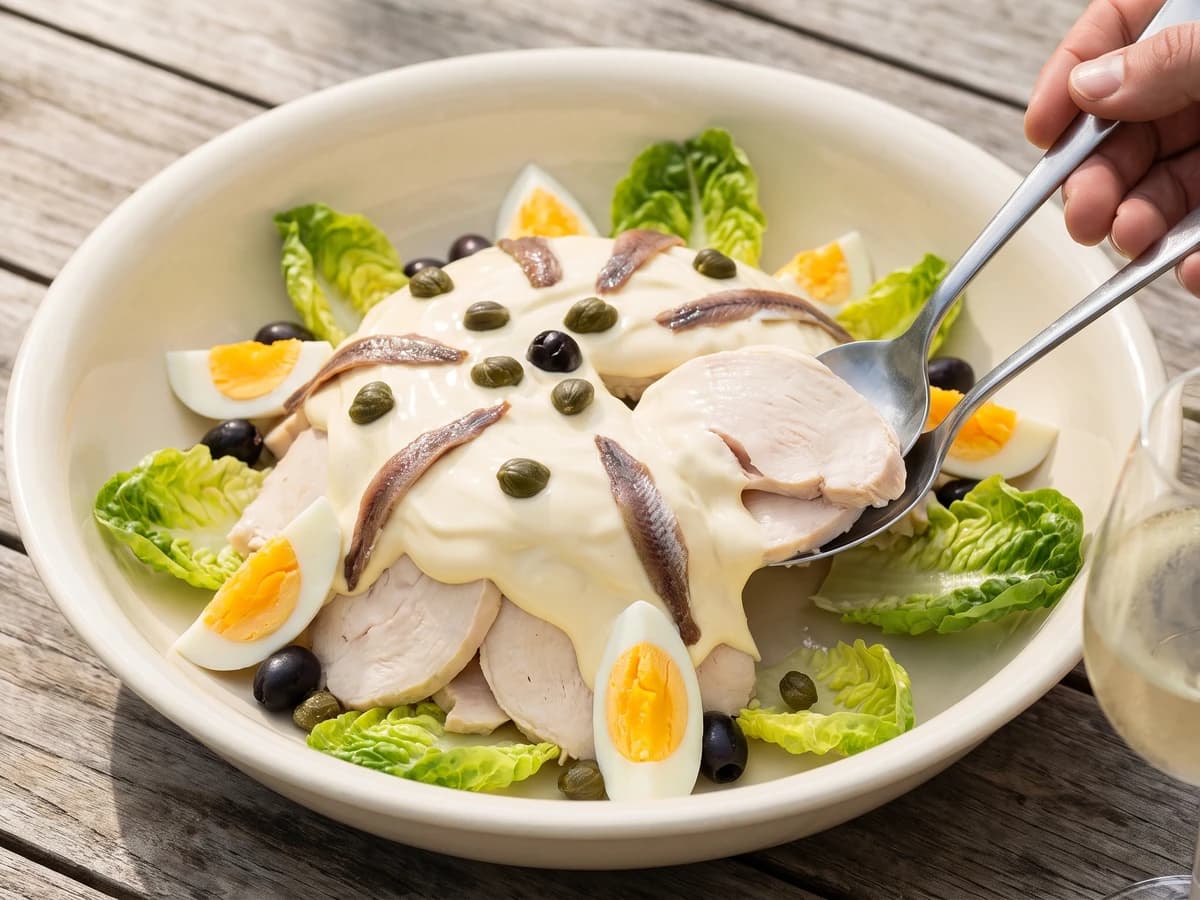
Mayonnaise de Volaille
Cold roast chicken, ciseled lettuce, and a shining coat of homemade mayonnaise, arranged with capers, olives, anchovies, eggs, and lettuce hearts, then tossed at the table as the canon intends.
A cooking platform built around craft, culture, and the stories behind what we eat.
Created by Chef Juliette
Based on No. 1997, Salade Allemande, from Le Guide Culinaire (1907) by Auguste Escoffier
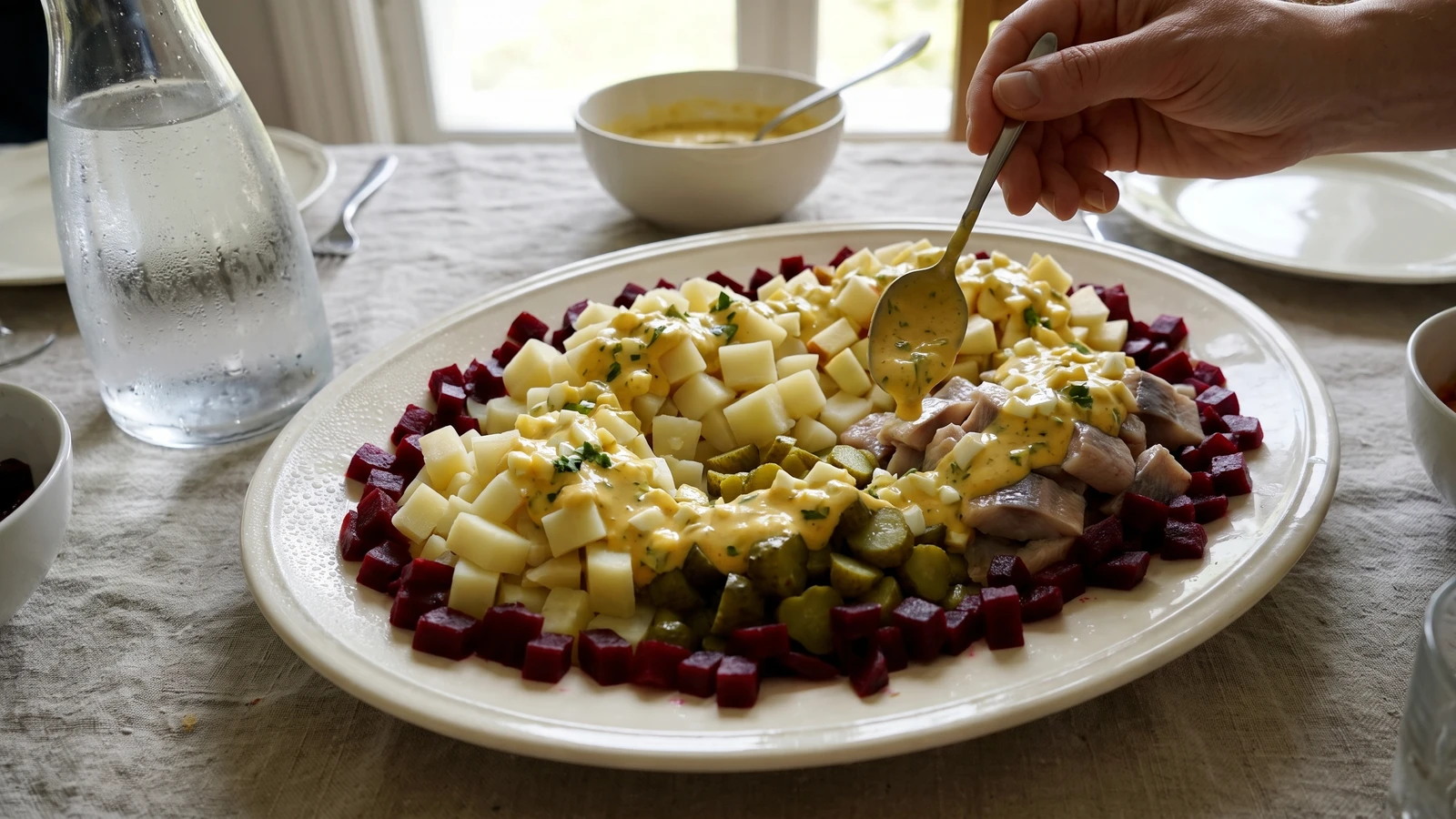
Four equal measures of potato, apple, gherkin, and salted herring stand in separate heaps beneath a sharp hard-boiled egg sauce, with beetroot for deep red sweetness and the herring deciding every grain of salt.
Salade Allemande (German-style composed salad) teaches proportion and restraint. Its four equal dice do not become one muddled bowl: potato, apple, gherkin, and herring stand apart, then meet under sauce aux œufs durs (hard-boiled egg sauce). The one true thing to know before touching a pan is that the herring sets the salt level. Salt nothing by habit.
The professional cold larder assumed cooked potatoes, eggs, and beetroot waiting, plus enough hands to cut each component for service. This dish needed neither a saucier, a stockpot, nor a salamander. At home, one saucepan handles the eggs and potatoes, while plain vacuum-cooked beetroot replaces the larder's ready pot. The beet's long cooking is scaffolding; equal weights, separate heaps, and the egg-yolk emulsion are the dish and must stay. One cook, one stove, one evening.
When the salad is right, each forkful changes: mild potato, crisp apple, sour gherkin, salty herring, earthy beetroot, then the round richness of egg. Taste the finished sauce with a cube of herring before any salt enters. That single bite decides the dish.
In the French classical garde-manger, Salade Allemande belongs to the family of named composed salads that translated neighboring cold-table habits into fixed proportions and formal arrangement. Potato, apple, gherkin, herring, and beetroot point toward German and Baltic larders, while separate heaps and an emulsified egg sauce give them the grammar of French service. It is not one German town's definitive potato salad, nor is it specifically Alsatian; the name marks the canon's reading of a pantry across the border.
Quantity
2 medium, about 10½ ounces (300 g), to yield 1½ cups (360 ml / 250 g) cooked dice
scrubbed
Quantity
2 medium, about 10½ ounces (300 g), to yield 1¾ cups (420 ml / 250 g) dice
cored
Quantity
1½ cups (360 ml / 250 g)
drained
Quantity
1½ cups (360 ml / 250 g)
drained
Quantity
1 cup (240 ml / 170 g)
Quantity
3
Quantity
1 tablespoon (15 ml / 15 g)
Quantity
2 tablespoons (30 ml / 30 g)
Quantity
6 tablespoons (90 ml / 82 g)
Quantity
1 to 2 tablespoons (15 to 30 ml / 15 to 30 g)
Quantity
¼ teaspoon (1.25 ml / 0.5 g)
Quantity
Up to ⅛ teaspoon (0.6 ml / 0.75 g)
| Ingredient | Quantity |
|---|---|
| waxy potatoesscrubbed | 2 medium, about 10½ ounces (300 g), to yield 1½ cups (360 ml / 250 g) cooked dice |
| firm tart applescored | 2 medium, about 10½ ounces (300 g), to yield 1¾ cups (420 ml / 250 g) dice |
| sour gherkinsdrained | 1½ cups (360 ml / 250 g) |
| ready-to-eat salted herring fillets in brinedrained | 1½ cups (360 ml / 250 g) |
| plain cooked deep-red beetroot | 1 cup (240 ml / 170 g) |
| large eggs | 3 |
| Dijon mustard | 1 tablespoon (15 ml / 15 g) |
| white wine vinegar | 2 tablespoons (30 ml / 30 g) |
| neutral salad oil | 6 tablespoons (90 ml / 82 g) |
| warm water | 1 to 2 tablespoons (15 to 30 ml / 15 to 30 g) |
| freshly ground black pepper | ¼ teaspoon (1.25 ml / 0.5 g) |
| fine sea salt (optional) | Up to ⅛ teaspoon (0.6 ml / 0.75 g) |
Place the eggs in a medium saucepan and cover them with cold water by 1 inch (2.5 cm). Bring to a lively simmer, cover, remove from the heat, and leave for 10 minutes; transfer the eggs to cold water. Refill the pan with fresh unsalted water, add the whole potatoes, and simmer gently for 18 to 25 minutes, until a small knife enters with slight resistance at the center. Drain them immediately, peel while warm enough to handle, then chill until completely firm. If a potato splits, drain it at once and let it cool uncovered; chilling will firm it enough to dice, though that one belongs at the back of the heap.
Drain the herring and taste a small corner. It should be distinctly salty but pleasant enough to eat as it is. If the salt catches harshly at the back of the throat, soak the fillets in cold water for 10 minutes, drain, pat dry, and taste again. Do not soak automatically, because mild ready-to-eat herring turns bland quickly. Drain the gherkins and beetroot separately and blot both dry so their brine cannot thin or stain the sauce.
Cut the cold potatoes, apples, gherkins, and herring into neat ⅓-inch (8 mm) dice. Weigh 8¾ ounces (250 g) of each after trimming; equal weight is the source recipe's governing proportion, even though their volumes differ. Cut the apples last so they remain pale, and keep all four ingredients in separate bowls. Cut the beetroot into slightly smaller ¼-inch (6 mm) dice and hold it apart.
Peel the eggs and separate the yolks from the whites. Mash the cooked yolks with the Dijon mustard, vinegar, and pepper until no lumps remain, then whisk in the oil a teaspoon at a time at first, followed by a thin steady thread. Loosen the emulsion with enough warm water to make a thick but spoonable sauce. Finely chop the whites and fold them through. Taste the sauce with one cube of herring, then add salt only if the combined bite is flat. If the sauce turns greasy or grainy, put 1 teaspoon of warm water in a clean bowl and whisk in the troubled sauce one spoonful at a time. Ça se rattrape.
Arrange the potato, apple, gherkin, and herring in four generous, clearly separate heaps on a 12-inch (30 cm) oval platter. Do not press them into rigid molds and do not toss them together. The separation is not decorative fuss; it lets each ingredient keep its texture while every serving takes a slightly different balance.
Spoon the sauce aux œufs durs across the four heaps, letting some settle into the gaps without burying the colors. Scatter the deep-red beetroot in a loose border and a little through the center, keeping it mostly off the pale sauce so the emulsion stays ivory rather than turning pink. Chill for 20 minutes, or cover and hold for up to 4 hours, then take the platter from the cold 15 minutes before serving. Draw the serving spoon through two or three heaps at once. À table!
1 serving (about 370g)
Culinary guides, cultural storytelling, and the editorial depth that makes cooking meaningful.
Discover Culinary ExplorerChef Juliette
Cold roast chicken, ciseled lettuce, and a shining coat of homemade mayonnaise, arranged with capers, olives, anchovies, eggs, and lettuce hearts, then tossed at the table as the canon intends.

Chef Juliette
Cold roast or poached chicken with fine ribbons of lettuce, dressed at the final moment with oil and vinegar: a composed salad whose freshness depends entirely on timing.

Chef Juliette
Five leaves, one living rule: laitue, romaine, chicorée, mâche, or pissenlit must be washed, dried, and dressed only as they go to the table, while every leaf still carries its light vinaigrette.

Chef Juliette
Salade de Betteraves proves that baking, not boiling, is the whole argument: concentrated garnet sweetness, tender baked onion, sharp mustard, and herbs cut into a weeknight salad worth making ahead.