Chef Juliette
Mayonnaise de Volaille
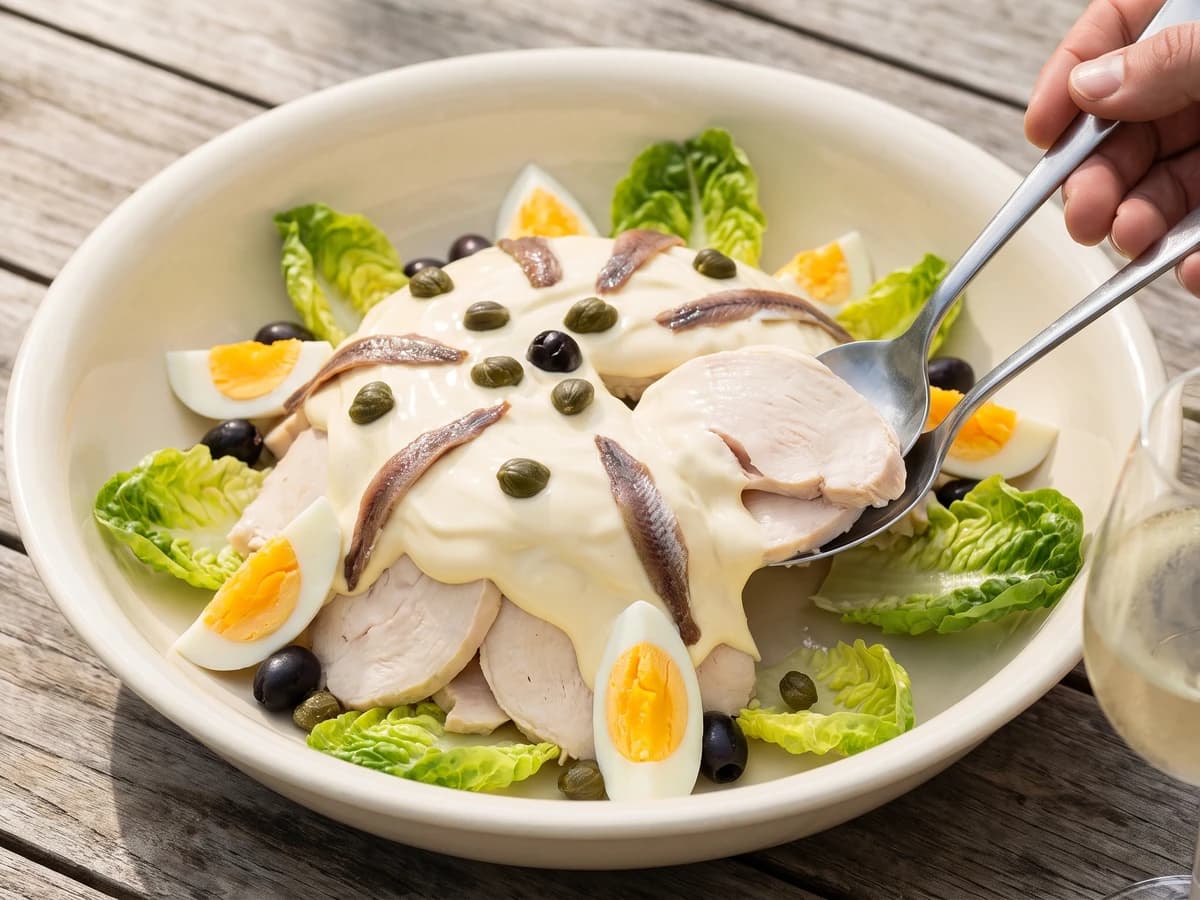
Cold roast chicken, ciseled lettuce, and a shining coat of homemade mayonnaise, arranged with capers, olives, anchovies, eggs, and lettuce hearts, then tossed at the table as the canon intends.
A cooking platform built around craft, culture, and the stories behind what we eat.
Created by Chef Juliette
Based on No. 1995, Tomato Salad, from Le Guide Culinaire (1907) by Auguste Escoffier
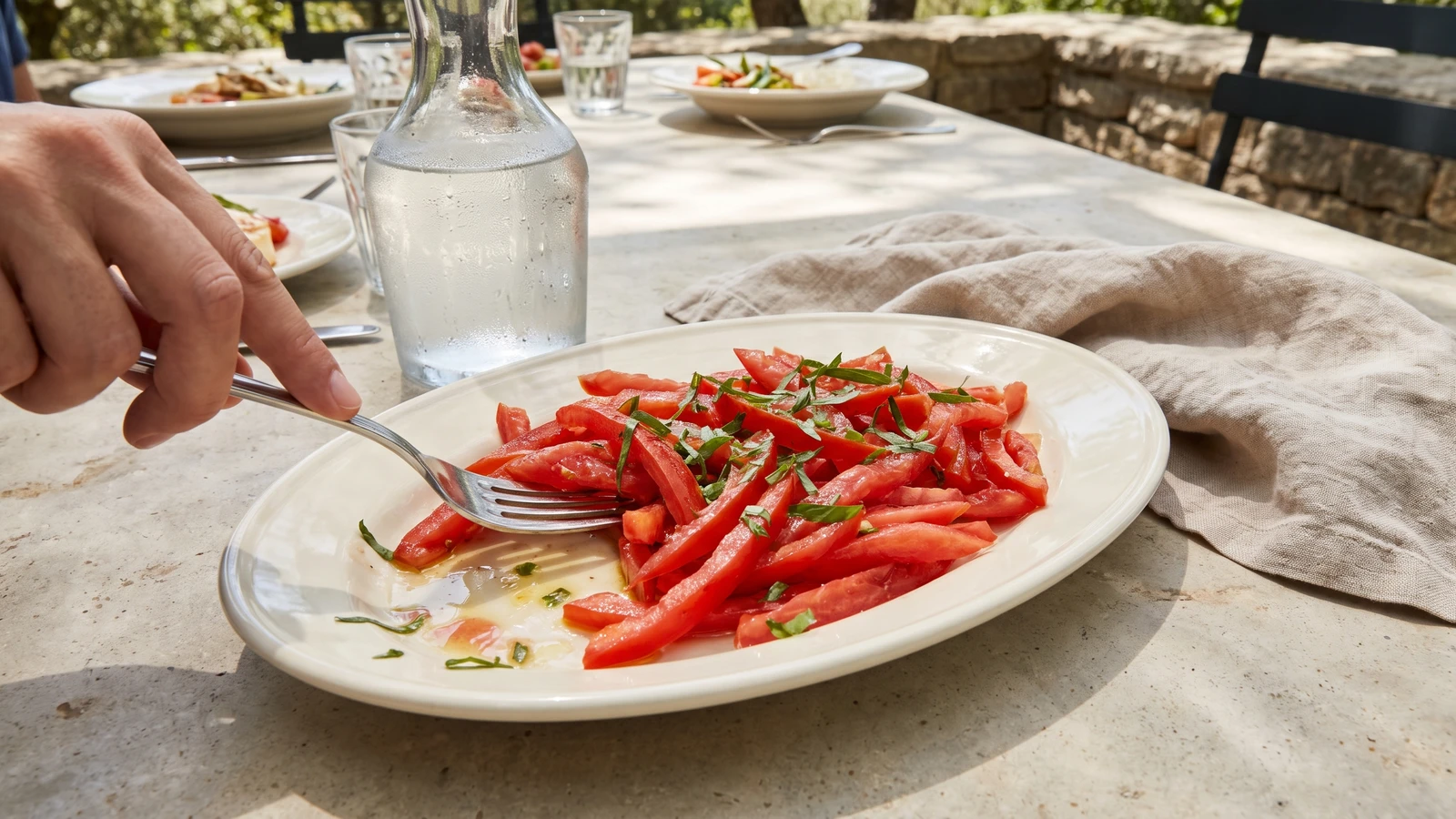
Salade de tomates makes discipline visible: firm red flesh, skinned and pressed clean of watery seeds, sliced into neat strips, then glossed with oil, vinegar, and the green lift of tarragon.
Salade de tomates teaches one true thing before you touch the saucepan: pressing is the salad. Scalding removes the skins, but clearing the cross-cut halves of juice and seeds gives the dressing somewhere to cling. Leave that water behind and the oil skates into a pink puddle; remove it and every strip tastes fully of tomato, vinegar, and tarragon.
The classical entry assumed a brigade peeling and seeding enough tomatoes for a full service, with boiling water ready, quick hands, and the dressing poured by eye. Your honest equivalent is one saucepan, one bowl of cold water, and six tomatoes for four people. I supplied a restrained 3:1 measure where the entry gives none, three tablespoons oil to one tablespoon vinegar, enough to gloss the flesh without drowning it. Brigade volume is scaffolding; scalding, skinning, crosswise halving, pressing, and cutting into strips are the dish and must stay. One cook, one stove, one evening.
Choose tomatoes that smell ripe at the stem but remain taut beneath your thumb. Press each half with a cupped hand, firmly enough to empty the seed chambers and gently enough to preserve the walls. That pressure is the one step that decides the salad.
The simple tomato-and-oil salad lives naturally at Provençal household tables, but this skinned, seeded, tarragon-dressed version belongs to the national classical hors-d'œuvre repertoire rather than to Provence alone. As the preparation moved through bistros and grand kitchens, cooks removed skins and watery seed pulp so the tomato flesh would hold its seasoning cleanly on a composed platter. Its precision is often mistaken for decoration, yet the purpose is practical: a dry, tender strip carries vinaigrette better than an unpeeled slice swimming in juice.
Quantity
6 (about 2 lb / 900 g)
Quantity
3 tablespoons (45 ml / 41 g)
Quantity
1 tablespoon (15 ml / 15 g)
Quantity
1 tablespoon loosely packed (15 ml / 3 g)
finely chopped
| Ingredient | Quantity |
|---|---|
| medium firm ripe tomatoes | 6 (about 2 lb / 900 g) |
| mild olive oil | 3 tablespoons (45 ml / 41 g) |
| wine vinegar | 1 tablespoon (15 ml / 15 g) |
| fresh tarragon leavesfinely chopped | 1 tablespoon loosely packed (15 ml / 3 g) |
Bring a wide saucepan of water to a full boil and set a bowl of very cold water beside it. Lower in two or three tomatoes at a time and scald them for 20 to 30 seconds, rolling them once, just until the skins wrinkle or begin to split. Lift them immediately into the cold water. The flesh must remain firm; you are loosening the skin, not cooking the tomato.
As soon as the tomatoes are cool enough to handle, lift them from the water and peel from any loosened seam. Use the tip of a paring knife only for a stubborn patch, then cut out the firm stem core. Do not leave the peeled tomatoes soaking; water on the surface will follow them into the dressing.
Cut every tomato in half crosswise so the seed chambers are exposed. Hold one half cut-side down over a bowl, cup it gently in your palm, and press once or twice while a fingertip coaxes out the remaining seeds. The goal is seedless flesh that keeps its shape, not purée. If a very ripe half collapses, ça se rattrape: place the damaged flesh in a sieve for 5 minutes, then cut it as neatly as it allows. The salad will be less regular, but it need not be watery.
Set the emptied halves cut-side down on the board and slice them into strips about ¼ inch (6 mm) wide. Keep the knife moving cleanly rather than sawing, which bruises the flesh. Transfer the strips to a wide, shallow bowl so their remaining weight does not crush the pieces underneath.
Make the vinaigrette, the oil-and-vinegar emulsion, by whisking the wine vinegar while adding the olive oil in a thin stream. Add the tomato strips and chopped tarragon, then turn everything gently with two spoons until each surface carries a light sheen. Let the salad stand for 5 minutes and turn it once more. If liquid gathers beneath it, lift the strips to a clean platter and spoon over only enough re-whisked vinaigrette to glaze them. Serve promptly, cool rather than refrigerator-cold. À table!
1 serving (about 175g)
Culinary guides, cultural storytelling, and the editorial depth that makes cooking meaningful.
Discover Culinary ExplorerChef Juliette
Cold roast chicken, ciseled lettuce, and a shining coat of homemade mayonnaise, arranged with capers, olives, anchovies, eggs, and lettuce hearts, then tossed at the table as the canon intends.

Chef Juliette
Cold roast or poached chicken with fine ribbons of lettuce, dressed at the final moment with oil and vinegar: a composed salad whose freshness depends entirely on timing.

Chef Juliette
Five leaves, one living rule: laitue, romaine, chicorée, mâche, or pissenlit must be washed, dried, and dressed only as they go to the table, while every leaf still carries its light vinaigrette.

Chef Juliette
Salade de Betteraves proves that baking, not boiling, is the whole argument: concentrated garnet sweetness, tender baked onion, sharp mustard, and herbs cut into a weeknight salad worth making ahead.