Chef Juliette
Mayonnaise de Volaille
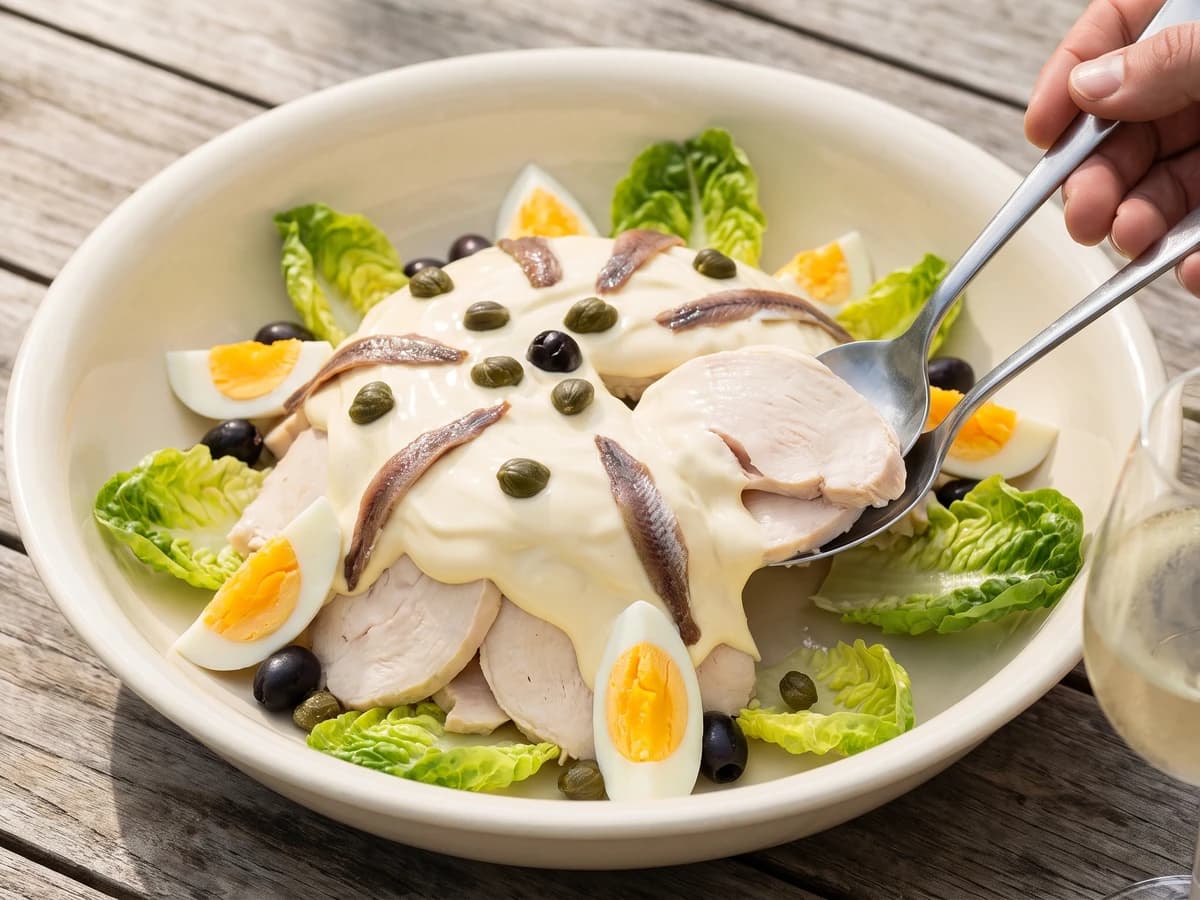
Cold roast chicken, ciseled lettuce, and a shining coat of homemade mayonnaise, arranged with capers, olives, anchovies, eggs, and lettuce hearts, then tossed at the table as the canon intends.
A cooking platform built around craft, culture, and the stories behind what we eat.
Created by Chef Juliette
Based on No. 1993, Potato Salad, from Le Guide Culinaire (1907) by Auguste Escoffier
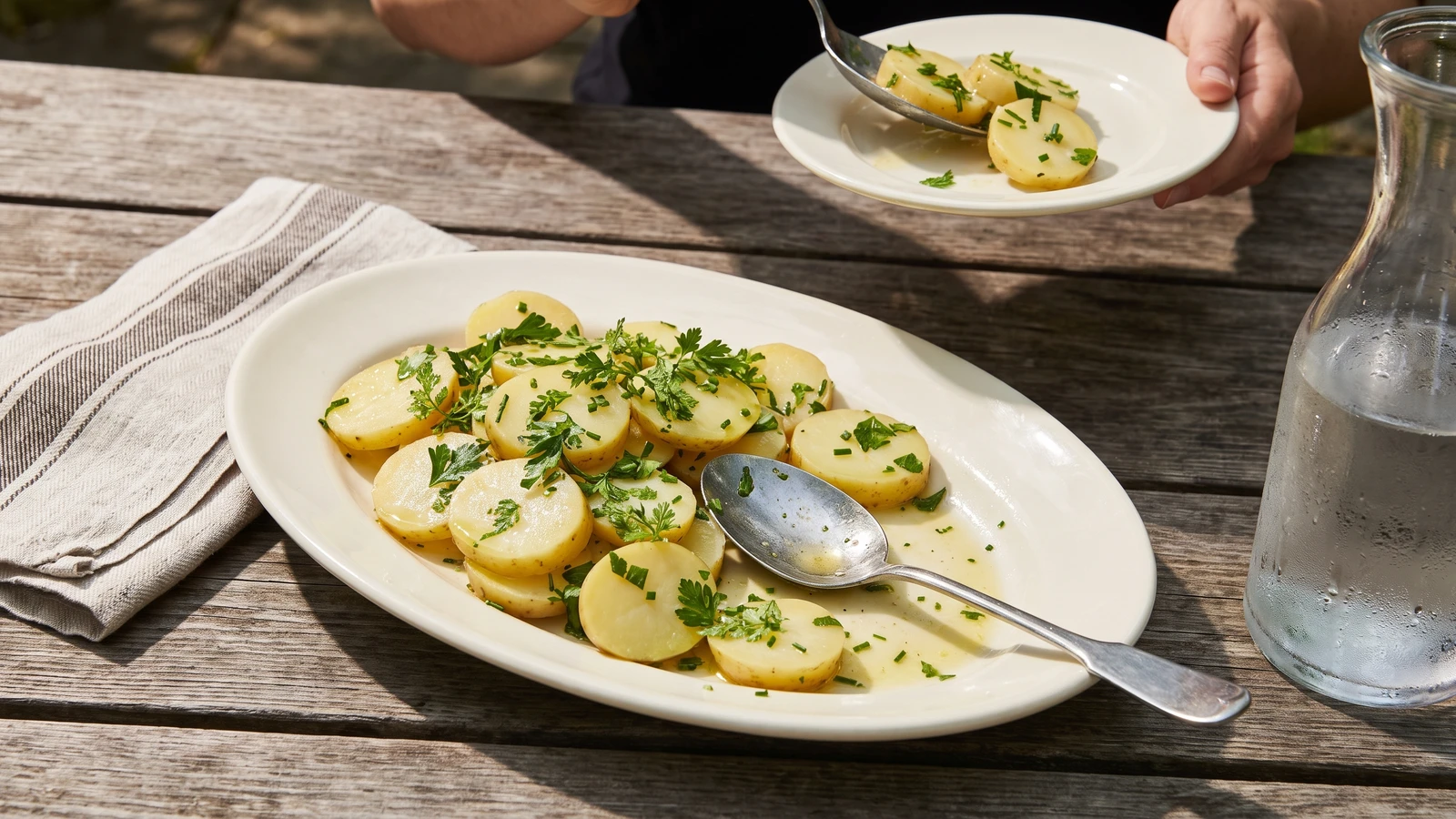
Salade de pommes de terre proves the decisive moment comes after cooking: slice the potatoes while lukewarm, dress them before they cool, and the vinegar and oil season every roundel.
Salade de pommes de terre (French potato salad) teaches one true thing: a warm potato drinks its seasoning, while a cold one only wears it. The dish is deliberately bare, waxy potatoes, wine vinegar, oil, and chopped herbs, so temperature does the work that mustard, mayonnaise, or stock might do elsewhere. Slice and dress the roundels while they're still lukewarm, and every bite tastes seasoned through instead of slicked on the surface.
The original entry assumed a brigade cook who would pare long, cooked potatoes into corks, then cut identical thin roundels for service. That full tournage (careful shaping) is presentation scaffolding, so at home you trim only the ends and broad shoulders, save the trimmings, and keep its useful intent: even slices that season at the same rate. Nothing else changes. Salted water, vinegar and oil, herbs after. One cook, one stove, one evening.
The one step that matters is timing the dressing. Have the vinegar, oil, and herbs measured before the potatoes leave the water; once sliced, vinegar goes on first, oil follows, and the herbs wait until the roundels have drunk. If oil pools, stop and give the warm starch a minute before folding again. Ça se rattrape.
Salade de pommes de terre belongs to France's cuisine bourgeoise and charcuterie table rather than to one province alone: boiled potatoes dressed warm with vinaigrette are the common grammar. Alsace often adds onion and warm broth, while this spare classical version keeps oil, vinegar, and chopped herbs, so mayonnaise is no requirement of the French dish. Its carefully cut roundels show a household preparation moving into professional service, where uniform shape mattered without changing the salad's thrifty heart.
Quantity
6 medium (about 2 lb / 910 g)
scrubbed with skins left on
Quantity
2 tablespoons (30 ml / 36 g)
for the cooking water
Quantity
3 tablespoons (45 ml / 45 g)
Quantity
6 tablespoons (90 ml / 83 g)
Quantity
¼ cup loosely packed (60 ml / 15 g)
finely chopped
| Ingredient | Quantity |
|---|---|
| long waxy potatoesscrubbed with skins left on | 6 medium (about 2 lb / 910 g) |
| fine sea saltfor the cooking water | 2 tablespoons (30 ml / 36 g) |
| white wine vinegar | 3 tablespoons (45 ml / 45 g) |
| neutral oil, such as sunflower or grapeseed | 6 tablespoons (90 ml / 83 g) |
| mixed tender herbs, such as flat-leaf parsley, chives, and chervilfinely chopped | ¼ cup loosely packed (60 ml / 15 g) |
Set the unpeeled potatoes in a 4-quart (3.8-liter) saucepan in a single layer and cover them with cold water by 1 inch (2.5 cm). Add the salt, bring the water slowly to a boil, then lower it to a steady, gentle simmer. Cook for 20 to 25 minutes, testing each potato separately; a thin skewer should enter the center with little resistance, but the potato must still hold its shape. If the skins split or the potatoes knock against one another, lower the heat immediately. A hard boil breaks the edges before the centers are ready.
Drain the potatoes and let them stand for 2 minutes, just until they can be handled through a folded kitchen towel. Peel them while they remain lukewarm. Trim the narrow ends, then pare away only enough of each broad shoulder to make a fairly even cylinder about 1½ inches (4 cm) across. Save every trimming for soup, an omelet, or the cook's plate. The full cork-shaped tournage is brigade scaffolding; even diameter is useful, waste is not.
With a sharp, thin-bladed knife, cut the shaped potatoes crosswise into roundels about ¼ inch (6 mm) thick. Slide the blade rather than pressing straight down, then transfer the slices to a wide, shallow bowl so their own weight does not crush them. If the edges begin to crumble, stop, let the potatoes settle for 2 minutes, and cut the remaining rounds slightly thicker. Ça se rattrape. Intact warm slices matter more than mathematical thinness.
Sprinkle the vinegar evenly over the lukewarm roundels and turn them once or twice with a broad spoon. Wait 1 minute, then drizzle over half the oil and fold gently from the bottom; repeat with the remaining oil. Vinegar goes first because warm potato accepts it readily, while oil added too soon can coat the surface and bar the door. If oil pools in the bowl, stop folding and wait 2 minutes before turning once more. If the potatoes have cooled, set the bowl over the still-warm saucepan for a minute, then continue. The warmth will help them drink again.
Let the dressed potatoes rest for 5 minutes, then scatter over the chopped herbs and fold only until evenly distributed. Taste a roundel from the center of the bowl; it should be bright with vinegar, lightly glossy with oil, and seasoned through from the salted water. Rest for another 5 minutes and serve lukewarm or at room temperature on a broad platter. À table!
1 serving (about 265g)
Culinary guides, cultural storytelling, and the editorial depth that makes cooking meaningful.
Discover Culinary ExplorerChef Juliette
Cold roast chicken, ciseled lettuce, and a shining coat of homemade mayonnaise, arranged with capers, olives, anchovies, eggs, and lettuce hearts, then tossed at the table as the canon intends.

Chef Juliette
Cold roast or poached chicken with fine ribbons of lettuce, dressed at the final moment with oil and vinegar: a composed salad whose freshness depends entirely on timing.

Chef Juliette
Five leaves, one living rule: laitue, romaine, chicorée, mâche, or pissenlit must be washed, dried, and dressed only as they go to the table, while every leaf still carries its light vinaigrette.

Chef Juliette
Salade de Betteraves proves that baking, not boiling, is the whole argument: concentrated garnet sweetness, tender baked onion, sharp mustard, and herbs cut into a weeknight salad worth making ahead.