Chef Juliette
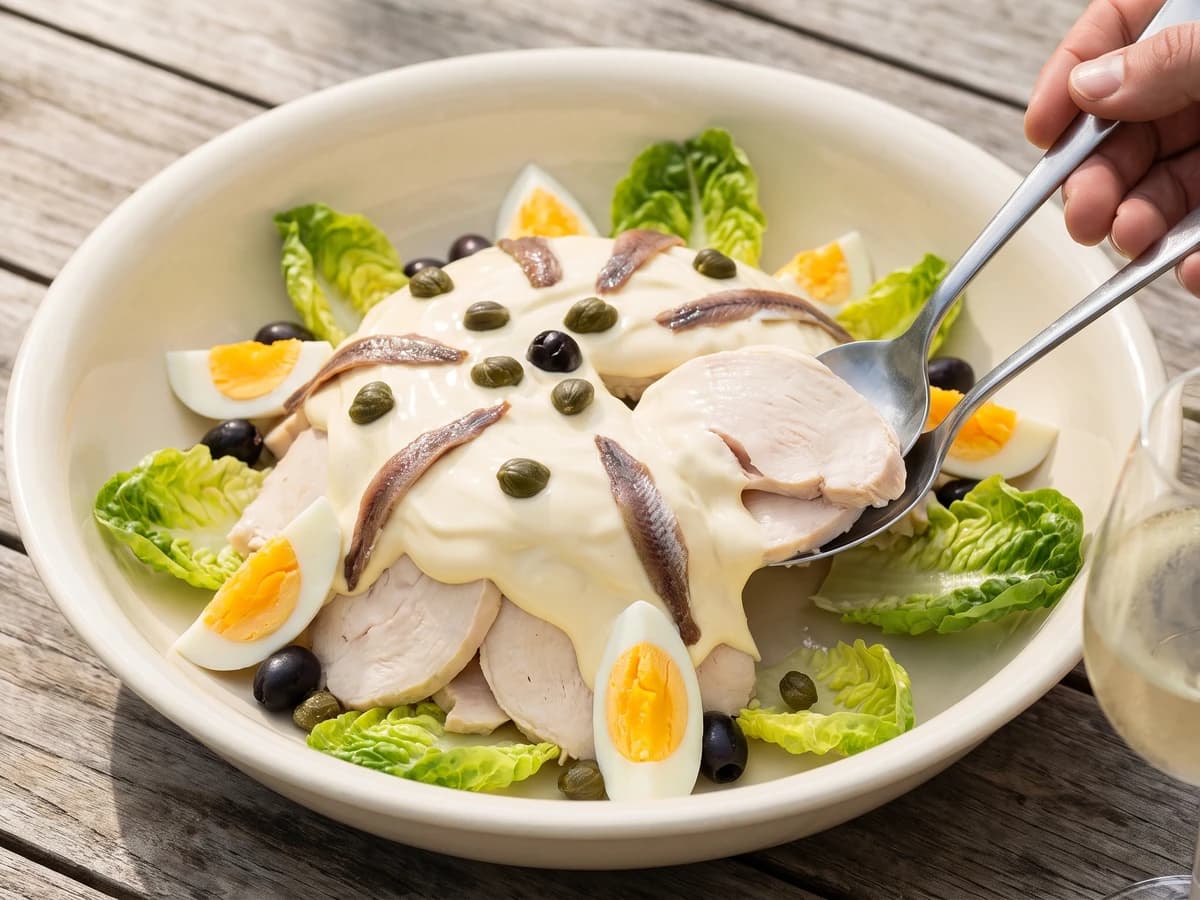
Mayonnaise de Volaille
Cold roast chicken, ciseled lettuce, and a shining coat of homemade mayonnaise, arranged with capers, olives, anchovies, eggs, and lettuce hearts, then tossed at the table as the canon intends.
A cooking platform built around craft, culture, and the stories behind what we eat.

Created by Chef Juliette
Based on No. 1990, Red-cabbage Salad, from Le Guide Culinaire (1907) by Auguste Escoffier
A fine julienne of red cabbage, briefly parboiled and cooled before six quiet hours in oil and vinegar, becomes crisp-tender, wine-dark, and ready for the potluck table.
Salade de chou rouge (red-cabbage salad) teaches a useful principle: vinegar, not boiling water, supplies the tenderness. The parboil merely takes off the raw edge, while six hours in the dressing turns a stiff julienne (matchstick cut) into something crisp, supple, and brightly seasoned.
This entry never needed a saucier, a permanent stockpot, or a salamander. It assumed something more ordinary: a practiced garde-manger, the cold-kitchen cook, cutting mountains of cabbage evenly and seasoning by eye. For four, one small cabbage and a measured two-to-one balance of oil to wine vinegar replace those brigade quantities. The bulk preparation is scaffolding and can go; the fine cut, brief parboil, thorough cooling, and six-hour rest are the dish and must stay. One cook, one stove, one evening.
The finished salad should glisten ruby and violet, with enough bite to stand beside pâté, roast pork, or lentils. Cool the cabbage completely and dry it before the dressing touches it. That pause decides whether the vinaigrette clings or runs uselessly to the bottom of the bowl.
Salade de chou rouge belongs to the French hors-d'oeuvre table, particularly the winter repertoire of the north and east, where sturdy cabbages remained when tender salad leaves did not. In Alsace, red cabbage also appears cooked sweet-sour beside pork, but this oil-and-vinegar salad is not choucroute, which is fermented white cabbage. The codified kitchen kept a household method used for generations: cut firm leaves finely, temper their raw bite, and let time complete the seasoning.
Quantity
1 small head (about 1½ lb / 680 g before trimming)
outer leaves, core, and thick midribs removed
Quantity
¼ cup (60 ml / 55 g)
Quantity
2 tablespoons (30 ml / 30 g)
Quantity
1 teaspoon (5 ml / 6 g)
| Ingredient | Quantity |
|---|---|
| red cabbageouter leaves, core, and thick midribs removed | 1 small head (about 1½ lb / 680 g before trimming) |
| neutral sunflower oil | ¼ cup (60 ml / 55 g) |
| red wine vinegar | 2 tablespoons (30 ml / 30 g) |
| fine sea salt | 1 teaspoon (5 ml / 6 g) |
Discard any tired outer leaves, quarter the cabbage through the core, and cut away the hard core and every thick white midrib. Slice the leaves crosswise into a julienne about ⅛ inch or 3 mm wide. Keep the strands even: thick pieces remain woody while thin ones soften properly during the six-hour rest.
Bring a large pot of water to a full boil. Add the cabbage, let the water return to the boil, and parboil for 2 minutes, no longer. The water will turn dramatically purple and the cabbage will remain firm. That is exactly right. This step modifies the rawness; it is not meant to cook the cabbage tender.
Lift the cabbage immediately into a large bowl of ice water and turn it until completely cold. Drain it thoroughly, then spin it dry or spread it between clean kitchen towels and blot without crushing. Do not dress warm or wet cabbage: warmth dulls its texture, and clinging water weakens the vinegar.
Whisk the vinegar and salt in a large bowl until the salt dissolves. Pour in the oil slowly while whisking to form an émulsion temporaire, a temporary emulsion. Add the cold, dry cabbage and turn it repeatedly until every strand carries a fine sheen. If the dressing immediately beads and collects in a watery puddle, the cabbage was not dry enough. Ça se rattrape: lift the cabbage into the spinner, pour the liquid into a small bowl, dry the cabbage again, rewhisk the liquid, and toss once more.
Cover and refrigerate the salad for 6 hours. Turn it after the first 30 minutes and once again halfway through so the vinegar reaches the whole julienne evenly. Do not shorten this rest to save time. The long seasoning is the tenderizing method named by the original entry, not idle waiting.
Let the salad stand outside the refrigerator for 10 minutes, then toss from the bottom and taste. It should be pleasantly sharp, well salted, and supple without becoming limp. If it tastes too sharp, fold in 1 teaspoon of oil; if it tastes flat, add a few drops of vinegar and a pinch of salt. Transfer it with a slotted spoon so it glistens without swimming. À table!
1 serving (about 170g)
Culinary guides, cultural storytelling, and the editorial depth that makes cooking meaningful.
Discover Culinary ExplorerChef Juliette
Cold roast chicken, ciseled lettuce, and a shining coat of homemade mayonnaise, arranged with capers, olives, anchovies, eggs, and lettuce hearts, then tossed at the table as the canon intends.

Chef Juliette
Cold roast or poached chicken with fine ribbons of lettuce, dressed at the final moment with oil and vinegar: a composed salad whose freshness depends entirely on timing.

Chef Juliette
Five leaves, one living rule: laitue, romaine, chicorée, mâche, or pissenlit must be washed, dried, and dressed only as they go to the table, while every leaf still carries its light vinaigrette.

Chef Juliette
Salade de Betteraves proves that baking, not boiling, is the whole argument: concentrated garnet sweetness, tender baked onion, sharp mustard, and herbs cut into a weeknight salad worth making ahead.