Chef Juliette
Mayonnaise de Volaille
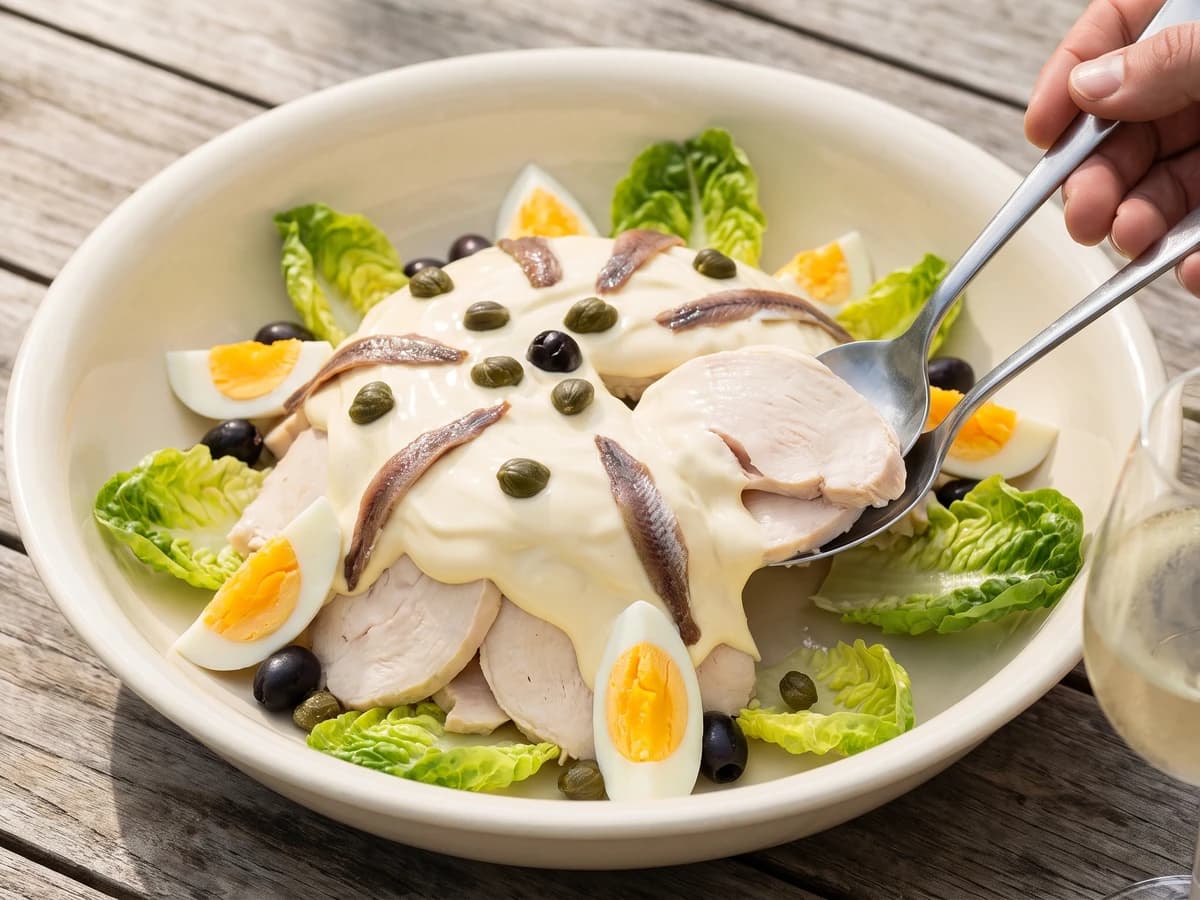
Cold roast chicken, ciseled lettuce, and a shining coat of homemade mayonnaise, arranged with capers, olives, anchovies, eggs, and lettuce hearts, then tossed at the table as the canon intends.
A cooking platform built around craft, culture, and the stories behind what we eat.

Created by Chef Juliette
Based on No. 1989, Cauliflower Salad, from Le Guide Culinaire (1907) by Auguste Escoffier
Salade de chou-fleur proves that texture can carry an entire dish: firm florets, cleared of stalk, catch a sharp gloss of oil and vinegar with the quiet anise-green lift of chervil.
Salade de chou-fleur (cauliflower salad) teaches one hard little truth: dressing cannot give structure to a vegetable that has lost it. The cauliflower must be cooked through and somewhat firm, because each small bunch, cleared of stalk, is meant to catch oil and vinegar across its craggy surface. Once a floret collapses, it can only drink the dressing and slump.
No saucier, stock kept forever on the fire, or salamander belongs here. The original brigade assumption is quieter: cauliflowers in the plural, already cooked and handed off for trimming and service. At home, one medium head serves four, and the unmeasured seasoning becomes only enough vinaigrette to gloss it. The brigade's batch work is scaffolding and goes; cooking the head intact, dividing it afterward, removing the stalk, and finishing with chervil stay because they are the dish. One cook, one stove, one evening.
The one step that decides everything is lifting the cauliflower while a skewer still meets a little resistance near the core. Do that, drain it thoroughly, and the rest is simple.
Salade de chou-fleur belongs to cuisine bourgeoise and the Parisian hors-d'oeuvre table, where cooked vegetables were dressed with vinaigrette and garden herbs before the main course. Professional manuals recorded it in a few lines because cooking and dressing vegetables were treated as common kitchen grammar, not separate spectacles. Mayonnaise-bound cauliflower salads are another branch; in this canonical form, oil, vinegar, and chopped chervil provide the entire finish.
Quantity
1 head (about 1½ lb / 700 g)
outer leaves removed
Quantity
4 quarts (3.8 L / 3.8 kg)
Quantity
1 tablespoon plus ¼ teaspoon (16 ml / 20 g)
divided
Quantity
3 tablespoons (45 ml / 41 g)
Quantity
1½ tablespoons (22 ml / 22 g)
Quantity
3 tablespoons (45 ml / 6 g)
finely chopped
| Ingredient | Quantity |
|---|---|
| medium cauliflowerouter leaves removed | 1 head (about 1½ lb / 700 g) |
| water | 4 quarts (3.8 L / 3.8 kg) |
| fine sea saltdivided | 1 tablespoon plus ¼ teaspoon (16 ml / 20 g) |
| neutral oil, such as grapeseed or sunflower | 3 tablespoons (45 ml / 41 g) |
| white wine vinegar | 1½ tablespoons (22 ml / 22 g) |
| chervil leavesfinely chopped | 3 tablespoons (45 ml / 6 g) |
Cut away the outer leaves and trim only the dry end of the central stalk, leaving the cauliflower whole. Keeping the head intact protects the small curds while they cook; cutting florets first would abandon the source method and make them easier to soften. Bring the water and 1 tablespoon of the salt to a full boil in a deep pot.
Lower the cauliflower into the water stem-side down. Once the water returns to the boil, reduce it to a lively simmer and cook for 9 to 13 minutes, turning the head once if it is not completely submerged. Begin testing early with a thin skewer near the thickest part of the core. It should enter with clear but gentle resistance, and the florets should remain firm when nudged. Do not wait until the skewer slips through without protest.
Lift the cauliflower into a colander and set it stem-side up so water can escape from between the branches. Leave it for 15 to 20 minutes, until cool enough to handle and dry on the surface. If droplets remain trapped inside, tilt the head and blot them with a clean towel. Wet cauliflower dilutes the vinegar and sends the oil sliding to the bottom of the dish.
Break the cooked cauliflower gently into small bunches about 1 to 1½ inches (2.5 to 4 cm) across. Use a paring knife to clear away every piece of thick central stalk, leaving only the tender branching stem required to hold each floret together. Work from the stalk side and keep the pale curds intact.
Whisk the white wine vinegar with the remaining ¼ teaspoon salt until the salt dissolves. Pour in the oil gradually while whisking to make a loose vinaigrette, an oil-and-vinegar emulsion. It does not need to remain perfectly bound. If it separates while waiting, whisk it once more. Ça se rattrape.
Arrange the cauliflower bunches in a wide shallow bowl and spoon over the vinaigrette. Turn them once or twice with two spoons, using a lifting motion so the curds do not crumble, then scatter over the chopped chervil and fold it through gently. Let the salad rest for 10 minutes so the dressing settles into the florets. If they begin to break, stop tossing and arrange them by hand, spooning the dressing over the top. Serve cool or at room temperature. À table!
1 serving (about 185g)
Culinary guides, cultural storytelling, and the editorial depth that makes cooking meaningful.
Discover Culinary ExplorerChef Juliette
Cold roast chicken, ciseled lettuce, and a shining coat of homemade mayonnaise, arranged with capers, olives, anchovies, eggs, and lettuce hearts, then tossed at the table as the canon intends.

Chef Juliette
Cold roast or poached chicken with fine ribbons of lettuce, dressed at the final moment with oil and vinegar: a composed salad whose freshness depends entirely on timing.

Chef Juliette
Five leaves, one living rule: laitue, romaine, chicorée, mâche, or pissenlit must be washed, dried, and dressed only as they go to the table, while every leaf still carries its light vinaigrette.

Chef Juliette
Salade de Betteraves proves that baking, not boiling, is the whole argument: concentrated garnet sweetness, tender baked onion, sharp mustard, and herbs cut into a weeknight salad worth making ahead.