Chef Juliette
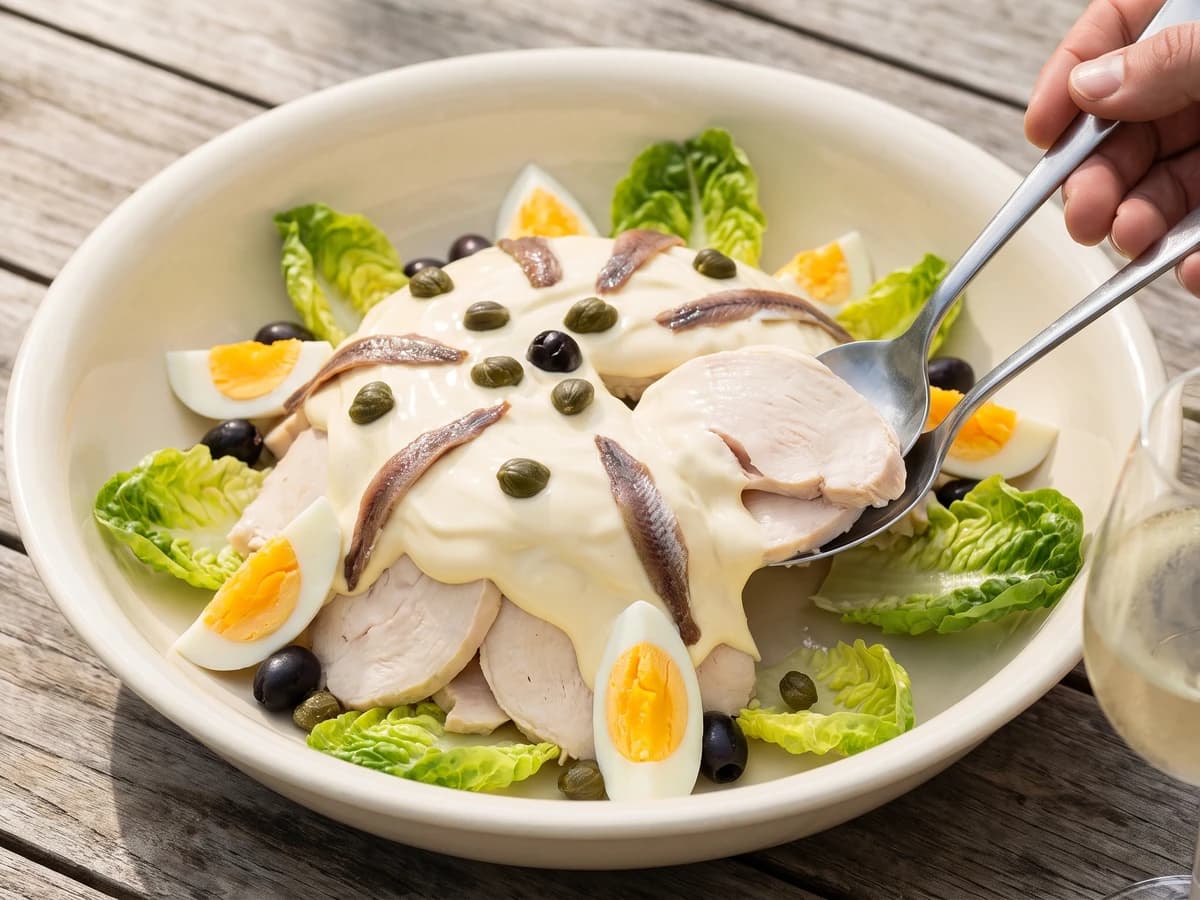
Mayonnaise de Volaille
Cold roast chicken, ciseled lettuce, and a shining coat of homemade mayonnaise, arranged with capers, olives, anchovies, eggs, and lettuce hearts, then tossed at the table as the canon intends.
A cooking platform built around craft, culture, and the stories behind what we eat.

Created by Chef Juliette
Based on No. 1988, Celeriac Salad, from Le Guide Culinaire (1907) by Auguste Escoffier
Céleri-rave becomes supple without losing its bite when a fine julienne meets mustard-rich mayonnaise. The knife work is the dish, and a short rest finishes what the dressing begins.
Salade de céleri-rave (celeriac salad) teaches one true thing: mustard can discipline a raw root, but only the knife makes it tender. Cut the celeriac finely and evenly, and the dressing softens its earthy force while leaving a clean snap. Leave the pieces thick, and no quantity of mayonnaise will persuade them to behave.
The original entry assumed a garde-manger cutting trays of julienne and a saucier handing over finished mustard mayonnaise or mustard cream. No stockpot or salamander belongs near this cold dish. For four people at home, one yolk, a whisk, and a medium bowl replace the separate stations; this version follows the entry's clear mustard-mayonnaise branch because it clings lightly to the fine cut without burying it. The brigade divisions were scaffolding and can go. The raw julienne and the generous mustard are the dish, and they stay.
There is no pan to touch tonight, only a root to peel honestly and a mayonnaise to keep calm. Cut the celeriac no thicker than a matchstick and dress it promptly. That is the step that decides everything.
Salade de céleri-rave belongs to the French winter larder and became especially familiar on Parisian bistro tables and at charcutier-traiteur counters, where sturdy raw roots could be dressed ahead for the hors-d'oeuvre assortment. Mustard-rich mayonnaise made the preparation widely known as céleri rémoulade, though classical practice also permits a cream-and-mustard dressing and cuts the root either julienne-fashion or paysanne-fashion. The defining idea is correction rather than heaviness: pungent mustard and acid temper celeriac's raw force while preserving its snap.
Quantity
1 medium, about 1½ lb (680 g), yielding about 1 lb (450 g) after trimming
Quantity
1 tablespoon (15 ml / 15 g)
Quantity
1 large
Quantity
2 tablespoons (30 ml / 32 g)
Quantity
2 teaspoons (10 ml / 10 g)
Quantity
½ cup (120 ml / 110 g)
Quantity
1 tablespoon (15 ml / 15 g)
Quantity
¾ teaspoon (4 ml / 4 g)
Quantity
¼ teaspoon (1 ml / 0.5 g)
Quantity
1 teaspoon (5 ml / 5 g)
| Ingredient | Quantity |
|---|---|
| celeriac | 1 medium, about 1½ lb (680 g), yielding about 1 lb (450 g) after trimming |
| fresh lemon juice | 1 tablespoon (15 ml / 15 g) |
| pasteurized egg yolk | 1 large |
| Dijon mustard | 2 tablespoons (30 ml / 32 g) |
| white wine vinegar | 2 teaspoons (10 ml / 10 g) |
| neutral oil, such as grapeseed or sunflower | ½ cup (120 ml / 110 g) |
| cold water | 1 tablespoon (15 ml / 15 g) |
| fine sea salt | ¾ teaspoon (4 ml / 4 g) |
| ground white pepper | ¼ teaspoon (1 ml / 0.5 g) |
| Dijon mustard for rescuing or sharpening the dressing (optional) | 1 teaspoon (5 ml / 5 g) |
Cut a flat slice from the top and base of the celeriac. Stand it upright and remove the thick skin in downward strokes, following the curve and cutting deeply enough to expose clean ivory flesh with no brown channels. Quarter the root and trim away any spongy centre. Celeriac is knobbly and the peel is stubborn; honest trimming gives a better salad than saving every last gram of tough skin.
Cut the quarters julienne-fashion, meaning match-shaped rods about 1.5 mm thick and 4 cm long. A guarded mandoline makes quick work of the slices, but finish the rods with a knife so you control their width. The source also permits paysanne-fashion, thin triangles no more than 2 mm thick. Whichever cut you choose, keep it fine and even, then toss it immediately with the lemon juice. If the first pieces are too thick, stack and recut them now; the dressing can soften a fine cut, but it cannot rescue raw batons.
Whisk the egg yolk with the 2 tablespoons Dijon mustard, vinegar, salt, and white pepper until completely smooth. Add the oil a few drops at a time at first, whisking until each addition disappears, then pour it in as a thin steady thread once the emulsion has body. Whisk in the cold water to make a pale, flowing mayonnaise that falls from the whisk in a soft ribbon. If it separates, stop pouring. Ça se rattrape: whisk the optional teaspoon of mustard with a teaspoon of cold water in a clean bowl, then add the broken mayonnaise one spoonful at a time until it comes together.
Fold the mustard mayonnaise through the celeriac until every piece carries a thin, even coat. Cover and rest the salad in the cold for 20 to 30 minutes; the mustard, acid, and salt will temper the root while the fine cut keeps its bite. If the celeriac releases enough liquid to leave a puddle, lift the salad into another bowl, whisk the liquid back into the dressing with a little of the optional mustard, and fold everything together again.
Taste the salad after its rest, not before. The mustard should be plain to recognize, the acidity clean, and the celeriac crisp-tender rather than harsh. Add the optional mustard if the root still dominates, or a few drops of cold water if the coating feels heavy. Serve cool in a shallow bowl, with the strands loosely mounded rather than compressed. À table!
1 serving (about 165g)
Culinary guides, cultural storytelling, and the editorial depth that makes cooking meaningful.
Discover Culinary ExplorerChef Juliette
Cold roast chicken, ciseled lettuce, and a shining coat of homemade mayonnaise, arranged with capers, olives, anchovies, eggs, and lettuce hearts, then tossed at the table as the canon intends.

Chef Juliette
Cold roast or poached chicken with fine ribbons of lettuce, dressed at the final moment with oil and vinegar: a composed salad whose freshness depends entirely on timing.

Chef Juliette
Five leaves, one living rule: laitue, romaine, chicorée, mâche, or pissenlit must be washed, dried, and dressed only as they go to the table, while every leaf still carries its light vinaigrette.

Chef Juliette
Salade de Betteraves proves that baking, not boiling, is the whole argument: concentrated garnet sweetness, tender baked onion, sharp mustard, and herbs cut into a weeknight salad worth making ahead.