
Chef Juliette
John Dory (St. Pierre)
John Dory has the delicacy of sole and the firmness of turbot. A light flouring, a quick butter sauté, and nut-brown beurre noisette show exactly why looks never mattered.
A cooking platform built around craft, culture, and the stories behind what we eat.
Created by Chef Juliette
Based on No. 1965, Pintade (Guinea Fowl), from Le Guide Culinaire (1907) by Auguste Escoffier
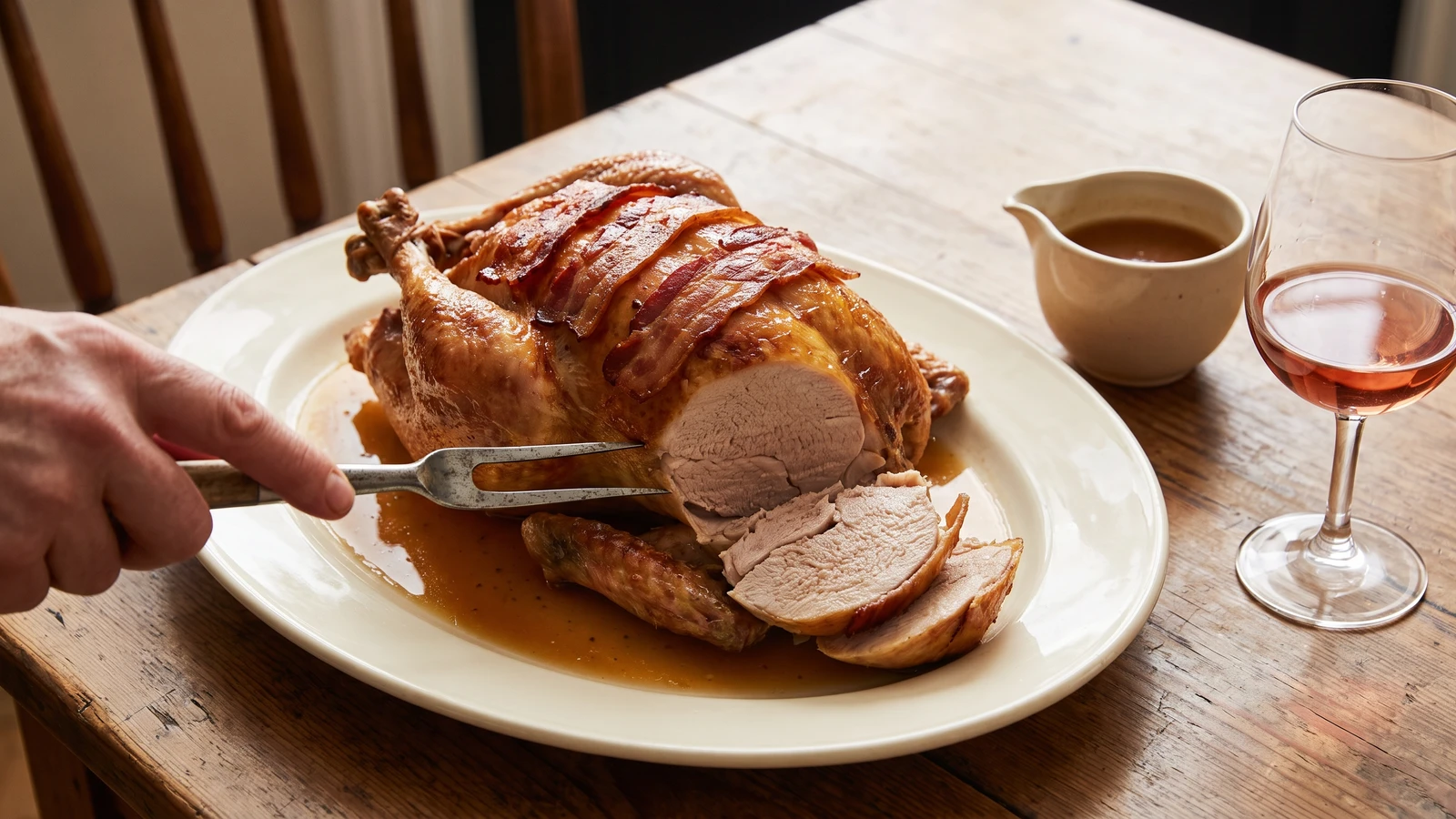
Young pintade, barded like pheasant and roasted only until its dark, fine-grained meat is just done, arrives burnished with a concentrated pan jus: a holiday bird made practical for one attentive home cook.
Pintade rôtie (roast guinea fowl) teaches judgment before fire: age chooses the method. Only a young pintade belongs in the roasting pan; an older bird has firmer muscle and belongs in the pot. The one true thing to know before touching the pan is that its lean breast will dry while the legs dawdle unless you protect it with fat and stop cooking the instant it is done.
The original entry gives one instruction, treat it as pheasant, because its kitchen expected the rest to be understood: barder (to cover the breast with pork fat), roast briskly, and call for hot stock and a saucier to turn the fond into jus de rôti (a light sauce made from the roasting juices). At home, thin unsmoked bacon replaces the butcher-cut barde, a small heavy roasting pan holds the fond, and 1¼ cups (300 ml) of unsalted stock makes enough jus for four. Constant basting and a separate sauce station are brigade scaffolding and can go; barding, the brief roast, the rest, and the reduced jus are the dish and must stay. One cook, one stove, one evening.
When it lands at the table, the skin is chestnut-bronze, the close-grained meat is juicy, and the jus tastes of the bird rather than a cupboard of additions. No wine, cream, or herb garnish is added because the entry names none. The decisive step is the last twenty minutes: remove the bacon for colour, watch the thermometer, and take the pintade out at 165°F (74°C) before one lean minute becomes two.
Pintade has no single provincial monopoly; its French home is the farmhouse and bourgeois Sunday table, though the bird itself came from Africa into European poultry yards. Classical cooks placed it beside pheasant because its flesh is darker, leaner, and more closely grained than chicken, not because pintade is wild game. The enduring rule is practical: the young bird is barded and roasted, while an older pintade is sent to the cocotte, where moisture and time suit it better.
Quantity
1 bird (3 to 3½ lb / 1.4 to 1.6 kg)
giblets removed and neck reserved if supplied
Quantity
1½ teaspoons (7.5 ml / 9 g)
Quantity
¾ teaspoon (4 ml / 1.5 g)
Quantity
3 tablespoons (45 ml / 42 g)
2 tablespoons softened and 1 tablespoon kept cold
Quantity
8 slices (about 6 oz / 170 g)
Quantity
1¼ cups (300 ml / 300 g)
divided
Quantity
2 tablespoons (30 ml / 30 g)
only if needed to rescue the jus
| Ingredient | Quantity |
|---|---|
| young oven-ready guinea fowlgiblets removed and neck reserved if supplied | 1 bird (3 to 3½ lb / 1.4 to 1.6 kg) |
| fine sea salt | 1½ teaspoons (7.5 ml / 9 g) |
| freshly ground black pepper | ¾ teaspoon (4 ml / 1.5 g) |
| unsalted butter2 tablespoons softened and 1 tablespoon kept cold | 3 tablespoons (45 ml / 42 g) |
| thinly sliced unsmoked streaky bacon | 8 slices (about 6 oz / 170 g) |
| unsalted chicken stockdivided | 1¼ cups (300 ml / 300 g) |
| cold water (optional)only if needed to rescue the jus | 2 tablespoons (30 ml / 30 g) |
Heat the oven to 450°F (230°C) with a rack in the lower-middle position. Remove the giblets without rinsing the pintade, reserve the neck if one was supplied, and dry the bird thoroughly inside and out. Season the cavity and skin evenly with the salt and pepper. A dry surface browns; water left on the skin merely delays the roast.
Rub 2 tablespoons (30 ml / 28 g) of the softened butter over the breast, legs, and flanks. Tuck the wing tips beneath the bird and tie the legs together without cinching them hard against the breast. Overlap the bacon across the breast and the tops of the thighs, then secure it with two loops of kitchen twine. The barde protects the lean meat while its fat renders; leave the lower flanks exposed so they can take colour.
Set the reserved neck, if supplied, in a small heavy roasting pan and place the pintade breast-side up over it. Roast for 15 minutes, then lower the oven to 375°F (190°C). Carefully pour ¼ cup (60 ml / 60 g) of the stock around the bird, never over its skin, rotate the pan, and roast for another 25 minutes. Watch the fond on the pan floor: if it races from chestnut toward black, add stock 1 tablespoon (15 ml) at a time and move the pan down one rack. Ça se rattrape. Act while the fond is still brown, because burnt fond cannot make a good jus.
Lift the bacon from the bird with tongs and lay the strips beside it in the pan. Baste the exposed skin once with the pan fat, then roast for 15 to 25 minutes more, lifting out the bacon as soon as it is crisp. Begin checking early with an instant-read thermometer, avoiding bone. Remove the pintade the moment the thickest parts of both breast and thigh reach 165°F (74°C). If the breast becomes deeply bronze before the centre is ready, lay the bacon back over it or cover that area loosely with foil and continue cooking the legs.
Transfer the pintade and crisp bacon to a warm platter or carving board. Rest the bird for 15 minutes, covering it only loosely at the sides with foil so the skin remains burnished. Collect every juice that runs onto the board. The rest is part of the cooking: carve immediately and the juices leave the meat instead of staying where they belong.
Pour all visible bacon fat from the roasting pan into a heatproof bowl, leaving the brown glaze behind. Set the metal pan over medium heat, add the remaining stock, and scrape the fond into it with a wooden spoon. Simmer until reduced to about ⅔ cup (160 ml), then strain into a small saucepan and add the resting juices. Taste before adding any salt because the bacon has already spoken. Off the heat, whisk in the remaining cold butter until the jus gleams. If it looks greasy, whisk in 1 tablespoon (15 ml / 15 g) of cold water; if it is too tight, add the second tablespoon. If it is thin, return it to the heat and reduce briefly.
Remove the twine. Cut away the legs and divide them at the joints, then remove each breast in one piece and slice it thickly across the grain. Arrange the meat on the warm platter with the crisp bacon. Spoon a little jus around the carved meat, not over the browned skin, and pass the rest at the table. À table!
1 serving (about 260g)
Culinary guides, cultural storytelling, and the editorial depth that makes cooking meaningful.
Discover Culinary ExplorerChef Juliette
John Dory has the delicacy of sole and the firmness of turbot. A light flouring, a quick butter sauté, and nut-brown beurre noisette show exactly why looks never mattered.

Chef Juliette
Fresh haddock proves its delicacy in the meunière pan: a fine flour crust, moist pearly flakes, and beurre noisette sharpened with lemon and parsley, ready from one skillet in half an hour.

Chef Juliette
Éperlans à l’Anglaise turns small fish into a lesson in disciplined coating: boned smelts under a close, crisp crumb, pan-fried in clarified butter and finished with bright, half-melted maître d’hôtel butter.

Chef Juliette
Tiny smelts, shallot, mushrooms, white wine, gratin sauce, and fine bread raspings meet a fierce oven, where the fish must turn tender in the same breath the buttered crust bronzes.